
Quick Answer
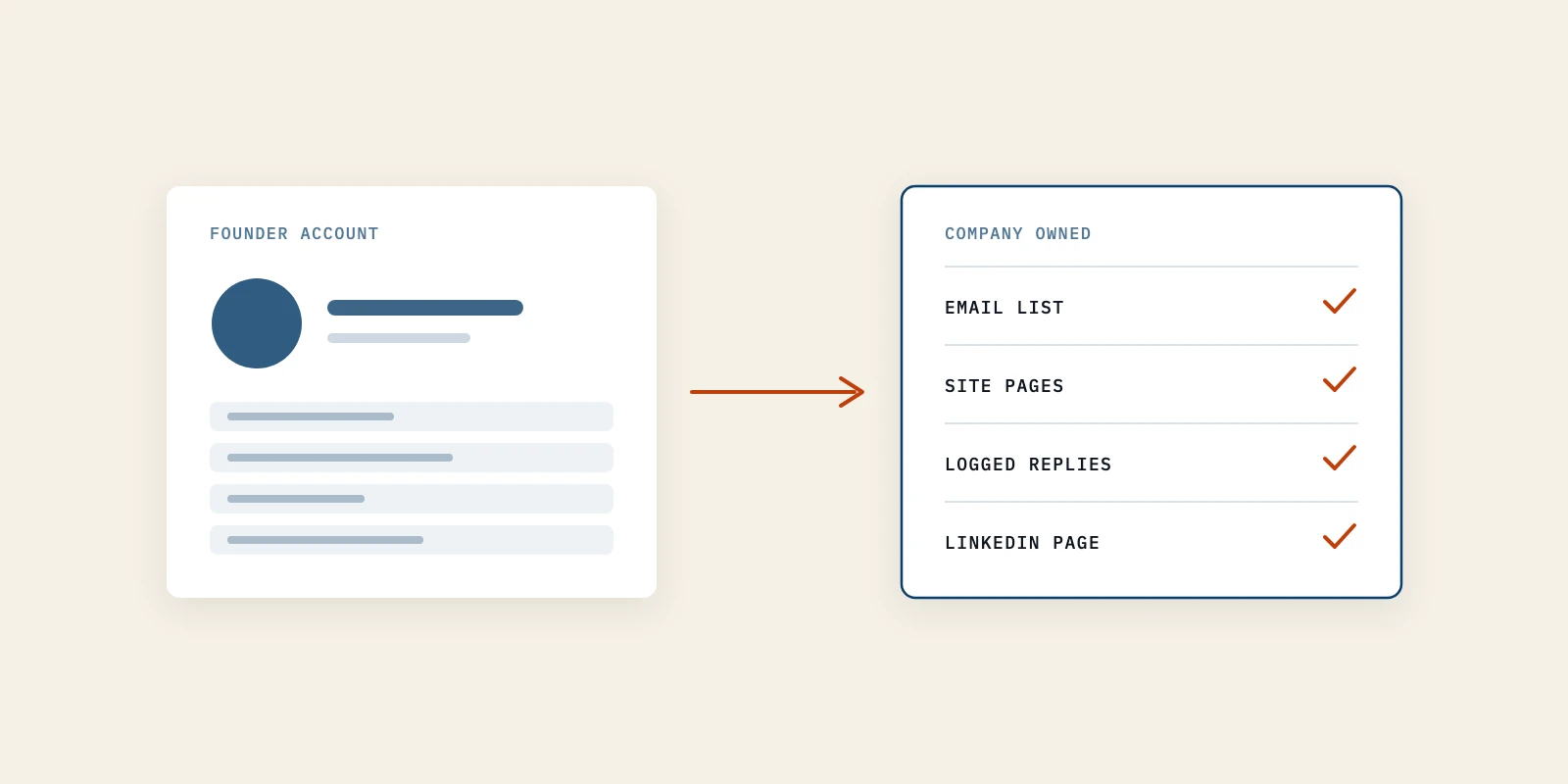
Founder-led marketing works, but the audience it builds sits on the founder's personal LinkedIn profile, which LinkedIn's User Agreement says belongs to the founder. Your best channel is a concentration risk the cap table never shows. The fix is to keep posting and move the reach, week by week, into owned media: the channels a company controls outright, such as its website, its email list and its LinkedIn Page.
Almost every piece of early-stage advice points the same way: post as the founder, not as the company. The advice is right, because a buyer trusts a person faster than a logo. What it leaves out is who holds the asset once the posting starts to work.
Picture the day your pipeline depends on one person's feed, and that person changes role, burns out or leaves. The company keeps the product and the customers, and loses the channel that found them. This covers what each side actually holds on LinkedIn, the four moments that concentration breaks a company, and a weekly routine that turns founder reach into assets the company keeps.
Convert Founder Reach Into Owned Media Every Week
You convert founder reach into owned media by giving every post a job that ends somewhere the company controls: an email list, a page on your own domain, a conversation your team can see, or the company's LinkedIn Page. The founder keeps posting in their own voice. What changes is where the attention lands afterwards.
Four conversions do the work. Set them up in this order, because each one is easier once the one before it exists.
1. Send Every Useful Post Toward an Email List
Add one line and one link to the posts that teach something, inviting the reader onto a list the company runs. The list lives in an email tool the company pays for, under a company login, with at least two people who can administer it.
LinkedIn won't hand you this list later. Its export of your connections includes an email address only for connections who have allowed their connections to see or download it. A LinkedIn newsletter is no escape hatch either: its author sees each subscriber's name, photo, job title and headline, not their email address.
That's why Better Marketing builds a founder's newsletter as the audience the company owns outright, not as a feature of someone else's platform. If the list doesn't exist yet, start with a newsletter built to win first customers.
You know it's working when signups rise in the weeks the founder posts and slow in the weeks they don't. The common mistake is linking to the homepage, which asks the reader to go and find the signup form on their own.
2. Publish the Strongest Posts Again on Your Own Domain
Once a month, take the post that drew the most useful comments and expand it into a page on the company site. The LinkedIn version was the draft, and the comments told you which objection the page has to answer.
A page on your domain is something the company can keep improving, link to from sales emails, and have found on Google and cited inside AI answers. That last part is the work an AI SEO service does, and it only has somewhere to happen once the page exists. This is the unglamorous core of content marketing for tech companies: the same idea earns its reach on a platform and its permanence on your site.
The founder is free to do this. LinkedIn's User Agreement states that "You own all of your original content that you provide to us," and LinkedIn takes only a non-exclusive license. Whether the company may reuse that content is a separate question between founder and company, and it's worth settling in writing.
You know it's working when prospects arrive on a sales call having read a page on your domain rather than a post that scrolled away months ago. The common mistake is pasting the post unchanged, because a feed post is written to stop a scroll and a page has to answer the question completely.
3. End Posts With a Next Step Your Team Can Answer
Some posts should invite a reply that becomes a conversation: an offer to review how the reader handles the problem, a short research call, a direct question. The point is that the reply lands somewhere more than one person can see and act on.
In practice that means every warm DM gets logged the same day in a shared CRM or inbox, with the next step owned by a named person. A founder's private inbox is where a lot of early pipeline quietly goes cold.
If you later bring in a B2B demand generation agency, this log is what it works from. Without it, the agency inherits a feed it can't log into and relationships it can't see, and you pay for weeks of reconstruction.
You know it's working when the conversation history would survive the founder taking a month off. The common mistake is treating replies as engagement to admire rather than leads to hand over.
4. Mirror the Best Material on the LinkedIn Page
Reshare the strongest founder posts from the company's LinkedIn Page. If the Page meets LinkedIn's newsletter access criteria, consider publishing the newsletter as the Page, not the person. LinkedIn lets a Page's super admin or content admin choose to publish as the Page, so the newsletter sits with the company.
Expect less reach than the founder gets. The Page isn't there to win the feed. It's there to hold followers the company keeps when roles change.
The common mistake runs the other way: making the Page the only channel. That buys continuity and very little attention, which is the trade founder-led marketing exists to avoid.
A founder with four hours a week can run all four conversions with a small, repeatable routine:
- Two or three posts a week, drawn from customer calls, product decisions and market observations
- One post a week that points readers to the company's email list
- One page a month on your own domain, expanded from the post with the best comments
- Every warm reply logged the same day where the team can see it
- The week's best post reshared from the LinkedIn Page
The test is simple. If the founder's account went quiet for a month, what would the company still have?
What the Company Owns Versus What the Founder Owns
The company owns its domain, its email list, its product, its customer records and its LinkedIn Page. The founder owns the LinkedIn profile, the connections, the posts and the trust attached to their name.
LinkedIn's User Agreement is explicit about the second half: “As between you and others (including your employer), your account belongs to you.” It also asks members to "not share or transfer your account or any part of it," and gives transferring your connections as the example.
| Asset | Who holds it | If the founder leaves |
|---|---|---|
| Domain and website | Company | Stays |
| Email list | Company, if it runs the account | Stays |
| LinkedIn Page and followers | Company, through its admins | Stays |
| LinkedIn profile and connections | Founder | Leaves |
| Posts on the profile | Founder | Leaves |
| Trust in the founder's name | Nobody cleanly | Mostly leaves |
The first three rows are owned media. The last three are the channel that's probably producing most of your attention, and none of them appears anywhere on the cap table.
None of this is an argument against the founder profile. It's a map of what the company is actually building on, drawn before anyone needs it.
Four Moments When Founder Concentration Breaks a Company
Concentration breaks a company when it starts depending on a channel it doesn't own, and it usually surfaces in one of four moments. Each is a form of key person risk, the exposure a business carries when too much value sits with one individual. Each is cheaper to handle if owned media already exists.
1. A Cofounder Split Turns the Audience Into a Dispute
The founder account feels like a company asset while it produces company outcomes. Then equity, credit or roles get renegotiated, and someone asks whose audience it really is.
By then the answer is already written into the platform's terms, and it names the person, not the company. The conversation goes better when the list and the pages were built as the company's all along.
2. The First Marketer Inherits a Channel They Can't Run
Your first marketing hire is usually asked to grow a founder account they don't own, can't log into and can't publish from. They're expected to build a system around someone else's habit.
The honest version of that job is to build the company's side of the table: the list, the site, the log and the Page. Brief them that way from day one, and brief a B2B demand generation agency the same way if you hire one instead.
3. An Acquirer Discounts Pipeline It Can't Take With It
In due diligence, a buyer looks for revenue that survives the sale. If most inbound starts on a personal profile the buyer cannot acquire, the pipeline is real but its transfer is not. Expect that to surface in the price or the terms.
An email list can move with the company, with one limit worth knowing. Under the CAN-SPAM Act, the FTC's compliance guide says that once people have opted out, you can't sell or transfer their addresses, even as part of a mailing list.
4. The Founder Stops Posting and Inbound Stops With It
This is the quietest failure. The founder gets tired, or the company changes, or they simply stop wanting to spend hours a week feeding a platform.
The company then learns that what looked like a distribution engine was partly one person's routine. When the routine ends, inbound falls with it, unless the attention had been landing somewhere the company holds.
A Second Voice Reduces Key Person Risk Faster
Adding a second person who publishes reduces key person risk faster than adding a second platform. A company that depends on one founder's voice is exposed to that person. A second contributor spreads the trust across the team without flattening the point of view.
Write down just enough that someone else can contribute without sounding like marketing:
- What the company believes about the problem it solves
- What it won't say, and which claims it never makes
- How direct the tone should be
- Which customer examples are fair to use
- Who can draft, who edits and who publishes
The second voice can be a cofounder, the first marketer or an engineer with clear opinions. Their posts should end in the same owned media the founder's do, which is how content marketing for tech companies stops being one person's hobby.
Write Down Five Ownership Decisions Before You Need Them
Five short written decisions turn founder reach from an informal habit into an arrangement the company can rely on. None of them needs a legal treatise, and all of them get expensive once they're contested.
- Where the email list lives, and which two people administer it
- Who holds super admin on the LinkedIn Page, and who is the backup
- Whether the company may republish and adapt the founder's posts
- What happens to the routine if the founder stops posting
- What happens to the company's owned media if the founder leaves
The third one deserves a lawyer's eye, because content ownership between a founder and a company usually sits in a founder or IP assignment agreement. The rest are operating questions, and a one-page document settles them.
Concentration Is Fine Before Your First Paying Customer
Before you have customers, don't spend hours on this. If the founder is the only credible voice and there's nothing yet to transfer, concentration is the correct bet. Worrying about owned media then becomes procrastination dressed as sophistication.
The stage-appropriate question at that point is simply being known at all, which is the problem in go-to-market for startups when nobody knows you. The line moves when the company starts depending on the channel for revenue, hiring or credibility with investors.
That's when the email link, the monthly page and the reply log stop being nice to have. Set them up the quarter the first real inbound arrives, not the quarter the founder wants to step back.
Start Moving Founder Reach Into Company Assets Now
Founder-led content is not the mistake. The mistake is confusing a personal channel with a company asset, when LinkedIn's own terms say the account belongs to the person.
Keep the founder posting, and give every post a destination the company controls: the list, a page on your domain that an AI SEO service can build on, a logged conversation, the LinkedIn Page. Better Marketing runs founder-led LinkedIn this way, so the founder's voice stays theirs and the owned media stays the company's. For how to hold the posting routine itself, see our LinkedIn marketing strategy.