

Quick Answer
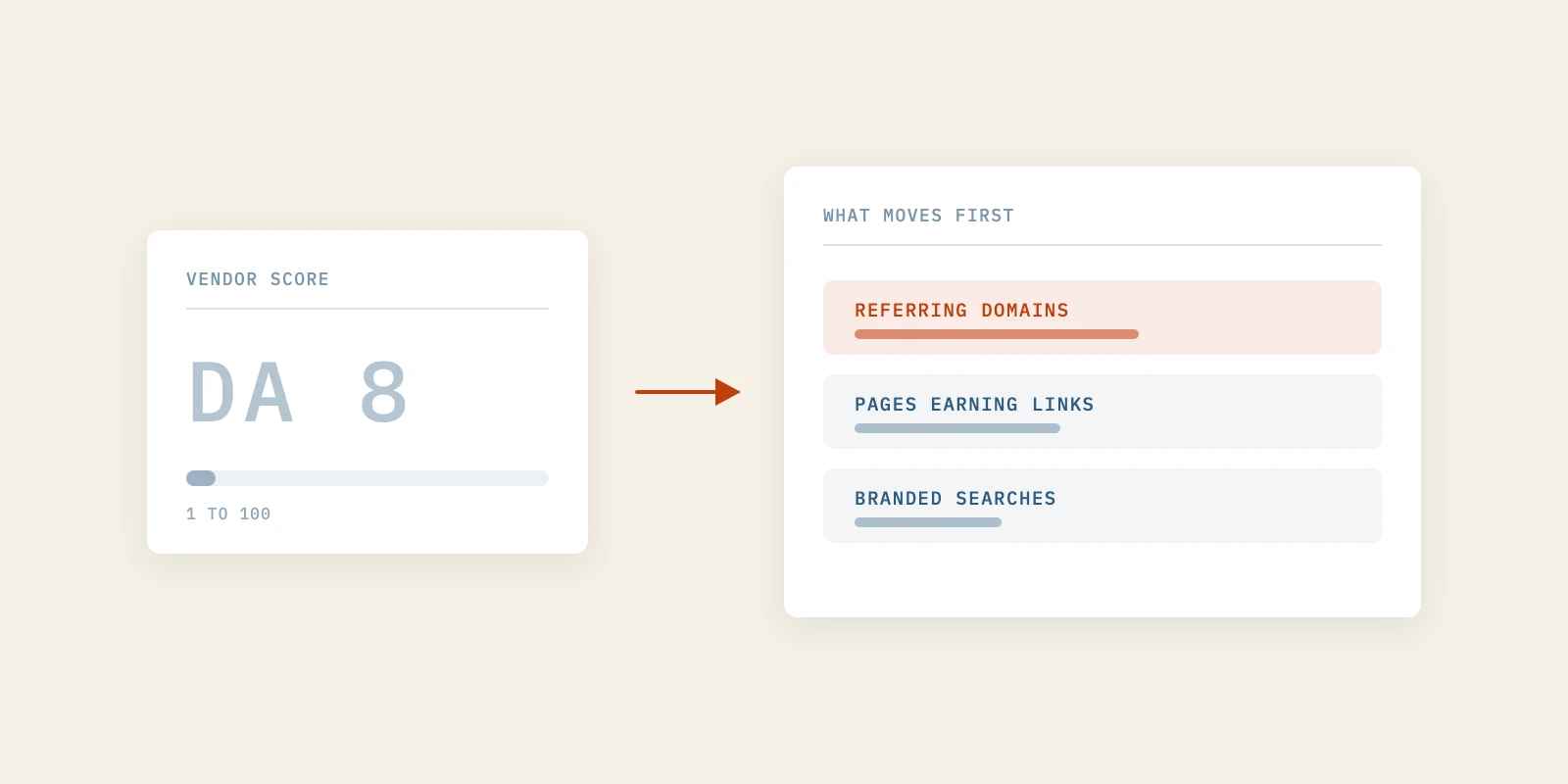
Domain Authority is a search engine ranking score developed by Moz that predicts how likely a site is to rank against competitors, on a scale of 1 to 100. Google does not use it. A Domain Authority of 8 describes a young site with few referring domains, not a penalty, and the work that raises it is the same work that earns rankings: an indexable site, one page worth citing, and a handful of real links.
You checked a free tool, saw 8 out of 100, and the next thing you saw was somebody selling an authority package. That's the sequence the score was never built to trigger. At 8, the number is mostly telling you that your domain is new.
The cost of misreading it is real money. Founders spend a quarter buying links that move a vendor number and drop the site inside Google's definition of link spam, while the one page that could have earned a citation never gets written.
This post covers what a score of 8 actually measures, what Google documents in its place, and the five-step order of work that replaces chasing the number.
Google Does Not Use Domain Authority to Rank Pages
There is no Domain Authority input inside Google Search. Moz built the score, Moz publishes it, and none of the ranking systems Google documents consumes it.
Google's guide to its ranking systems names them one at a time: BERT, neural matching, passage ranking, freshness systems, site diversity, spam detection, and link analysis systems and PageRank. No site-wide authority score appears on that list. The guide also says, in its opening lines, where ranking happens at all.
"Our ranking systems are designed to work on the page level, using a variety of signals and systems to understand how to rank individual pages."
That sentence is published by Google on Search Central, in its guide to Google Search ranking systems. Page level is the part founders skip past. A strong page on a young domain can outrank a weak page on an old one, and no single domain-level number can express that.
Google does say site-wide signals exist and feed its understanding of pages. It also says good site-wide signals do not make everything on a site rank, and poor ones do not sink everything either. Domain Authority is a third party's attempt to compress all of that into one digit, which makes it a useful shorthand and a bad target.
What a Domain Authority of 8 Actually Measures
A Domain Authority of 8 measures your backlink profile and very little else. Moz calculates the score from its own link index, and the quantity and quality of backlinks pointing at your site are what move it.
New domains start at 1, and Moz says the score rises as a site earns authoritative backlinks over time. So an 8 is not a penalty or a filter. It's a count, behaving exactly as designed.
The score is also relative. Moz describes it as a comparative metric, which is why it is easier to grow a score from 20 to 30 than from 70 to 80: the top of the scale is held by domains whose link profiles you won't match this year.
That relativity is what makes the number misleading on its own. Two sites can both sit at 8 and be in completely different positions — one has nothing published and no referring domains, the other has twenty indexed pages and three links from customers. The second site is months ahead, and Domain Authority cannot tell you that.
So the practical read at 8 is this. Your constraint is almost never the score; it is that too few people have a reason to link to you yet.
Domain Authority vs the Signals Google Publishes
The difference is ownership and level. Domain Authority is one company's prediction about your whole domain, and Google's documentation describes systems that judge a single page against a single query.
| Factor | Domain Authority | Google's documented signals |
|---|---|---|
| Who publishes it | Moz, a third-party software company | Google, in Search Central documentation |
| What it estimates | How likely a domain is to rank against competitors | How well a page answers a query |
| Level it works at | The whole domain | The page, with site-wide signals contributing |
| What moves it | Quantity and quality of referring domains | Content, relevance, links, spam status and more |
| Where you read it | A vendor tool | Google Search Console |
Read the right-hand column as the job and the left as the commentary on it. When the two disagree, the commentary is the one that is wrong, because only one of them sits inside the ranking system.
It's also why a rising Domain Authority can sit next to flat traffic for months. The score responds to new referring domains on a tool's refresh cycle. Rankings respond to whether the page deserves the query.
What to Do Instead of Chasing Domain Authority
Run these five steps in order. Each is cheap next to a link package, and each produces a result you can check without opening a Domain Authority tool.
The order matters more than the effort. Links pointed at a site that cannot be crawled, or at a page nobody would cite, accelerate nothing.
1. Make the Site Crawlable and Indexable First
Confirm the pages you care about are in Google's index before you chase a single link. Open Google Search Console, run URL Inspection on your five most important URLs, and read what it reports about indexing rather than assuming a sitemap settled it.
The usual failure on a founder-built site is a page that only renders after JavaScript runs, so the raw HTML a crawler receives is close to empty. You can check it in thirty seconds: view source, and if the words on the page are not in the source, crawlers don't have them either.
You know this step worked when those URLs report as indexed and their text appears in the served HTML. The on-page work that turns an indexed page into a ranking one only starts paying after that.
2. Publish One Page Other People Can Cite
Write the one page in your category that somebody else would have to reference to make their own argument. A benchmark you measured, a teardown of a real product decision, a comparison nobody has assembled honestly yet.
Google's guidance on creating helpful, reliable, people-first content asks who made the content, how, and why, and says that of the four parts of E-E-A-T, trust is most important. Answer those three questions on the page itself, with a named author and a stated method.
That page is also the cheapest form of content marketing for tech companies, because it does two jobs at once: it earns links, and it is the passage an assistant quotes. Better Marketing builds an AI SEO service around exactly that order, page first and links second.
3. Earn the First Ten Links From Real Relationships
Start with people who already know your name: customers, partners, investors, the communities you post in, the newsletters and podcasts in your category. Those are the ten that also send a reader, which is the half of a link nobody sells you.
Google's site position FAQ answers this in one line: create unique, compelling content that other people want to link to. The same answer warns that link-exchange and paid-link schemes can do more harm than good.
You know it worked when the Links report in Google Search Console shows a root domain you recognize and your analytics shows a referral session from it. A link that sends nobody is worth less than the hour you spent asking for it.
4. Use a Directory Only When Its Listing Ranks
Search for a competitor's listing on that directory and see whether the page ranks for anything at all. If the listing page is not indexed and nobody arrives on it, the link is decoration.
Google names low-quality directory and bookmark site links as an example of link spam, so the bar is not "is it free" but "would a buyer ever land here". Ecosystem, marketplace and category listings usually clear it. Generic submission lists usually do not.
The mistake is volume. Seventy submissions in an afternoon is the pattern Google's systems were built to discount, and it costs you the day you could have spent on step two.
5. Track Referring Domains in Search Console
Watch the inputs, not the summary. The Links report shows your top linking sites, top linked pages and top linking text, free, from Google's own data rather than a vendor's index.
Set a monthly check on four numbers: new linking domains, pages earning links, queries picking up impressions, and branded searches. All four move before Domain Authority does, and all four move for reasons you can act on.
The mistake here is reporting the score upward. A Domain Authority that rose while impressions stayed flat describes your link profile and says nothing about your pipeline.
Link Schemes Move the Score and Risk the Site
Buying links is not a faster version of this work. It is a policy violation, and Google's spam policies define link spam as creating links primarily to manipulate search rankings.
The policy names, one by one, the tactics sold to founders sitting at a Domain Authority of 8:
- Buying or selling links for ranking purposes, including goods, services or a free product sent in exchange for a link
- Excessive link exchanges, and partner pages that exist only for cross-linking
- Advertorials and guest posts carrying links that pass ranking credit, or links with keyword-heavy anchor text
- Low-quality directory or bookmark site links
- Keyword-rich or hidden links embedded in widgets distributed across other sites
Google is clear that paid placement itself is not the problem when it is declared. Links bought for advertising or sponsorship are fine as long as they are qualified so they do not pass ranking credit.
The consequence sits on the same page: sites that violate the policies may rank lower in results, or not appear in results at all. That is the trade being offered whenever somebody sells a Domain Authority increase, and it is rarely the slide they lead with.
When Earning Links Is the Wrong Next Move
Sometimes the link count is the wrong thing to fix, and a Domain Authority of 8 is a symptom of something further upstream. Three cases come up repeatedly in early-stage work.
The first is demand. If nobody searches for the category you named, ranking first for it changes nothing, and that is a positioning problem rather than a search problem.
The second is click math. At position 11 on a query with forty searches a month, a rank improvement returns a rounding error, and the arithmetic of which keywords are worth targeting settles that before any link does.
The third is that search is not the channel yet. When your buyer does not know the problem has a name, outbound and founder-led distribution reach them first, which is the work a B2B demand generation agency is hired for and a link campaign cannot do.
None of that makes links worthless. It makes them second, behind knowing which query, from which buyer, is worth winning.
AI Answers Read the Page, Not the Score
ChatGPT, Perplexity and Google's AI answers select passages, not domains. There is no Domain Authority field in that selection, and a page from a site at 8 can be quoted in the same answer as a page from a site at 80.
What they need is a clear answer sitting in the raw HTML, a named entity attached to it, and a page that does not hide its content behind JavaScript. That is the same work as steps one and two, aimed at a different reader.
It is also why an AI SEO service measures pages cited rather than a vendor score. The difference between ranking on Google and being cited by an assistant is the part most founders have not priced in yet.
Links still matter here, indirectly: a page other sites reference is a page more systems can reach. What nobody can show you is a citation score, and anyone selling one is guessing.
Build What the Domain Authority Score Measures
At a Domain Authority of 8 the honest plan is boring, and it works. Get indexed, publish one page worth citing, ask ten people who already know you, and read Search Console once a month.
The score moves when those move. It is a trailing indicator, and treating it as the goal is how founders end up buying links they would not defend to their own board.
That is the order: page first, links second, score last. It is how Better Marketing runs content marketing for tech companies, and it is the only version that survives contact with Google's spam policies.