Quick Answer
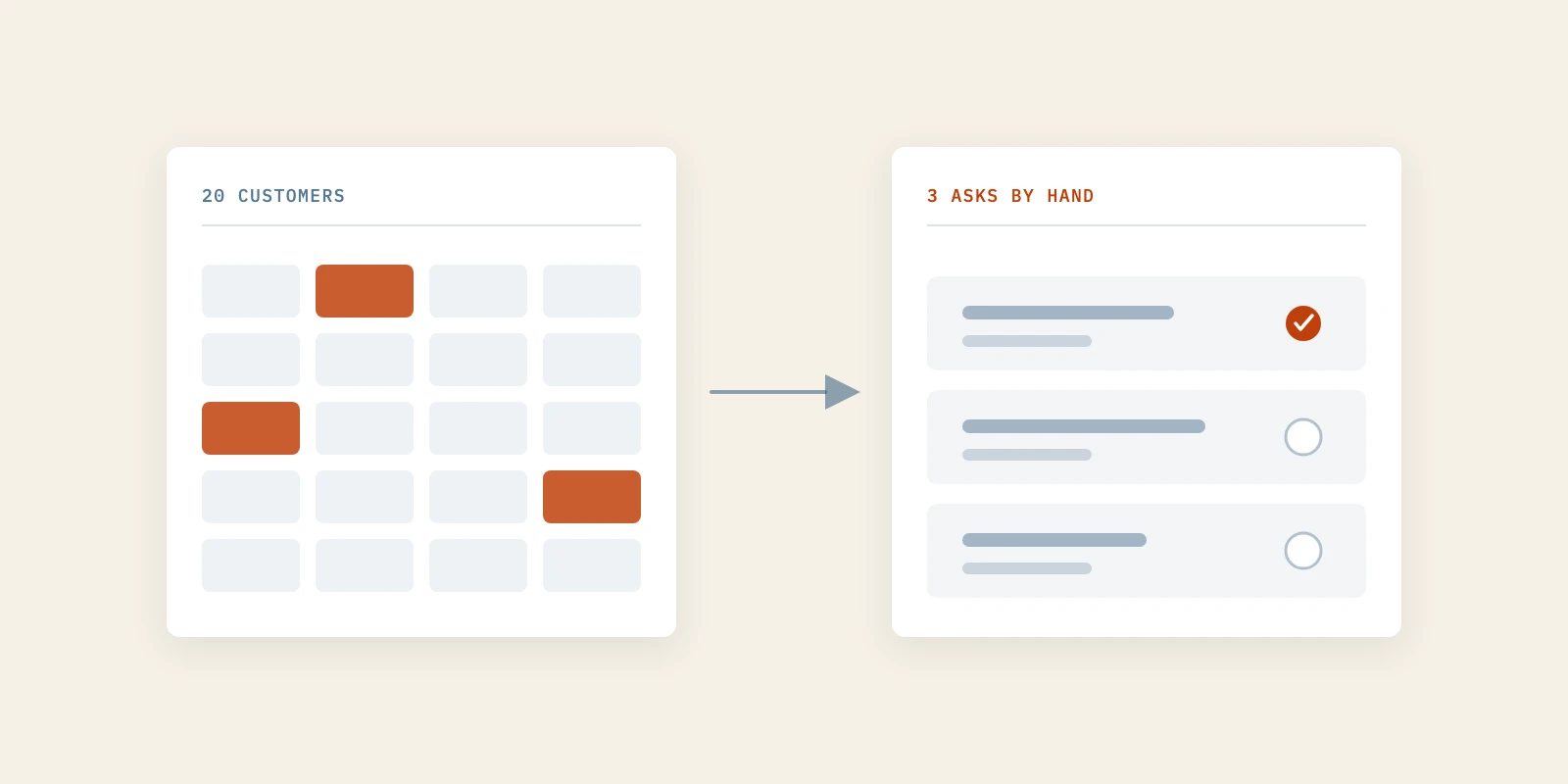
A referral program is a firm-run scheme that rewards existing customers for bringing in new ones. At 20 customers you do not have one yet, and you should not build one. Run the ask by hand instead: pick the three or four customers who have already shown satisfaction, ask each for one or two named introductions, send a note they can forward, and keep the whole thing in one sheet.
Search the category and page one is mostly software. Vendor pages, a few build-it guides, and first among the organic results a Reddit thread asking if any of it actually works for a small software company.
That thread is the honest summary of the category. Almost every page above and below it assumes a customer base large enough for a program to produce a signal, and at 20 customers you have neither the volume nor the evidence.
Buying the software first is how a founder ends up with a dashboard reporting zero. This covers the arithmetic at 20 customers, the manual motion that replaces the software, what the research on referred customers actually found, and the two rules that change the moment you attach a reward.
Twenty Customers Cannot Carry a Referral Program
Twenty customers cannot carry a referral program because the sample is too small to tell a repeatable motion from a coincidence. Work the arithmetic before you work the tooling.
Say two of your 20 customers introduce someone this quarter, which would be a healthy rate. Say half of those introductions turn into a real conversation. You get one conversation, and one conversation teaches you nothing about a system.
That is not an argument against referrals. It is an argument against instrumenting them. A referral program is overhead: tracking, attribution, a reward, and a page explaining the rules.
What you can do at 20 is make the asks and watch what comes back. Three signals tell you the asks are worth making at all.
- Someone has already introduced you once without being asked.
- Your customers renew, or stay put, without a rescue call from you.
- You can say why each customer bought, in their words, not yours.
Miss the first and no program will create the behavior, because a referral program makes an existing behavior easier to repeat rather than starting one. Miss the second and every introduction you win accelerates churn you have not fixed.
Referrals also only reach the people your customers already know. Creating demand among people they have never met is the job of content marketing for tech companies and of search, and it runs on a different clock. If you are still in the very first stretch, the sequence in getting your first ten customers comes before any of this.
Run the Referral Program by Hand Before You Build It
Run the referral program by hand: a shortlist, a timed ask, a forwardable note and one sheet. None of it needs a tool you do not already have, and it produces the evidence that would justify buying one later.
Treat each step below as something you can finish this week. Five steps, in the order the work actually happens.
1. Pick the Four Customers With Evidence
Do not ask all 20. Ask the ones who have already given you a signal, which at this size is usually three or four names.
The signals are specific: they sent praise nobody asked for, they renewed without a negotiation, they had a support problem solved fast and said so, or they have already introduced you once. Write the four names down with the evidence beside each one.
You will know the shortlist is right when the ask feels obvious rather than pushy. The common mistake is treating the list as a fairness exercise and mailing all 20, which turns a warm ask into a campaign. The same shortlist is the one you go to for testimonials with four customers, and asking for both in the same conversation usually costs you one of them.
2. Ask After a Win, Not on a Schedule
Timing beats incentive design at this size. The ask lands when the value is fresh in the customer's mind and it dies when it arrives on a quarterly cadence.
The four moments that work are a support problem resolved well, an onboarding that hit its goal, a renewal, and the week after a customer volunteers praise. An ops lead who emails you to say the Monday report finally runs itself is giving you the opening that day, not next month.
You will know the timing is right when replies come back in days rather than weeks. The common mistake is asking in week one, before the customer has anything to vouch for.
3. Name Two Companies in the Ask
Ask for one or two named companies, never for "anyone you know". A general ask puts the work of remembering onto the person doing you the favor, and it is why most referral asks die politely.
Do the remembering for them. Look at their LinkedIn and pick two companies that resemble the ones you already serve. Then name those two, in their own words: "you mentioned that the ops team at your last company had this exact reporting problem, would an introduction there make sense?"
You will know it worked when the reply names a person rather than a category. The common mistake is asking for a volume of introductions instead of a specific one, which reads as a quota and gets declined.
4. Write a Note They Can Forward
Send the customer a short block they can forward without rewriting it. Three sentences: the problem you solve, the kind of company you solve it for, and one low-friction next step.
Keep it under 80 words and put it in the body of the email, not an attachment. If the customer has to compose anything themselves, the introduction sits in drafts until it expires.
You will know the note is good enough when it comes back forwarded verbatim. The common mistake is writing a pitch instead of a forwardable paragraph, which makes the customer look like a salesperson to their own contact.
5. Track Five Columns in One Sheet
Five columns hold everything a referral program would track at this size: customer, date of ask, who they named, introduction made or not, and what happened. Nothing else earns a column until the sheet stops fitting on a screen.
That last column is the only one people skip and the only one that teaches you anything. Record the outcome even when it is nothing, because a run of four asks and zero introductions is a finding about your product, not about your asking.
You will know it is time to build something when tracking by hand becomes genuinely painful, which means dozens of live asks rather than four. The common mistake is buying the tool at the point the spreadsheet gets slightly untidy.
A Referral Program Differs From an Affiliate Program
A referral program and an affiliate program get used as synonyms and they are different instruments. One runs on a personal relationship, the other on audience reach, and at 20 customers only the first is available to you.
| Factor | Referral Program | Affiliate Program |
|---|---|---|
| Who introduces you | An existing customer | A publisher or promoter |
| What it runs on | Trust and fit | Traffic and audience |
| How it is tracked | A named ask in a sheet | Links, codes and software |
| What has to be disclosed | Nothing, if nothing is paid | The paid relationship, every time |
| What it needs to work | Customers who got real value | Reach you can measure |
The rows matter because they change the design. A public sign-up page with a payout schedule is an affiliate program wearing a referral program's name, and it will attract people who have never used your product.
At your size the useful version is the middle column: four people, four asks, no page. Build the affiliate instrument later, if at all, and build it knowing it is a media buy rather than an act of advocacy.
What the Research on Referral Program Value Found
The research found a real referral program effect and a narrower one than most vendor pages quote. Philipp Schmitt, Bernd Skiera and Christophe Van den Bulte tracked 5,181 customers a large German bank acquired through its referral program in 2006 against a random sample of 4,633 acquired by other methods, following both to September 2008.
Their paper in the Journal of Marketing reports two findings that point in different directions. Referred customers started with a contribution margin about 19.8 cents a day higher, and that advantage fell to zero after roughly 29 months. Their churn hazard was about 18 percent lower once demographics and acquisition month were controlled for, and that gap did not close.
Read the retention finding in absolute terms before you build anything on it. After 33 months, 82.0 percent of referred customers were still active against 79.2 percent of the others.
The six-year customer lifetime value difference was about 40 euros against a base of 253, which is where the paper's "at least 16% higher" headline comes from. So the durable advantage is retention, not margin, and it is worth single-digit percentage points of survival rather than a step change.
Two caveats the summaries drop. This is a German bank rather than B2B software, so the direction transfers and the magnitudes do not, and the authors are explicit that the referral effect "need not be present in every customer segment".
The Dropbox Referral Program Rewarded Its Own Product
The Dropbox referral program is the example every guide reaches for, and its central condition is one almost no B2B software company can copy: the reward is the product. Dropbox pays 500 MB of extra storage to both sides of an invite on a free account, capped at 16 GB, and both sides are only paid once the referred person installs the app and verifies their email.
Storage cost Dropbox close to nothing at the margin, so the loop could pay both sides indefinitely without touching revenue. Your equivalent is a discount on a seat you sell for money, which comes straight out of contribution margin.
The second condition is that the behavior was already there. Dropbox's own announcement of the doubled reward says as much: "Once upon a time, we noticed that Dropbox spread fastest via word of mouth," wrote Jon Ying on the Dropbox blog in April 2012. The program amplified a loop that already ran.
The third condition is volume. A self-serve product with millions of sign-ups can read a referral program change in a week, and at 20 customers you would wait a year for a weaker read of the same thing. Copy the sequence, which is behavior first and program second, and leave the mechanics where they belong.
A Reward Turns a Referral Program Into a Legal Question
Attaching a reward to a referral program moves it from a private introduction into regulated territory, and it happens the moment something of value changes hands. Neither point below is legal advice, and both are worth ten minutes with someone who does this properly.
The first is the email. The FTC's CAN-SPAM compliance guide says that who counts as the sender of a forwarded commercial message "depends on the facts". Then it gets specific: "if a seller pays or gives a benefit to someone in exchange for generating traffic to a website or for any form of referral, the seller is likely to have compliance obligations under the CAN-SPAM Act".
A customer forwarding your note because they want to is one thing. The same customer forwarding it for a 200 dollar credit is another, and the obligation can land on you.
The second is disclosure. The FTC's endorsement guides set one test for an incentive. It is this: "The answer depends on whether knowing about that gift or incentive would affect the weight or credibility your readers give to your recommendation."
A one-to-one introduction is not a recommendation to an audience. A public post from someone you paid is, and that one needs a disclosure.
Both point the same way at your size. A named ask, sent by you, with nothing attached to it, carries almost none of this.
When a Referral Program Should Wait Longer
A referral program should wait when the introduction would land on someone who cannot buy from you yet, and more customers will not fix that. Three cases make the asks premature at any company size.
The first is that your customers' peers are not your buyers, which happens when you sell to one function inside a company type your customers do not have in common. The second is unfixed churn, where every introduction you win accelerates a loss. The third is that the reason people bought is one you cannot repeat, such as a founder relationship or a single migration window.
In all three the constraint is demand, not advocacy, and the distinction matters because the fixes are unrelated. How first customers actually arrive is worth reading before you decide which one you have.
Creating demand among people your customers have never met is a different job from capturing word of mouth. It is what content marketing for tech companies and a B2B demand generation agency are hired to do, and it is where Better Marketing starts with founders whose network has run dry.
An AI SEO service covers the other half, which is being found by buyers who are searching rather than asking someone they trust. Neither replaces the referral asks. Both are what keep a pipeline moving once the list of 20 is exhausted.
Make the Asks Before You Buy the Software
At 20 customers the referral program is you, a shortlist and a sheet. Make five named asks this quarter, send notes people can forward, and record what came back, including the silences. If three of the five produce a conversation, you have found something worth instrumenting later.
If none do, the problem sits upstream of referrals and no tool reaches it. That is the point at which an AI SEO service and founder-led outreach earn the budget, and it is the work Better Marketing does.