

Quick Answer
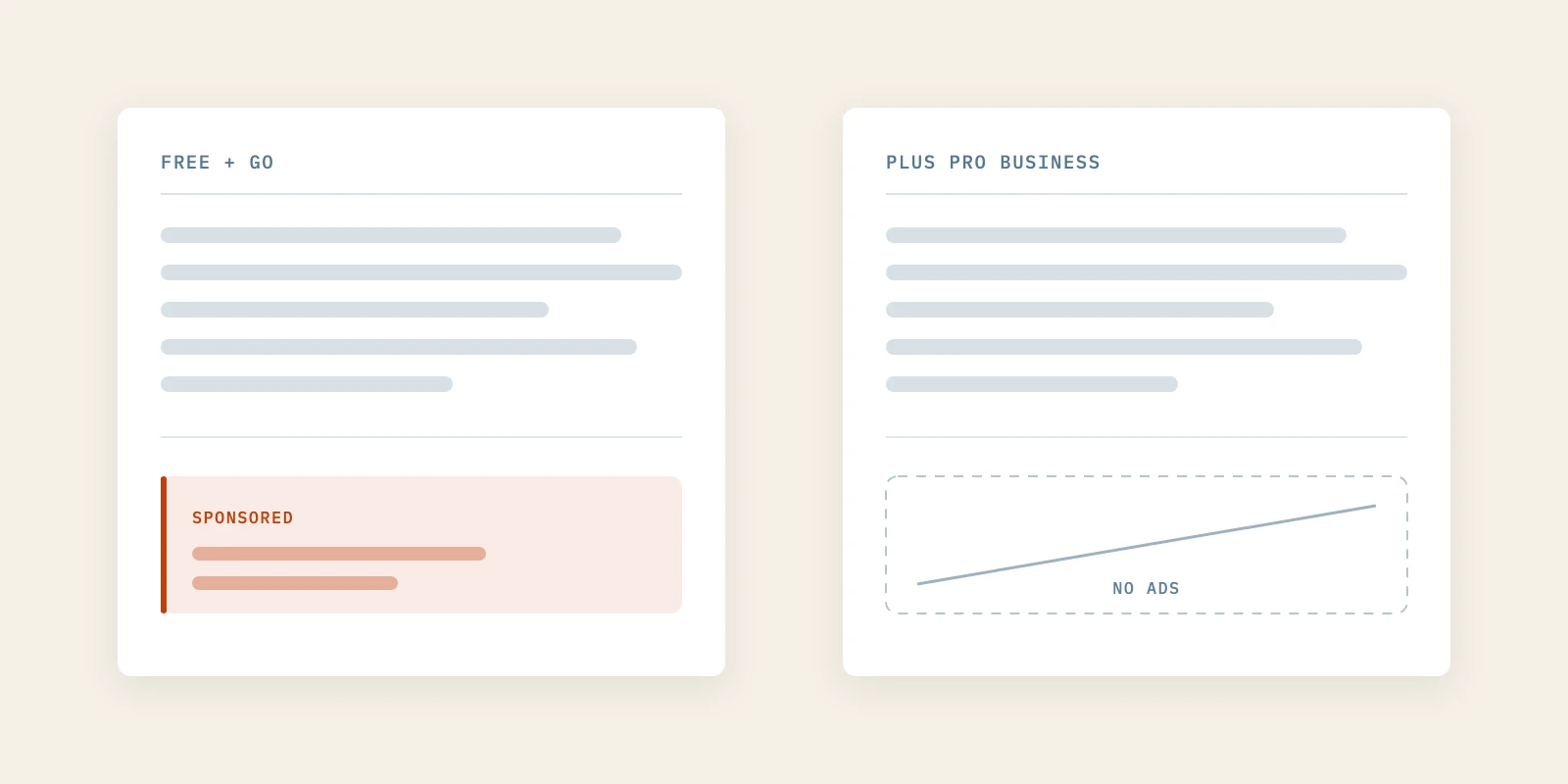
ChatGPT ads are sponsored placements OpenAI sells beside answers inside ChatGPT, and by OpenAI's own tier rules they appear only on the Free and ChatGPT Go plans, never on Plus, Pro, Business, Enterprise or Edu. Most people who research software on an employer's account sit on one of those paid tiers, so the slot cannot reach them. The honest limit is that OpenAI publishes no data on which tier its heaviest researchers use.
OpenAI began showing ads inside ChatGPT to United States users on 9 February 2026, and opened a self-serve way to buy them three months later. If your buyers now start their research in a chat window, a placement next to that answer reads like a channel worth a test budget.
The part that does not travel with the announcement is who the placement can be served to. That one rule sets the ceiling on your spend before you write a line of ad copy.
It is not a rollout gap that closes next quarter. This post dates what OpenAI has actually announced, tests the reach question against G2's March 2026 survey of B2B buyers, and sets out where the same money buys ground you keep.
ChatGPT Ads Cannot Reach Buyers on Paid Plans
ChatGPT ads cannot be served to anyone on a paid ChatGPT plan, because OpenAI excludes those tiers from ad delivery as a matter of product policy. Its help center article Ads in ChatGPT states that ads may appear for users on the Free and Go plans, and that Plus, Pro, Business, Enterprise and Edu accounts do not have ads.
That makes your reachable audience a property of the product rather than a setting in your campaign. No bid, budget or creative moves it.
1. The Tier Rule Is Product Policy, Not a Rollout Gap
The tier split is written into the product, not into a phased launch plan. OpenAI describes the ad-supported experience as a feature of the Free and Go plans, and the absence of ads as a feature of the paid ones. That is a positioning choice, not an engineering queue.
The practical test is cheap. Ask three people who look like your buyer which ChatGPT plan they use and who pays for it, and you will usually get the answer in a day.
The common mistake is reading "not yet available in your market" and "not shown to your buyer's account type" as the same problem. The first resolves with time. The second does not resolve at all, and no amount of waiting changes it.
2. The Ads-Free Option Removes More of the Reachable Audience
Even the Free tier is not fully addressable. OpenAI's help center describes a free, no-ads option a Free-plan user can choose instead, which removes ads in exchange for additional limits: fewer messages a day and no access to tools such as images.
That trade tells you something useful about who stays on the ad-supported version. A person who accepts fewer messages a day to avoid advertising was not running long vendor evaluations in ChatGPT in the first place.
So the addressable pool is Free and Go users who have not opted out. You can confirm the control exists yourself in a few seconds, under Settings and then Ads controls, on any eligible Free account.
3. Heavy Software Researchers Sit Inside Employer-Paid Accounts
The people who evaluate software in a chat window are heavy users, and heavy users at work are usually on an account someone else pays for. G2's March 2026 survey of 1,076 B2B decision makers found that nearly two-thirds now spend six or more hours a week using AI chatbots for work. Over 40 percent describe themselves as daily power users.
The evaluation behavior is more specific still. G2 found that 41 percent of buyers use Deep Research tools regularly for software evaluations. ChatGPT is the chatbot 63 percent of them reach for when they do it.
Put those together and the picture is a professional, on an employer's seat, running long structured evaluations. Every one of the business tiers that seat is likely to sit on is a tier OpenAI excludes from ChatGPT ads.
4. The Inference Has a Falsification Test You Can Name
This is an inference, and it should be labeled as one. G2 does not publish which ChatGPT plan its respondents use, so the step from "heavy professional user" to "paid tier" is reasoned rather than measured.
Here is what would break it. If a large share of six-hour-a-week professional users turn out to be on Free or Go, the reach argument weakens considerably and a test becomes defensible.
Nobody has published that number. Until somebody does, run the version of the test you can afford to be wrong about, and measure it against reached buyers rather than impressions.
ChatGPT Ads Buy Adjacency, Never the Recommendation
ChatGPT ads buy a position beside an answer, not a place inside it. OpenAI is explicit that ads run on systems separate from the chat model, and that advertisers cannot shape, rank or alter responses. Placements are labeled Sponsored and set apart from the answer text.
That is the right posture for a product people are asked to trust. It also means the thing you are buying is proximity, and the thing that moves a buyer is a mention.
G2 measured the gap. Eighty-five percent of buyers say they think more highly of a software vendor when an AI chatbot mentions them in a recommendation. A mention is the one thing OpenAI has said it will not sell.
How the ChatGPT Ads Rollout Changed Since February 2026
The ChatGPT ads offer has moved four times in seven months, which is why undated advice about it is worse than no advice. Here is the sequence as reported.
| Date | What Changed |
|---|---|
| 9 February 2026 | Ads begin in the United States for logged-in adults on the Free and Go plans |
| 10 April 2026 | OpenAI tells Digiday the ads manager is not fully rolled out; a subset of advertisers test an early version at a reported fifty thousand dollar minimum |
| 5 May 2026 | OpenAI announces new ways to buy, including a beta self-serve Ads Manager and cost per click bidding |
| 19 August 2026 | Ads expand to 31 more European markets, on top of the United States, Canada, Australia, New Zealand, the United Kingdom, Japan, South Korea, Brazil and Mexico |
In April an OpenAI spokesperson told Digiday that the company had "not fully rolled out the ads manager platform" and that a subset of advertisers were testing an early version. Four months later Adweek reported the expansion into 31 European markets.
Two things are worth taking from that table. The geography and the buying mechanics keep changing, and the tier rule has not changed once.
Buyers Check the Sources Behind an AI Answer
Buyers do not take an AI answer at face value, which is the finding that matters most for anyone deciding where ChatGPT ads money should go. G2's Answer Economy report found that 45 percent of buyers say citations from software review sites are the signal that most inspires confidence in an AI-generated response.
They have reason to check. Sixty-four percent of the same buyers encounter inaccurate chatbot recommendations often or very often. When a chatbot conflicts with a brand they already trust, 24 percent go to peer reviews next.
G2's chief innovation officer, Tim Sanders, puts the shift in one line: "Buyers have moved from reference to inference."
That checking is also why being unknown is survivable. G2 found that 69 percent of buyers chose a different vendor than they had initially planned, on the strength of chatbot guidance, and that 33 percent bought from a vendor they were not familiar with.
That is a different job from being seen. The buying committee arriving through a chat window reads the answer, then reads what the answer was built from. It is the same behavior driving the zero-click pattern in ordinary search.
Where the Same Budget Buys More Durable Ground
If your buyers sit outside the ChatGPT ads inventory, the same money still has somewhere useful to go. The order below matters, because each step makes the next one cheaper.
- Make your pages readable to the crawlers that feed answers, since a page an engine cannot fetch cannot be cited from.
- Write the comparison and objection pages buyers are already asking for, in the words they use rather than your product's words.
- Earn coverage on the review sites and third-party pages that answers cite, because that is the corroboration a buyer checks for.
- Measure which prompts return you, and treat each absence as a missing page rather than a missing bid.
That ordering is what an AI SEO service is for, and it is how Better Marketing sequences the work: make the page readable, make the claim checkable, then go and earn the outside mention. The mechanics of getting quoted are covered in more depth in our guide to answer engine optimization for startups.
None of this replaces outbound. A B2B demand generation agency and an answer-engine plan solve different problems, and a founder with no pipeline at all usually needs both running. Content marketing for tech companies is the slow half of that pair, and it is the half that compounds.
Buying the Slot Differs From Being the Answer
Buying the slot and being cited in the answer differ on who sees the result, how long it lasts and who controls it. They are often discussed as though they were the same spend with different labels.
| Factor | Buying ChatGPT Ads | Being Cited in the Answer |
|---|---|---|
| Who can see it | Free and Go users who have not opted out | Every tier, paid plans included |
| What it buys | Adjacency, labeled Sponsored | A mention inside the recommendation |
| How long it lasts | As long as the budget runs | As long as the page and the citations hold |
| Who controls it | OpenAI's inventory and auction | Your pages and third-party coverage |
| Speed to first result | Days | Months |
Read the last row honestly. Buying is faster, and an AI SEO service is slower and does not expire, which is the whole trade.
The first row is the one founders skip. A campaign that cannot be shown to a Plus or Enterprise account is not a slow channel, it is a closed one. The groundwork under the second column starts with how AI crawlers read a page differently from Googlebot.
When Testing ChatGPT Ads Is a Reasonable Call
The tier argument narrows the case for ChatGPT ads. It does not close it, and there are situations where a test is the sensible thing to run.
- Consumer-adjacent products, where the buyer is a private individual likely to be on Free or Go rather than an employer's seat.
- Low-ticket software with a self-serve signup and an evaluation that takes minutes rather than a buying committee and a quarter.
- Launch tests where the goal is learning what language converts, and the media cost is tuition rather than pipeline.
- A short-term floor under demand while the slower work of getting cited is still building.
Outside those cases, the honest reading is that the money is better placed elsewhere. If the real need is pipeline inside one quarter, that is a demand problem rather than a visibility problem, and a B2B demand generation agency is the right hire for it.
Check Three Things Before You Spend Anything
Before any ChatGPT ads test, confirm three things in order. First, that you are eligible to advertise in your market; second, that inventory is live where your buyers are; third, that those buyers sit on Free or ChatGPT Go rather than a paid plan. The third one ends most of these conversations.
Better Marketing does not run paid ads, and our answer to this question is content marketing for tech companies that earns the citation instead. That is a positioning choice about what we build, not a verdict on anyone who buys the slot. A mention outlives a campaign.