
Quick Answer
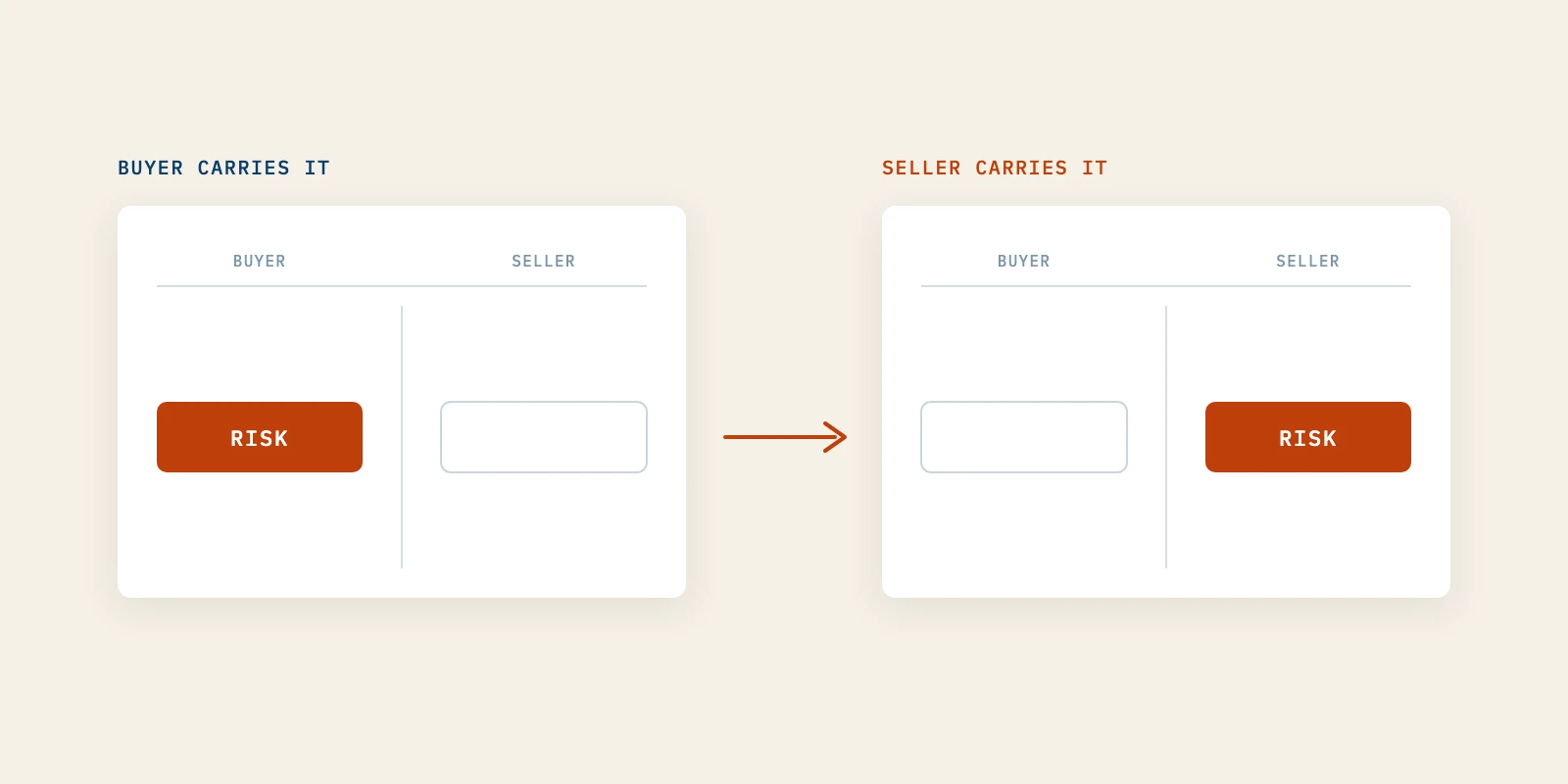
Risk reversal is the seller taking on, in writing and with a deadline, the downside a buyer would otherwise carry alone. Richard Sears built a mail-order catalog business on it, printing the price, the trial period and the refund terms beside the goods so a stranger could check the promise before sending money. When nobody has heard of you, that is still cheaper than asking for faith.
Most founders answer a trust problem by adding proof. More logos, another case study, a longer wall of testimonials. That helps, and it's also the expensive half of the job.
There is an older lever, and it costs nothing until somebody uses it. Stop asking the buyer to carry the cost of being wrong about you, and write down who carries it instead.
Sears is the clearest worked example on record, because the promises are still readable in the catalogs themselves. This post reads the guarantee language out of a Sears catalog from the early 1900s, turns it into five things you can write into your own offer this week, and says where the tactic breaks.
What Sears Printed Instead of a Slogan
The slogan arrived decades after the practice. The catalog chronology kept by the Sears archives dates the first Sears, Roebuck and Co. catalog to 1893 and the "Satisfaction Guaranteed or Your Money Back" banner to 1927, which is thirty-four years of selling to strangers before the famous line existed.
What sat on the pages in between is the more useful material, because it is risk reversal written out in full. (The term also has an unrelated options-trading meaning; this is the marketing one.)
Catalogue No. 112, an undated Sears book from the early 1900s digitized from the Winterthur Museum Library copy, states its terms beside the goods rather than on a cover. A carpet sweeper is "Sold under our universal guarantee, if not satisfactory return it and money will be refunded."
A bicycle shipped on a deposit of one dollar, "subject to examination," which meant the buyer could inspect it at the express office and pay the balance only after it matched the page.
Sewing machines went further again. Every machine carried a twenty-year written guarantee and a three months trial offer, and the catalog spelled out the consequence in plain words: return it inside three months and the money is refunded in full.
The clothing pages of that catalog put the whole mechanic in one line. Sears told the reader, in its own words: "we take all the chances. You take none."
This was not a stunt that stayed small. Sales under Richard Sears topped $400,000 in 1893 and exceeded $750,000 two years later, on a book that had grown to 532 pages by 1895.
The pattern repeats whenever a seller is unknown and the buyer cannot inspect. It is the same move the Michelin guide used to make its ratings credible, and it is the reason content marketing for tech companies keeps returning to published terms rather than published adjectives.
Five Moves That Put Risk Reversal in Writing
Risk reversal becomes real when a buyer can read it, test it and hold you to it without speaking to anyone. Five things do that, and each one has a catalog ancestor.
1. Print the Price Where a Stranger Can Find It
A price on the page is the first risk you take off the buyer, because it removes the fear of wasting a call to find out they cannot afford you. The catalog did this by default: every item in Catalogue No. 112 carries a number beside it, which is why a farmer could compare it against the general store without asking anyone.
Publish a starting price, a range, or the unit economics of your smallest sellable package. If pricing genuinely has to be custom, publish the two or three variables that move it and a worked example.
You will know it worked when demo requests start arriving with the plan already named. The common mistake is treating "contact sales" as neutral, when to an unknown buyer opacity reads as a risk they are being asked to absorb.
2. Describe the Product Well Enough to Inspect
A distant buyer cannot pick the thing up, so the page has to do the work the shop floor used to do. The 1897 Sears catalog set that bar out loud, in wording preserved by the University of Delaware and Winterthur review of the catalogs.
"Our illustrations and descriptions are such as will enable you to order intelligently; in fact, so that you can tell what you are getting as well as if you were in our store selecting the goods from stock."
The same review records that catalog images were engraved directly from photographs of the objects, which is a costly way to keep a picture honest.
Replace one abstract claim on your product page with a real screenshot, a real workflow or a real export file. Then add the limits section almost nobody writes, naming what the product does not do and who it is a poor match for.
It worked if sales calls stop being product tours. The mistake is showing the outcome instead of the product, which is convenient to write and expensive for the buyer to verify.
3. Let the Buyer Try It Before the Contract Starts
A free trial is only risk reversal when the exit is as easy as the entry, and most aren't. Sears ran a ten days free trial on bicycles and a three months trial on sewing machines, and it took a one dollar deposit rather than nothing, which kept the offer honest on both sides.
Give the buyer a way in that does not require a card, or a pilot with a written end date and a stated exit. If you must take a card, say on the same page how cancellation works and how long a refund takes.
The signal that it worked is activation happening before the first call. The mistake is a trial that converts by inertia, where the off-ramp is quieter than the on-ramp.
4. Write One Promise With a Scope and a Deadline
A money-back guarantee only works when it is specific enough that two people reading it reach the same answer. "We stand behind our product" is a feeling. "Full refund if the migration is not complete within thirty days of kickoff" is a term someone can act on.
Write one promise with three parts: what has to be true, by when, and what happens if it is not. Name who decides, and pick something you can measure rather than something you can argue about.
You will know it landed when buyers quote it back to you in the first email. The mistake is promising the whole relationship instead of one outcome, which reads as bravado and pays out unpredictably.
5. Prove the Company Behind the Promise Exists
A promise is worth the entity standing behind it, which is why the catalog spent pages on proof of existence rather than proof of quality. Catalogue No. 112 printed the company's cash capital and surplus and then named its banks, referring readers to them "by special permission."
Facsimile copies of letters from four banks, among them the National City Bank of New York, were reproduced on page 12, ahead of almost every price in the book.
The modern equivalent is unglamorous and under-built: named humans on an about page, a real address, a status page, a security page, and a support channel that answers in public.
It worked when procurement stops asking for a reference call before a pilot. The mistake is one polished marketing page and nothing behind it, which doesn't hide risk so much as relocate it onto the reader.
A Guarantee Nobody Can Read Is Not Risk Reversal
A promise that only appears after a sales call is not risk reversal, because the person deciding whether to take the call never sees it. Most guarantees fail here rather than in the wording.
The mechanics are not mysterious. Google's own documentation on AI features states that "there are no additional requirements to appear in AI Overviews or AI Mode, nor other special optimizations necessary." What it does require is that a page "must be indexed and eligible to be shown in Google Search with a snippet".
So the terms have to live in ordinary body text on an indexable page. Inside a PDF, behind a form, in a slide deck or in an MSA nobody reads before signing, they are invisible to Google Search, to AI Overviews, and to the assistant your buyer is actually asking.
Content marketing for tech companies has the job the catalog had, which is why Better Marketing starts an AI SEO service engagement on the page that carries the promise rather than on a keyword list.
The test is blunt, and you can run it yourself. Search your own guarantee wording and see whether your page comes back. Then check the sentence reads correctly with nothing around it, the way publishing your numbers in public only works when they are legible alone.
Risk Reversal Versus Adding More Proof
Both levers answer the same question, and they cost differently. Proof asks the buyer to believe the people who went before them; risk reversal removes the need to believe anything until the offer has been tested.
| Factor | Adding More Proof | Risk Reversal |
|---|---|---|
| What it asks of the buyer | Believe the customers who bought first | Nothing, until the promise fails |
| What it costs you | Time, plus customers willing to be named | Only the claims actually made |
| How fast you can ship it | Months, at the pace of customer consent | This week, in one paragraph |
| Where it has to live | Case study pages and a logo wall | The offer page, in indexable text |
| What it needs to be found | Pages that rank and get cited | The same pages, plus wording a model can quote |
Neither replaces the other, and you shouldn't pick one. Proof compounds and risk reversal starts from zero, which is why an AI SEO service engagement usually runs both: the guarantee earns the first trial, and the case study it produces becomes the proof for the next buyer.
Where Risk Reversal Turns Into a Support Problem
The tactic breaks when the promise is wider than the thing you control. A guarantee that covers an outcome depending on the customer's data, their staffing or their timeline will be claimed for reasons that have nothing to do with your product, and the team learns to resent it.
It also breaks on volume. A free trial with no qualification and an unbounded refund window turns support into an arbitration desk, and the cost lands on the people least able to change the offer.
Scope it before you publish it:
- Narrow the promise to one outcome you can measure.
- Put a window on it, and say when the window starts.
- Name who decides, and what evidence settles a disputed claim.
- Treat the refund rate as product feedback rather than leakage.
- Staff the off-ramp before you advertise it.
There is also a timing limit. If you have no product a stranger can try yet, a guarantee is a promise about a thing that does not exist.
The work is earlier then: the founder-led writing and outreach that gets the first customers through the door, which is what a B2B demand generation agency is hired to run.
Move One Risk off Your Buyer This Week
Move one risk off your buyer this week, and write it down where a stranger can read it without asking. Trust is built in specifics, never in slogans, and a scope with a date is the most specific thing you own.
Sears did not out-shout the general store; it made itself the safer thing to try. Find the single place your buyer is carrying a downside you could carry instead, then put that risk reversal on a page a crawler can reach.
When that trust needs converting into first customers, a B2B demand generation agency is the next hire, and it is the work Better Marketing does without paid ads.