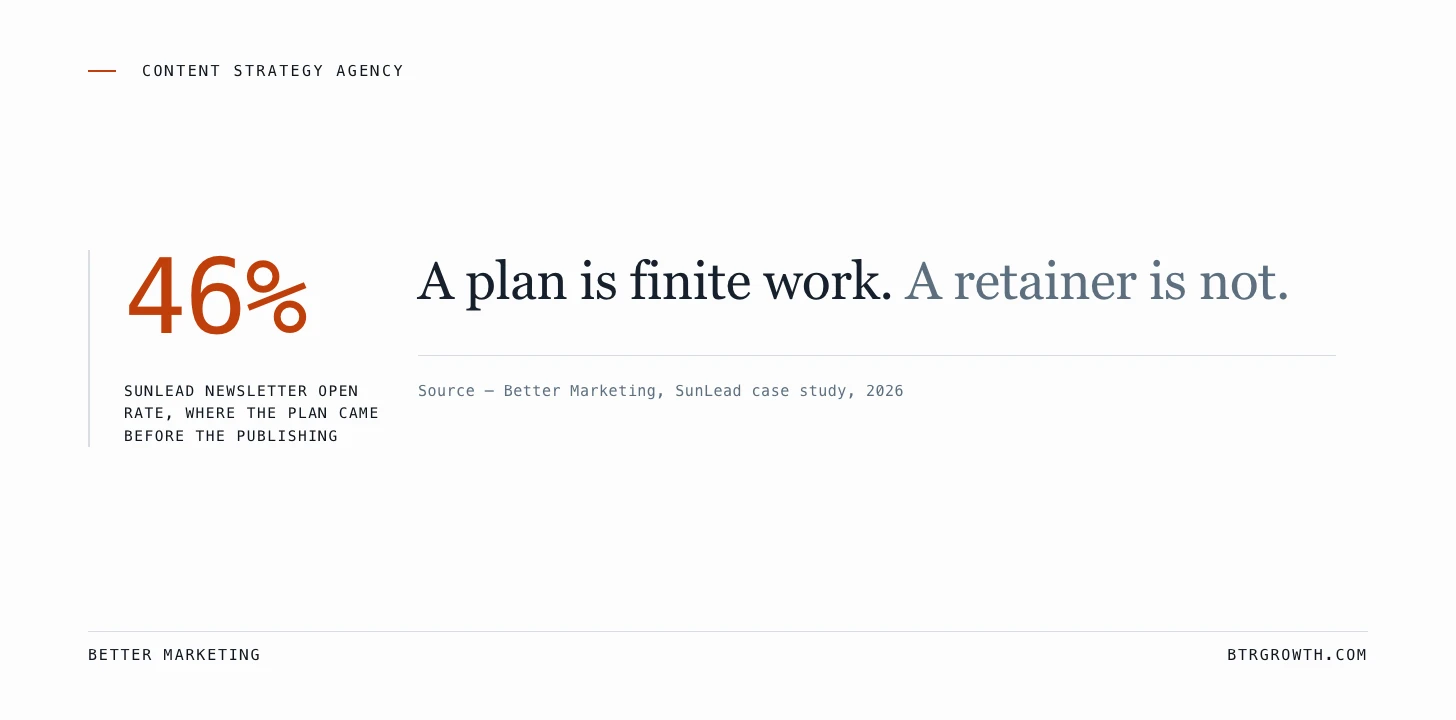
A content strategy agency sells you a plan for what to publish and why. A content marketing agency sells you the publishing. Almost every firm ranking for the term does both, prices both as a monthly retainer, and never draws the line for you. If what you actually need is the plan, that is a finite piece of work and you should not be paying for it by the month.
This is a buying guide for founders trying to work out which of the two they are shopping for. It names what the deliverable should be, what the market charges, and the case for hiring nobody at all.
The term means two things, and the sellers blur them.
Search the category and you get a page of firms who agree with each other. The clearest example is HawkSEM, whose ranking of ten content strategy agencies is headed "We Did the Research" and defines the category as "a digital marketing agency that offers content creation as a specialized service, often under the umbrella of SEO."
Read that again. It defines a content strategy agency as a content production agency. That is not a slip. It is the commercial reality of the category: strategy is the thing you sell to get bought, production is the thing you bill for.
The self-selection is worth noticing too. HawkSEM's list of ten puts HawkSEM at number one. Siege Media's list of twelve content strategy agencies puts Siege Media at number one. Both are competent firms. Neither list is a survey, and reading either as one is how founders end up on a shortlist somebody else wrote. We went through this pattern in detail when we checked who actually appears on these lists, and it holds here without modification.
What a content strategy actually is
A strategy is a decision document, not a calendar. If you are buying one, the deliverable should tell you six things and be judged on whether it does:
Who the buyer is, specifically enough that you could name three of them.
What that buyer already believes about the problem before you arrive.
The questions they ask themselves, in order, between noticing the problem and paying someone.
Which of those questions you can answer more credibly than anyone else, and which you cannot.
Where the answers have to live so the buyer meets them, which now includes surfaces you do not own.
What you will look at in ninety days to know whether the thesis was wrong.
Notice what is not on that list. No posting cadence, no keyword volume table, no channel mix. Those are outputs of a strategy. Handing you a content calendar and calling it a strategy is the most common substitution in this category, and it is easy to catch: a calendar tells you what gets published, a strategy tells you why anything should be.
Notice also that the last item is a falsification test. A plan that cannot be wrong is not a plan, it is a pitch.
Strategy is finite work. Retainers are not.
Here is the structural problem, in the sellers' own numbers. Siege Media publishes its pricing openly, which is more than most of the category does, and every tier it names is monthly: three thousand to seven thousand dollars a month for content with limited strategy, seven to fifteen thousand for strategy plus content plus SEO, fifteen to forty-five thousand and up for the integrated tier. HawkSEM's own FAQ gives a range of three to fifteen thousand a month.
Those are production prices. They are reasonable production prices. But a strategy is a diagnosis, and a diagnosis has an end. The six answers above take a competent person somewhere between two and six weeks depending on how much customer contact already exists, and then they are done until the market moves. Buying that as a twelve-month retainer means you pay for eleven months of a thing you already own.
The honest version is that most agencies would rather sell the retainer, and an agency that skips the diagnosis is selling you activity. That is a real conflict of interest, not a rhetorical one, and it applies to us as much as anyone. Better Marketing builds trust over months rather than weeks, so if the plan on its own is all you need, we are the wrong shape and we will tell you that on the call.
What B2B changes about the answer
Founders searching specifically for a B2B content strategy agency are usually reacting to a real difference, and they are right to. In B2B the buying committee is several people who never meet you, the decision takes months, and most of the research happens with nobody watching. A strategy built for consumer demand capture assumes a buyer who can be moved in one sitting, and it will underperform against a purchase that needs four people to agree.
What changes concretely is what the plan has to cover. It has to name the skeptic in the room, not just the champion. It has to account for the fact that the person who finds you is often not the person who signs. And it has to survive being read secondhand, because the champion will paraphrase you to their CFO and your content will not be there to defend itself.
That last point is why we keep returning to specifics over slogans. Trust is built in specifics, never in slogans, and a paraphrase strips the slogans out first. Our fuller argument on how to pick a B2B content marketing agency covers the selection questions in more detail than this page does.
Where AI fits, and where it does not.
The AI content marketing agency label is now attached to two completely different offers, and the gap between them is the whole story.
The first is production automation: models drafting posts faster and more cheaply than writers. That does lower unit cost. It also lowers it for every competitor at the same moment, so it buys efficiency and not advantage, and it makes the strategy question sharper rather than softer. When publishing is nearly free, choosing what to publish is the only remaining decision.
The second is genuinely new and worth paying attention to. Buyers increasingly ask an assistant instead of a search engine, which means the question is whether a model reaches your pages, understands them, and repeats them accurately when nobody is looking. That is a mix of writing and plumbing, and it is what our AI SEO service exists to do. It is not the same skill as prompting a model to write faster, and an agency selling the first while charging for the second is worth walking away from.
One caveat we will not dress up: nobody can guarantee a citation. A citation is a model's decision at the moment somebody asks, and any firm quoting you a rate for it is selling something it cannot deliver.
When to hire nobody
Three situations where the honest answer is that an agency of either kind is premature.
You have not sold anything yet. A strategy is a compression of what you have learned from buyers, and with no buyers there is nothing to compress. What you would receive is a competent guess assembled from your competitors' websites, which is what you would have written yourself for free. Sell to ten people first, badly and by hand, and the strategy will half write itself.
Your problem is that nothing gets finished. Some teams have a perfectly good plan and no throughput. A second plan does not fix throughput. If the last few content projects died somewhere near the finish line, buy execution or buy nothing.
You are one person and you are the product. Below a certain size the founder is the strategy, and the constraint is hours rather than direction. We wrote a threshold test for whether it is time to hire at all, and it applies to agencies as much as employees. If you are shopping mainly for a writer rather than a plan, the writer versus agency comparison is the more useful page.
How to tell the two apart on the first call
You do not need to audit a portfolio. Ask what the deliverable is and what it costs on its own. A strategy firm can tell you what document arrives, roughly when, and what it costs as a standalone engagement. A production firm will move to monthly scope and volume within about a minute, because that is the shape of what it sells.
Then ask the disqualifying question: what would have to be true for you to tell us not to do this. Anyone who has actually diagnosed businesses has an answer ready, because they have given it before. Anyone who does not will treat the question as an objection to handle, and you will hear it in the pause.