
Quick Answer
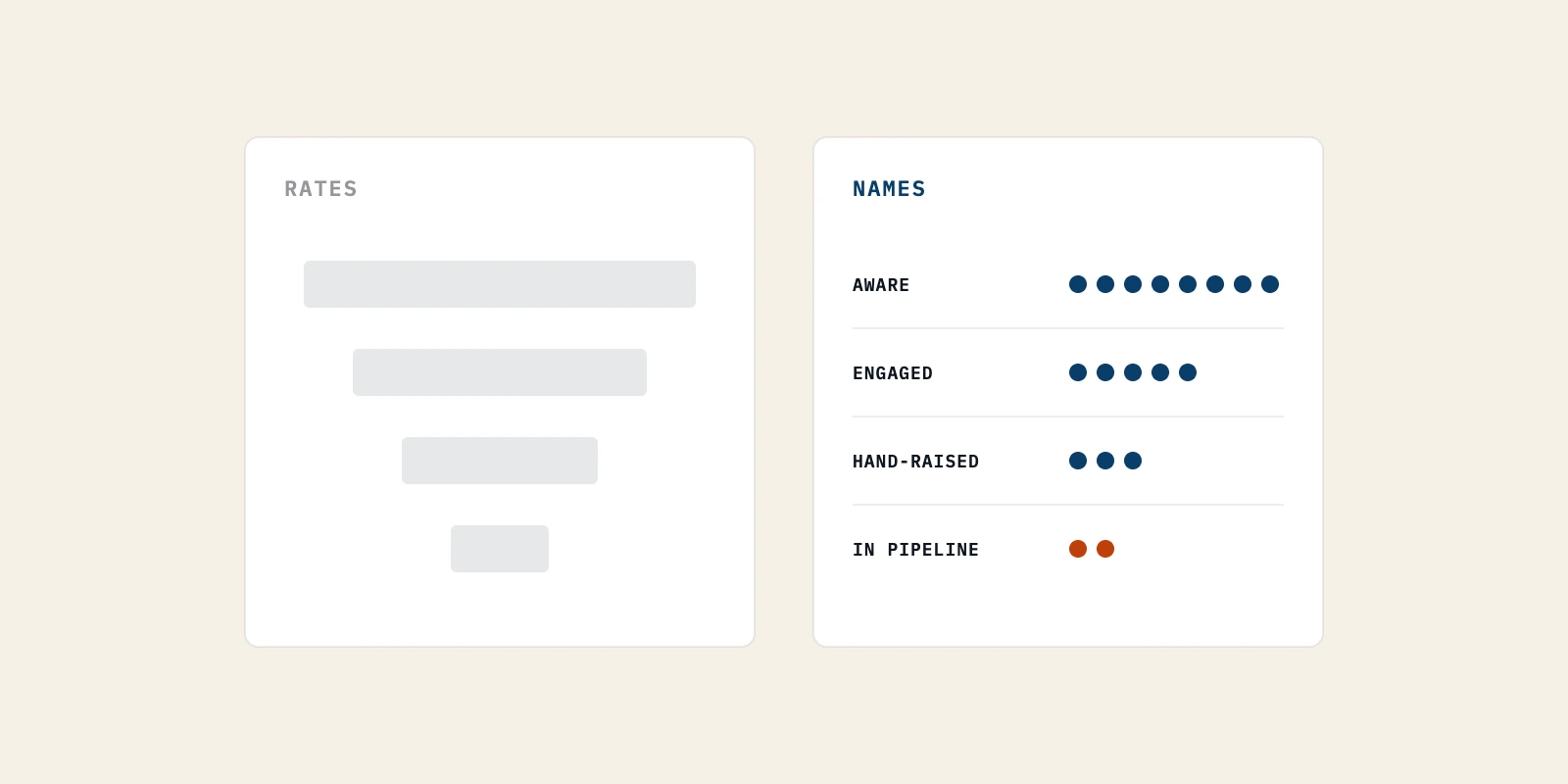
A B2B demand generation funnel has four stages defined by what a buyer does, not by what marketing sends. Those stages are aware, engaged, hand-raised and in pipeline. With no ad budget, founder-led content and outreach fill the top, and at low volume the useful report counts named accounts at each stage instead of conversion rates. Rates matter later, once each stage can survive one deal slipping.
Most funnel templates were drawn for a team with an ad budget and thousands of leads, so a seed-stage founder with 50 target accounts copies them and gets numbers that swing every week.
I use demand generation to mean building awareness and interest before a buyer asks for a sales call, and Wikipedia defines demand generation as "the focus of targeted marketing programs to drive awareness and interest in a company's products and/or services." A B2B demand generation agency may talk about dashboards, but I care first about buyer actions a founder can actually see.
The hard part is not naming stages. The hard part is refusing to pretend that tiny samples behave like a mature revenue engine.
I will walk through the four stages, what fills each without ads, what to count, and when the demand generation funnel needs more hands than the founder has.
Why the Classic Funnel Misleads a Small B2B Team
The classic purchase funnel models a buyer's journey. It was never built to measure a team with a few dozen accounts. Wikipedia traces it to William W. Townsend's 1924 link with the AIDA model: awareness, interest, desire and action.
Enterprise buyers rarely move in that neat order. Google's Alistair Rennie and Jonny Protheroe wrote that "what happens between trigger and purchase decision-making is not linear". Buyers loop between exploring options and narrowing them down. Founders who force the funnel onto that loop end up marking an account as lost when it goes quiet after one good call.
So I use buyer-action stages, where each stage shows where an account stands today. Demand generation shapes that whole journey, and lead generation records the one moment someone shares their details. More in demand generation vs lead generation.
This version is about 145 words, between the last two. I added back the AIDA stages, the Google authors' names, the explore-and-narrow loop and the founder example.
The Four Stages, Defined by What the Buyer Does
The four stages of a B2B demand generation funnel are aware, engaged, hand-raised and in pipeline, and each one is entered by a buyer action you can see, not by an email you sent. I use these stages because they work when a founder has no ad budget and small numbers.
When I checked Google's AI Overview for "B2B demand generation funnel" on 2026-09-28, it listed four stages, awareness, consideration, decision and demand capture, retention and advocacy. I leave retention for a later customer-stage discussion because a seed-stage team with few customers needs to see demand before it can measure advocacy.
Stage 1 - Aware
Aware means an account in your ideal customer profile has seen something specific from you and could name you. I like this as the first demand generation stage because it replaces vague reach with a real buyer action.
This can work without paid ads. A founder can post on LinkedIn, publish one piece of content marketing for tech companies around a problem the ideal customer profile already searches for, or appear on a podcast the buying group trusts.
Findability work can help too. An AI SEO service is one way a technical founder might make the same explanation visible in search and AI answers, but the point is still the named account, not the channel label.
Say a founder sells observability to platform teams. They post one teardown a week of an incident writeup, and a VP from a target account comments with a specific follow-up.
I would count that account as aware because a named person interacted with something specific. I would not count every follower, view or impression, because those numbers measure reach, not the right account knowing you exist.
The mistake is calling attention demand generation before the buyer can name the problem and connect it to you. A spike can flatter a founder for a week, but a launch spike is attention, not demand when the right accounts do not reappear.
Pro tip: Keep an account note beside each visible interaction. The note should say who interacted, what they touched, and why that action matters.
Stage 2 - Engaged
Engaged means someone at the account comes back for more on their own. I measure each demand generation stage by the buyer action that proves movement, so this stage counts repeat self-initiated contact per account in the last 30 days.
A newsletter works here because it gives the buyer a reason to return without booking a call. So does a second and third piece in the same series, or a useful tool or checklist that is not gated.
In the observability example, the same VP subscribes to the newsletter and opens three issues in a row, then forwards one to a colleague. I would mark the account as engaged because the behavior repeated and spread inside the company.
The measurement is not total subscribers. It is accounts with repeat self-initiated contact in the last 30 days, and the table after these stages shows the same logic across the full funnel demand generation view.
The mistake is gating content to capture an email and calling the form fill engagement. That is lead generation borrowing demand generation's name, and it often creates a list that looks larger than the real buying interest.
I would rather have a smaller engaged account list with named people than a bigger form-fill list nobody remembers. Small teams need confidence about which accounts are warming up, not a dashboard that hides the names.
Stage 3 - Hand-Raised
Demand capture vs demand generation is simple at this stage because demand generation created awareness and engagement, while demand capture starts when the buyer asks a buyer's question. Hand-raised means the buyer asks for something that only a buyer would ask for.
That question might come through a reply to outreach asking about pricing, security or integration. It might be a call request, or a founder-led outreach message that lands because the account is already engaged.
In the observability example, the VP replies to a founder's note with "does this work with our Kubernetes setup?" I would treat that as a hand-raise because it points at fit, risk and implementation.
The measurement is named hand-raises per month. I would write the person, the account, the question and the response time, because a hand-raise can decay fast when the founder waits too long.
The mistake is treating every reply as a hand-raise. "Interesting post" is engagement, not intent, because it does not ask a buying question or request a next step.
This is where a no-ad demand generation funnel starts to feel real. The account did not arrive through retargeting, but it did move from recognition to inquiry through repeated exposure and a timely founder message.
Stage 4 - In Pipeline
In pipeline means a qualified conversation with a named next step and a buying group you can list. I count this as the last demand generation stage for a seed-stage founder because the account has crossed into an active sales pipeline.
The action usually starts with a discovery call. It can continue with a mutual plan and account-based marketing touches aimed at other people in the buying group.
In the observability example, the second call is booked with the VP plus their security lead, with a date on the calendar. I would not count the account as in pipeline until that next step exists.
The measurement is open opportunities in the sales pipeline with a next step dated within 14 days, plus the names of everyone involved. The date matters because enterprise conversations go stale quietly.
The mistake is letting a deal sit with no next step and still counting it. A pipeline with undated next steps is a wish list.
I like this stage because it forces the founder to make the buying group visible. One excited VP can create momentum, but enterprise demand generation gets stronger when security, finance and the end user all have a reason to keep talking.
| Stage | Entered When the Buyer... | What Fills It Without Ads | What to Count |
|---|---|---|---|
| Aware | Interacts with something specific you made | Founder posts, one focused content series, guest spots | Target accounts with a named person who interacted |
| Engaged | Comes back on their own | Newsletter, a series, ungated tools | Accounts with repeat self-initiated contact in 30 days |
| Hand-raised | Asks a buyer's question | Founder-led outreach to engaged accounts, fast replies | Named hand-raises per month |
| In pipeline | Agrees a dated next step | Discovery calls, ABM touches to the buying group | Open deals with a next step inside 14 days |
Count People, Not Percentages, Until the Numbers Are Big Enough
When a stage holds a handful of accounts, one deal moving changes the conversion rate so much that the rate tells you nothing, so report the named accounts at each demand generation stage instead. I use percentages later, but not before the count can survive one deal slipping.
Here is the plain arithmetic. If 4 accounts are hand-raised and 1 moves to pipeline, that reads as 25%. If 2 move, it reads as 50%.
Nothing meaningful changed about the business between those two reports. One account moved, and the rate jumped enough to make the board conversation sound more dramatic than the sales reality.
At low volume, a name is a measurement and a percentage is a guess. I would rather show the board the exact accounts that moved, what triggered the movement, and which account went quiet.
That does not mean rates are useless forever. It means a founder should earn the right to use rates by building stages with enough accounts that one unusual week does not rewrite the story.
This is the same reason I tell founders to count attempts, not open rates in small outbound samples. A percentage looks precise, but the named attempts show what actually happened.
For a board slide, I would keep the demand generation report short and named:
Accounts at each stage this week
Accounts that moved up and why
Accounts that went quiet
The one stage that is thinnest and what you will do about it
This style feels less polished than a dashboard, but it gives a seed-stage board something useful. They can challenge stage definitions, ask why a named account went quiet, and see where the founder's time should go next.
The warning is simple. Do not turn a one-week jump into proof that demand generation is working. A launch, a founder post or one newsletter issue can create attention before it creates durable demand.
Pro tip: Put the account name before the metric in early board slides. That small ordering choice keeps the conversation grounded in buyer movement.
Where This Demand Generation Approach Falls Short
Counting named accounts by stage is slower to set up than a dashboard of rates, and it depends on the founder logging what they see. Logging slips when the founder is busy, dark social goes uncounted, and past a few hundred accounts it needs tighter systems.
Four objections come up often:
"It's just vibes." With a tiny sample, named stages are more disciplined than rates.
"Demand generation is top of funnel only." Buyers build trust during evaluation too.
"Awareness needs paid social." A focused content series and direct outreach can reach a narrow account list.
"Attribution needs every touch." A founder only needs enough evidence to decide the next move.
This approach takes judgment, and low-volume enterprise demand generation already runs on judgment.
When the Demand Generation Funnel Outgrows the Founder and a B2B Demand Generation Agency Helps
The demand generation funnel outgrows the founder when hand-raises arrive faster than the founder can answer them within a day, or when the aware stage stops growing because nobody has time to publish. I would not hire around the funnel before those constraints show up.
Before hiring, I would pick one demand generation channel first. A small team that has not proven one repeatable source of aware and engaged accounts usually does not need more activity.
The job changes once the founder knows the motion but cannot tend it. Someone has to keep the content series alive, record account movement, reply quickly, and make sure hand-raises do not sit unanswered.
That is the point where a B2B demand generation agency earns its cost, because the job has become filling and tending stages, not proving a channel. The agency should help the founder protect the buyer-action definitions rather than replace them with generic MQL steps.
At Better Marketing, we run zero ad spend, so I look for demand generation work that can survive without paid traffic. That bias matters for seed-stage teams because the funnel has to work from trust, content and outreach before budget becomes the answer.
Pro tip: Hire when the founder can name the bottleneck. Do not hire just because the board wants a more official-looking funnel.
Build Your Demand Generation Funnel Around Names Before Rates
A B2B demand generation funnel that works at seed stage is four buyer actions, filled without ads, and reported as names until the numbers can carry a rate. I would rather defend a small list of real accounts than decorate a board deck with unstable percentages.
The practical sequence is aware, engaged, hand-raised and in pipeline. If one stage is thin, fix that stage instead of blaming the whole funnel.
A B2B demand generation agency should make that discipline easier, not hide it behind a bigger dashboard. If you want help building the content and outreach system around those stages, talk to Better Marketing.