Quick Answer
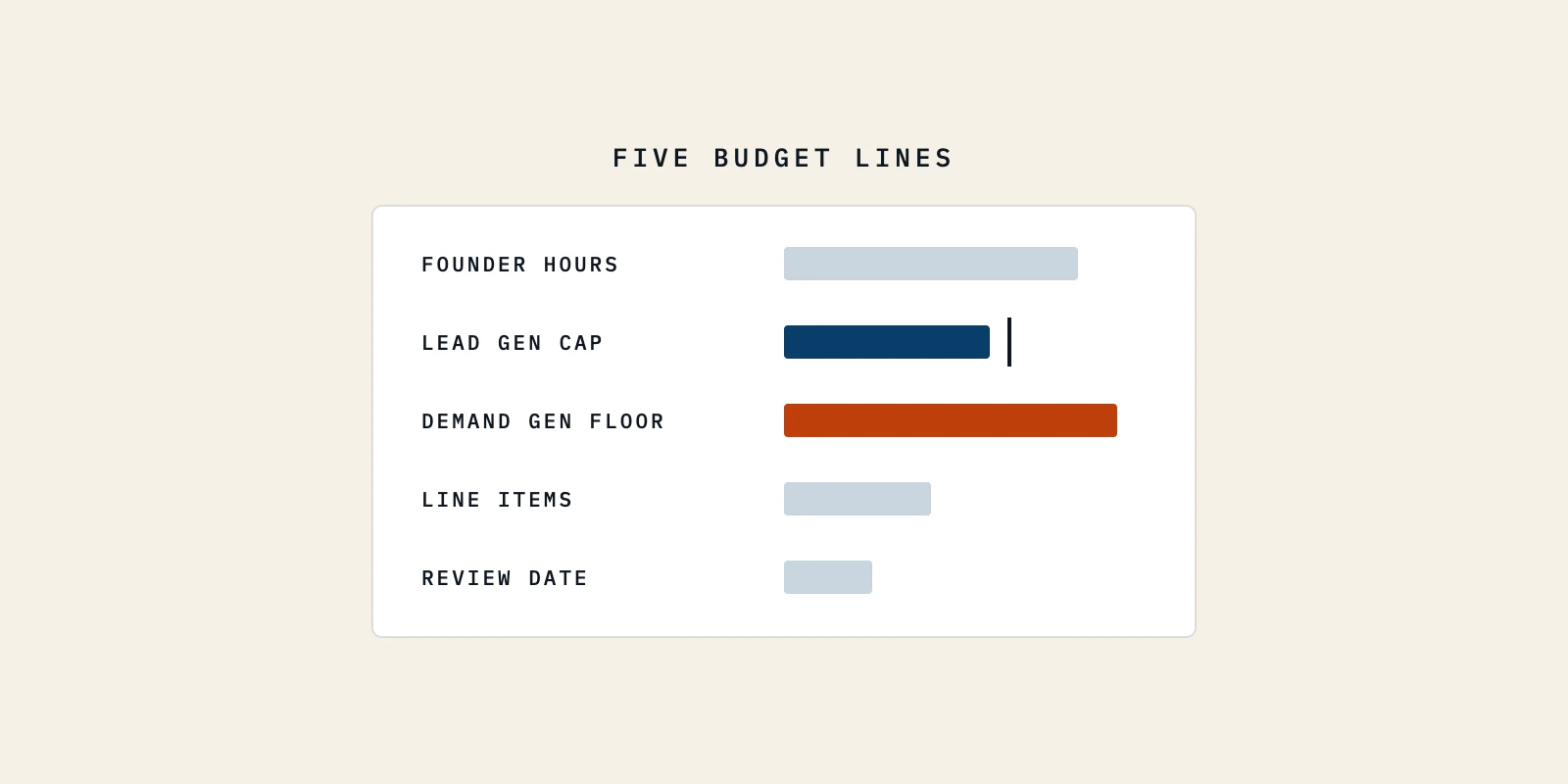
A small B2B budget splits into five lines. Founder hours come first, then a capped lead generation line for visible demand, a fixed demand generation floor, vendor-priced line items, and a quarterly review date. The 60/40 rule comes from consumer advertising. The B2B figure is 50/50, and both assume paid media. The worksheet comes before paying a B2B demand generation agency.
Your first customers came from old colleagues, friendly operators, or people who already trusted you. Then that network went quiet, and every B2B marketing budget allocation guide started from revenue you do not have.
Demand generation is the work that makes buyers who are not shopping yet know you and trust you, so you are on the list when they start. That matters when you have a few thousand dollars a month, not a mature revenue base to multiply.
When I checked Google US on 23 Sep 2026, the page-one answers for this problem were built for companies with revenue. Forrester says the average B2B firm invests 8% of revenue in marketing, and Grey Matter reports Gartner's 7.8% figure.
Those benchmarks are useful later. I would not use them to decide what to do with $3,000 a month while the founder still writes the emails, joins the calls, and carries the customer language in their head.
In this blog I'll walk you through the five-line worksheet I use, why the 60/40 rule misleads a budget this size, what a few thousand dollars buys on each side, and how to stop the demand generation line from being cut first.
How Should a Bootstrapped B2B Founder Split a Small Marketing Budget?
I would cap lead generation at the demand that already exists, give demand generation a fixed floor, and treat founder hours as the largest line. On most small budgets, I want demand generation to get the larger cash share because the market has not heard from you yet.
That answer sounds uncomfortable because lead generation feels more measurable. I get the appeal. If someone asks, is lead generation worth it, the honest answer is yes when buyers already show intent and no when you try to force a tiny market to produce more buyers than it has.
When I checked Google US on 23 Sep 2026, 9 organic results for B2B marketing budget allocation were editorial benchmark or allocation guides, and 0 service pages appeared in that observed top-10 result set. That gap matters because the pages explain percentages, not the founder's cash constraint.
| Budget Line | Who It Reaches | What It Costs to Run | When It Pays Back | How I Judge It | What Happens If You Cut It |
|---|---|---|---|---|---|
| Lead generation line | Buyers already searching, replying, or comparing | Contact data, outbound tooling, review-site work, and bottom-of-funnel search engine optimization pages | Weeks when the demand exists | Replies, calls, qualified conversations, and customer acquisition cost | You lose visible opportunities, but the market still knows the same amount about you |
| Demand generation line | Buyers who fit but are not shopping yet | Founder time, editing, newsletters, community work, and consistent publishing | Quarters, not weeks | Conversations, branded search, newsletter replies, and sharper sales calls | You create a silent future pipeline gap that shows up later |
The split is not a moral choice between patience and revenue. It is a cash control system. Lead generation captures today's visible intent; demand generation creates familiarity before the buyer enters a buying motion.
I also do not treat customer acquisition cost as a single blended number too early. With a small budget, I want to see which line caused the conversation, which line warmed it up, and which line merely booked the meeting.
A Five-Line Budget Worksheet for Demand Generation and Lead Generation
Write the budget as five lines in this order, and the split between demand generation and lead generation falls out of the first three. I do not start with a percentage because a startup marketing budget breaks when it copies a company with a sales team, a brand, and a known funnel.
This is the worksheet I would use for a bootstrapped software team with $3,000 a month set aside. It works better than a generic B2B SaaS marketing budget template because it forces the founder's time into the same conversation as cash.
1. Write Down Founder Hours Before the Dollars
Founder hours belong inside the budget because they are the scarcest line. If the founder writes one useful post, records one customer-led teardown, or sends one careful email to a named account, that is not free.
I would not repeat a full time-budgeting method here because we already have a guide on how to budget a pre-revenue week in founder hours. For this worksheet, I only need one rule. If the task needs the founder's judgment, it gets written down before any tool does.
This matters for demand generation because the founder usually holds the sharpest point of view. An editor can tighten the argument. A newsletter tool can send it. Neither can invent the painful customer problem the founder heard on sales calls.
For a SaaS startup marketing budget, I would write founder hours as the first line even after first customers exist. The company may have cash, but the market still trusts founder specificity more than polished campaign language.
2. Cap Lead Generation at the Demand You Can Already See
Lead generation should not get a blank check. I cap it at the demand already visible in search suggestions, commercial keyword volume, inbound replies, and sales conversations.
The search numbers show why. Ubersuggest US showed B2B marketing budget allocation at 30 searches, startup marketing budget at 30 searches, B2B SaaS marketing budget at 30 searches, and SaaS startup marketing budget at 10 searches on 23 Sep 2026. A query set that small cannot absorb a large capture budget.
That does not make lead generation useless. It means I would fund the pages, lists, and outreach needed to meet the visible market, then stop before I pretend more buyers exist.
Pro tip: Put the demand generation floor on a separate card or sub-account. In a slow reply month, the easiest mistake is raiding the patient line to buy more of the urgent line.
3. Give Demand Generation a Floor That Does Not Move Month to Month
The demand generation floor is the part of the budget you do not touch during a quiet week. It pays for the habit of showing up where future buyers can learn what you believe, what you reject, and why your product exists.
I prefer a fixed floor because a founder spending savings will otherwise cut the slowest-paying line first. That feels rational in the moment, but it creates a start-stop pattern that the market never notices.
The floor can include editing founder-written posts, keeping the newsletter alive, and giving the founder room to appear in communities or podcasts. The line should stay boring. Boring is the point.
4. Price Every Line From a Vendor Page, Not a Benchmark
Benchmarks do not tell you what you can buy on Monday. I price each line from current vendor pages, then decide the split. If I cannot verify a vendor price, I do not put the dollar into the worksheet.
That rule matters because tool prices change often. Before I commit a dollar to Apollo.io, LinkedIn Sales Navigator, G2, Capterra, beehiiv, Substack or a freelance editor, I check the vendor's current pricing page and write that figure into the worksheet.
I can still use one priced signal. Ubersuggest US showed a $46.56 CPC for B2B demand generation agency on 23 Sep 2026, which tells me one commercial click can consume meaningful budget fast on a small account.
5. Set the Review Date Before You Spend the First Dollar
The review date protects the budget from mood. I would set a quarterly review date before the first purchase, then decide which signals count for lead generation and which signals count for demand generation.
For lead generation, I review replies, meetings, qualified conversations, and customer acquisition cost. For demand generation, I review newsletter replies, branded search, repeat conversations, and better sales-call language.
Say you run a three-person developer-tools company with $3,000 a month set aside. I would fill the worksheet like this before buying a tool or hiring help.
| Line | Hours | Dollars | What It Buys | Review Date |
|---|---|---|---|---|
| Founder hours | Written before cash | Part of the $3,000 a month decision | Founder-written points of view, customer language, and named-account follow-up | Quarterly |
| Capped lead generation | Founder approves targets | Part of the $3,000 a month, capped by visible demand | Contact research, direct outreach, review-site work, and bottom-of-funnel pages | Quarterly |
| Fixed demand generation floor | Founder supplies the raw material | Part of the $3,000 a month, protected from monthly cuts | Editing, newsletter publishing, community presence, and repeated buyer education | Quarterly |
| Vendor-priced line items | Only the hours needed to run them | Enter only prices checked on current vendor pages | Tools and services that support the first three lines | Quarterly |
| Review and reallocation | Founder owns the decision | No separate spend unless a tool is bought | A written decision on what stays, pauses, or moves | Quarterly |
This worksheet is not elegant, but it is hard to fool. It makes the marketing mix visible because founder labor, capture work, brand awareness work, tools, and review discipline all sit in one place.
Why the 60/40 Rule Misleads Small B2B Budgets
The 60/40 rule marketing answer gets misused because it sounds precise. The original 60/40 split comes from Binet and Field's consumer advertising work. The LinkedIn B2B Institute's own B2B figure is 50/50, and both describe paid media budgets at established brands.
Perplexity on 23 Sep 2026 told a bootstrapped B2B founder to use 60% demand generation and 40% lead generation and credited it to LinkedIn. I would not use that answer for a founder spending $3,000 a month.
• The 60/40 Split Was Built on Consumer Advertising
Binet and Field's The Long and the Short of It, published by IPA in 2013, presents a 60/40 brand-to-activation balance from 996 campaigns, 700 brands, and 83 categories. That is not the same problem as a founder deciding what to do next week.
The useful lesson is not the exact split. The useful lesson is that short-term activation and long-term brand awareness behave differently, so I should not ask one line to do the other's job.
• The B2B Figure Is 50/50 and Assumes Paid Media
The LinkedIn B2B Institute says to balance long-term brand building and short-term sales activation with a 50/50 split, using IPA Databank 1998–2018 B2B cases. That is closer to B2B, but still not a small founder cash plan.
A bootstrapped team usually does not have a paid media budget to split. It has founder hours, a few tools, content help, and sales follow-up. That is a different marketing mix.
• What Still Carries Over to a Bootstrapped Budget
The idea that brand awareness compounds still carries over. Demand generation needs repeated exposure, not one heroic post, because buyers need to remember you before they need you.
Dawes and the Ehrenberg-Bass Institute argue that 95-5 means most B2B buyers are out of market at a given time, so demand creation vs demand capture cannot be judged on the same week.
| Rule | Source | Built From | What It Splits | Fit for a $3,000-a-Month Team |
|---|---|---|---|---|
| 60/40 | Binet and Field, IPA, 2013 | 996 campaigns, 700 brands, 83 categories | Brand and activation in consumer advertising | Poor as a literal split, useful as a warning against starving demand generation |
| 50/50 | LinkedIn B2B Institute | IPA Databank 1998–2018 B2B cases | Long-term brand building and short-term sales activation | Better category fit, but still assumes paid media |
| 95-5 | Dawes and Ehrenberg-Bass Institute | B2B buyer in-market timing | Market state, not budget | Useful reminder that demand generation pays back later |
I use these rules as guardrails, not as a spreadsheet formula. If a rule ignores founder hours, vendor prices, and visible search demand, it is too blunt for this stage.
What a Few Thousand Dollars a Month Buys in Lead Generation
On a small budget, lead generation cash buys contact data and outbound tooling, review-site listings, and a handful of bottom-of-funnel search pages. I leave paid search out because one commercial click can be too expensive for a founder-funded test.
Ubersuggest US showed a $46.56 CPC for B2B demand generation agency on 23 Sep 2026. I read that as a warning, not a media plan.
• Contact Data and Outbound Tools
Contact data can help if the founder already knows the right segment and can write a specific reason to talk. It wastes money when the team buys a list before it can explain why the account should care.
I would connect this line to founder-led sales, not treat it as outsourced demand. If you have not done the work behind founder-led sales starts with 30 calls, a tool will mostly let you make vague messages faster.
• Review Site and Directory Listings
Review sites and directories can support lead generation because buyers already comparing vendors may check them. I do not count those listings as demand generation unless they teach the buyer something before a comparison begins.
The founder should decide which category language matters before paying for any profile work. That keeps the line tied to customer acquisition cost instead of vanity exposure.
• Bottom-of-Funnel Search Pages
Search engine optimization can be a lead generation line when it targets bottom-of-funnel pages. I mean pages for comparison, pricing objections, integration questions, and painful use cases that buyers already search.
A few pages can work better than a broad blog calendar at this stage. I would rather answer one commercial objection clearly than publish a dozen generic awareness posts.
| Line Item | Vendor | Price | What You Get | When It Stops Paying |
|---|---|---|---|---|
| Commercial paid search click | Search platform market price observed through Ubersuggest | $46.56 CPC for B2B demand generation agency on 23 Sep 2026 | One click on a commercial B2B term | Immediately after the click, unless the page converts |
| Outbound contact data | Apollo.io or LinkedIn Sales Navigator, after checking current pricing | Check the vendor's current pricing page | Names and contact paths for accounts you already understand | When targeting or message quality is weak |
| Review-site presence | G2 or Capterra, after checking current pricing | Check the vendor's current pricing page | A comparison surface for buyers already evaluating options | When no buyer reaches the category page |
| Bottom-of-funnel pages | Internal or hired writing help, after checking current pricing | Check the vendor's current pricing page | Search pages that answer active buying questions | When rankings fade or the offer changes |
This is why I do not ask lead generation to carry the whole month. It can catch real intent, but it cannot create a market that does not know the problem yet.
What a Few Thousand Dollars a Month Buys in Demand Generation
Demand generation cash mostly buys help around the founder's own voice, including editing, a newsletter tool and list, and time spent where buyers already learn. I keep the money close to the message because that is what the market remembers.
The mistake I see in a small budget is buying production before the point of view exists. A clean design cannot rescue a vague claim.
• An Editor for Founder-Written Content
An editor is often a better early demand generation purchase than another tool. The founder brings the sharp claim, the customer story, and the unpopular opinion. The editor makes it readable enough to travel.
I would price the editor from a current vendor page or a published rate source before adding the dollar figure to the worksheet.
• A Newsletter to a Named-Account List
A newsletter can act like account-based marketing when the list is built around named accounts, not random subscribers. The point is not audience size. The point is repeated, useful contact with the people your sales motion already cares about.
If the newsletter is the chosen line, I would use the guides on how to start a newsletter that wins first customers and choosing beehiiv or Substack before buying anything.
Pro tip: Write the named-account list before choosing the newsletter tool. If the list is fuzzy, the tool choice will feel productive while the demand generation work stays unfocused.
• Podcast and Community Appearances
Podcast and community appearances cost less in cash than in preparation. The founder needs a point of view, a simple story, and enough repetition to become recognizable.
I would not treat these appearances as a content tour. I would treat them as buyer education. If the founder cannot name the audience and the pain, the appearance belongs outside the budget.
| Line Item | Price | Founder Hours It Still Needs | When It Starts Showing Up |
|---|---|---|---|
| Editor for founder-written content | Check the vendor's current pricing page | Founder drafts the argument and approves the final point | After repeated publishing creates recognizable language |
| Newsletter tool and named-account list | Check current beehiiv or Substack pricing | Founder chooses the accounts and writes from sales conversations | After repeated sends create replies and remembered problems |
| Podcast and community appearances | Check the vendor's current pricing page | Founder prepares the angle and follows up with buyers | After buyers hear the same clear point more than once |
Demand generation is not the place to hide from sales. I want the founder close enough to hear which phrases land, which claims confuse people, and which problems earn replies.
How to Protect the Demand Generation Line When Leads Are Slow
Protect demand generation by deciding the minimum run before you start, cutting lead generation spend first when cash gets tight, and moving founder hours before moving dollars. This is hard because demand generation can show almost nothing in the first months.
A founder spending savings feels that every week. I do not minimize that pressure. I just do not want one bad reply week to erase the only line that helps future buyers know you.
1. Decide the Minimum Run Before You Start
The minimum run should be written before the budget begins. If the demand generation line can be canceled after one quiet month, it was never really funded.
I use the quarterly review date as the first serious checkpoint. That does not guarantee success, but it stops the founder from changing the plan every time the inbox feels light.
2. Cut Lead Generation Spend First When Cash Gets Tight
If cash gets tight, I cut the most expandable lead generation spend before I cut the demand generation floor. That sounds backwards until you remember that lead generation is capped by visible demand.
If the visible market is small, extra capture spend may only add noise. Keeping the demand generation floor alive protects the future market while the founder tightens the current one.
3. Move Founder Hours Before You Move Dollars
Founder hours can move before dollars do. If newsletter replies matter more this month, the founder can spend more time there. If sales calls reveal a pricing objection, the founder can turn that into a bottom-of-funnel page.
The cash floor stays stable while the founder's attention shifts. That gives the plan some flexibility without turning the budget into a weekly argument.
Pro tip: Write a one-sentence kill rule for each line. I like rules tied to buyer behavior, not mood, because mood gets loud when savings are on the line.
This is the part of B2B marketing budget allocation that most benchmark guides skip. The problem is not only where money goes. The problem is keeping the right line alive long enough to learn anything.
Where a B2B Demand Generation Agency Fits in a Bootstrapped Budget
A demand generation agency becomes a budget line after one channel works in-house and founder hours, not cash, are the constraint. I would not use an agency to replace the founder's voice at this stage.
If you are still testing the category, the message, and the buyer, the agency will ask for inputs you do not have yet. If one channel already works but the founder cannot keep carrying it, help can make sense.
• After One Channel Works In-House
I want one channel to show signs of life before outside help enters the marketing mix. That could be a newsletter that earns replies, a search page that brings qualified calls, or a founder post that starts real conversations.
The channel does not need to be mature. It does need enough evidence that the team knows what kind of demand generation it wants to repeat.
• When Founder Hours Are the Constraint, Not Cash
The right moment is often when the founder can write the argument but cannot keep editing, publishing, repurposing, and following up. That is a capacity problem, not a strategy blank.
Before hiring, I would read what a demand generation agency costs you and the threshold test for a first marketing hire. Those are separate decisions, and I would not collapse them into one anxious purchase.
• Never as a Replacement for the Founder's Voice
A B2B demand generation agency should help sharpen, package, and distribute what the founder knows. It should not invent a personality for the company.
For a bootstrapped founder, that distinction matters. If the agency can only operate when the founder disappears, the output will drift toward safe language that buyers ignore.
Fill In the Five-Line Worksheet Before Next Month's Spend
I would fill in the five-line worksheet before you buy a list, a tool, or a B2B demand generation agency. Write down founder hours, cap lead generation at visible demand, protect a fixed demand generation floor, price each vendor line from a current page, and set the quarterly review date before the money leaves the account.
If you want help turning founder knowledge into demand generation without paid ads, Better Marketing builds trust through content, then runs outreach to win first customers.