

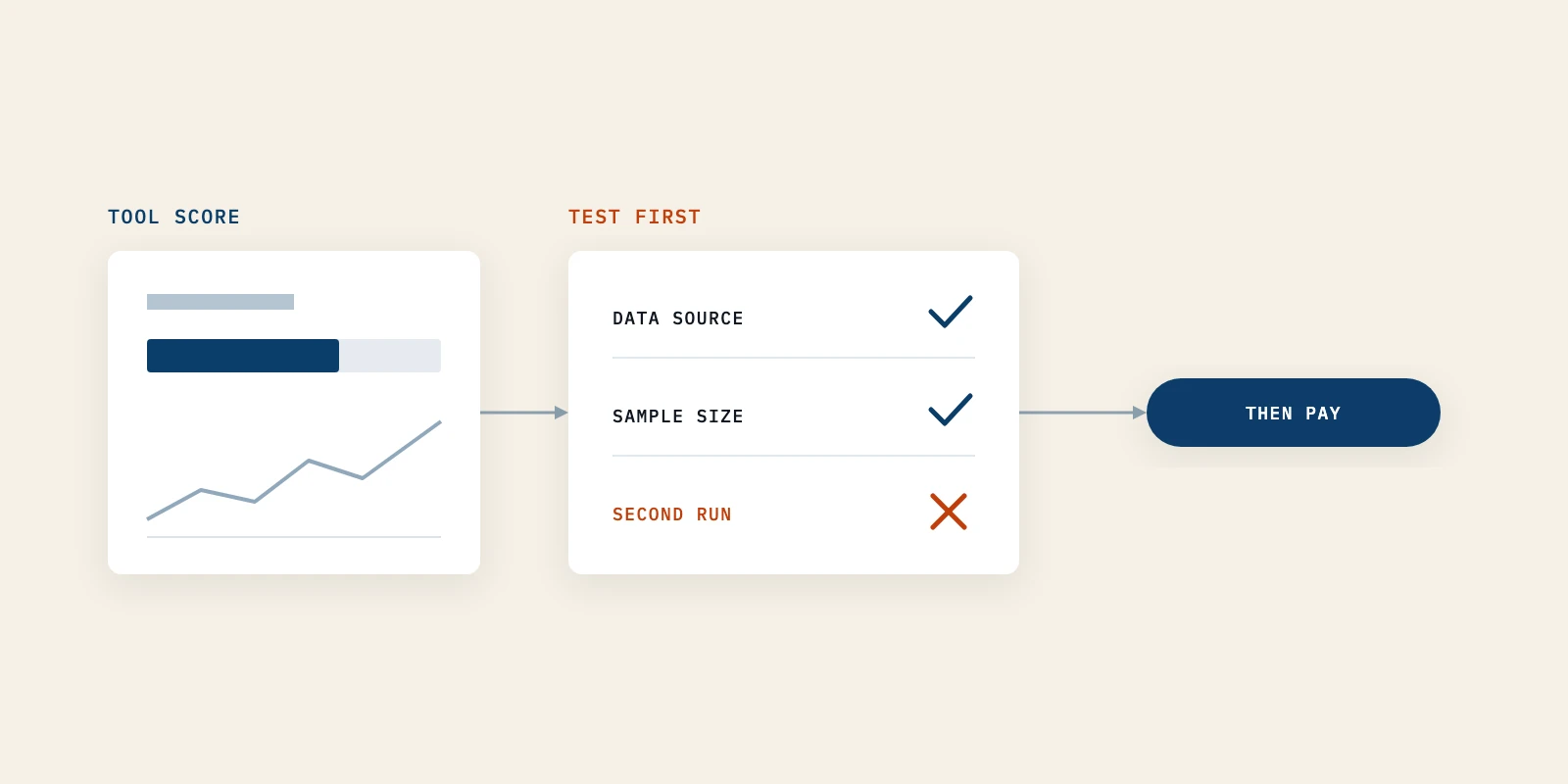
Quick Answer
An AI visibility tool sends a fixed set of prompts to assistants such as ChatGPT, Perplexity and Google's AI Overviews on a schedule, then scores how often your brand is mentioned or cited. Before paying, ask where its data comes from, how it reaches Google, how many prompts it samples, who chose them, and what a second run shows. Google Search Console and Bing Webmaster Tools now report part of this for free.
The pitch usually arrives as a screenshot. Your brand's score sits beside three competitors, with a trend line and a red cell where a rival shows up in ChatGPT and you do not.
It looks like rank tracking, and it lands in the same budget line. The trouble is that the number is only as good as the method under it, and most demos never show the method.
Two tools can look at the same brand in the same week and disagree, because they asked different questions on different days. This covers the six questions that expose the method, the two free first-party reports that already do part of the job, and the point where paying starts to make sense.
Six Questions to Ask an AI Visibility Tool Before Paying
Ask six questions before you pay for an AI visibility tool, and treat a vague answer to any one of them as a reason to wait. Together they cover where the numbers come from, how they were collected, and what they are made of.
Each question has a good answer and a bad one. None of them needs you to understand how a model works, only to insist that the vendor explains its own work in plain terms.
1. Where the Data Comes From
The first question is the source of every number on the dashboard. An AI visibility tool can collect answers by calling a model's API, by driving the consumer app your buyer actually uses, or by sending queries to a search engine and reading what comes back.
Each route produces a different object. An API response is not guaranteed to match what your buyer sees in the ChatGPT app, which may search the web or draw on that person's history, so ask which one the tool measures and why.
Google is blunt about the whole category. Its guidance on third-party SEO tools names AEO and GEO tools directly, says Google does not evaluate third-party services, and points you to its own first-party tool, Search Console.
"Third-party tools don't have access to our internal ranking data." — Google Search's guidance on using third-party SEO tools, services, and advice
A good answer names the collection method for each engine and admits what it cannot see. A bad answer says "proprietary" and moves to the next slide. The common mistake is assuming a number on a vendor dashboard came from the engine itself.
2. How It Collects AI Overview Data
Ask this one separately, because AI Overviews live inside Google Search and Google has a written rule about how you get at them. Google's spam policies define machine-generated traffic as sending automated queries to Google, including scraping results for rank-checking purposes without express permission.
The same policy says such activity violates both the spam policies and Google's Terms of Service. A tool that tracks AI Overviews by firing automated searches at Google is building its numbers on access Google says it never granted.
A good answer describes a permitted data route, or says plainly that the tool does not cover AI Overviews. A bad answer changes the subject. We looked at the wider policy in Google calling AI answer manipulation spam, and the same logic holds here: a measurement built on a violation is fragile before it is anything else.
3. The Sample Size Behind Every Score
Every score is a sample, so ask how big it is: how many prompts, run how many times each, on how many days. A small set run once a week can swing on a single answer, and a swing that size looks exactly like a trend on a chart.
Take a simple case. If a tool asks twenty questions and your brand appears in four, one answer changing moves your result by five points in either direction, and nothing about your brand has changed.
A good answer gives exact counts and runs each prompt more than once. A bad answer quotes the number of engines and skips the number of prompts. The common mistake is comparing two months without knowing the sample behind either.
4. Who Wrote the Prompt Set and Why
The prompt set decides the score more than the brand does. Generic category prompts measure a market your pipeline may never search, and prompts that name your brand make you look visible by construction.
Ask to see the full list and who picked it. The prompts should read the way your buyers talk: the problem they have, the comparison they are making, the objection they raise before a first call.
A good answer lets you edit the list and keeps the old version, so trends stay comparable after a change. The common mistake is letting a vendor's default list stand in for your buyer.
5. What Happens When You Run It Twice
Ask for the same prompts run twice on the same day, and look at how far the answers move. AI answers are not fixed, and Bing says so about its own system: its notes on its citation data say patterns shift with user behavior, evolving models, freshness signals and partner refresh cycles.
That is the engine's owner describing its own answers. If a tool cannot show how much a result varies between identical runs, it cannot tell you whether next month's movement is real.
A good answer reports a range, or an average across repeated runs. A bad answer reports one number to a decimal place, which is precision the method does not have. The common mistake is reacting to a change smaller than the noise.
6. What the Score Is Made Of
Ask for the formula. A dashboard score usually blends mentions, citations and share of voice against named competitors, and each vendor weights those parts differently, so two correct scores can still disagree.
Share of voice deserves the hardest look, because it depends entirely on which competitors the tool decided to count. Bing draws the same line in its own reporting, describing its citation share as an observational metric rather than a ranking system or a competitive scoreboard.
A good answer shows each component on its own and lets you ignore the blend. The common mistake is putting a blended score in a board deck without being able to say what moved it.
An AI Visibility Tool Measures a Sample, Not a Ranking
An AI visibility tool measures whether you appear inside an answer, not where you sit on a page. A rank tracker checks a position on a list of ten links, while an AI visibility tool runs a prompt set against a group of engines on a schedule and counts mentions, citations and sometimes sentiment.
That difference is why the work has its own name, generative engine optimization, or GEO. Traditional SEO earns you a position. GEO earns you a mention, and there's no page two to fall back on.
It's also why your rank data can't tell you how you're doing in ChatGPT, and why the tools disagree with each other. Three variables drive most of that disagreement:
- The prompt set, meaning which questions the tool asks on your behalf.
- The sampling frequency, which can be daily, weekly or on demand.
- The engine coverage, meaning which of ChatGPT, Perplexity, Gemini, Copilot and AI Overviews it actually checks.
Change any one of them and the score changes, with nothing about your brand having moved. What the score can't show is the cause, and the cause is almost always a page that answered the question better than the alternatives.
That's why content marketing for tech companies does more for the number than any dashboard can. The tool reads the result. It never produces it.
Search Console and Bing Webmaster Tools Report AI Visibility Free
Two first-party reports now show part of your AI visibility for free, and they come from the engines rather than from a sample. Google launched Search Generative AI performance reports in Search Console on 3 June 2026, and its announcement notes they reached all websites worldwide on 31 August 2026.
The reports show impressions from generative AI features such as AI Overviews and AI Mode, plus the pages that appeared, countries, devices and dates. The announcement lists no query view, so you see which pages surfaced, not which prompts surfaced them.
Bing got there first. It introduced AI Performance in Bing Webmaster Tools as a public preview on 10 February 2026, counting how often your pages are cited in Microsoft Copilot, AI-generated summaries in Bing and select partner integrations.
Bing's report also shows grounding queries, the phrases the AI used when it retrieved your content, which is the closest any engine comes to showing you the prompts. Bing describes that data as a sample of overall citation activity, and in June 2026 it added a citation share view for each grounding query.
| What you need | Search Console | Bing Webmaster Tools | Paid AI visibility tool |
|---|---|---|---|
| Cost | Free | Free | Monthly subscription |
| Engines covered | AI Overviews, AI Mode, Discover | Copilot, Bing summaries, partners | Whatever the vendor samples |
| Where the data comes from | First-party, from Google | First-party, from Microsoft | The vendor's own collection |
| Prompts or queries shown | None listed | Grounding queries, sampled | The vendor's prompt set |
| ChatGPT and Perplexity | Not covered | Not covered | Usually the reason to buy |
| Competitor view | None | Citation share, no names | Share of voice |
Read the table from the bottom up. The free reports can't see ChatGPT or Perplexity and won't name a competitor, and that gap is the honest case for paying for anything.
Everything above that row is already yours. Set both reports up before a sales call, and you'll know which questions the vendor has to answer and which ones Google and Microsoft have answered for them.
A Manual Prompt Check Answers the First Question Free
You can answer the question most founders are really asking, whether you show up at all, with an afternoon and a spreadsheet. A manual check won't give you a neat score, but it gives you a baseline you understand line by line, which no AI visibility tool demo can.
- Write ten prompts the way your buyers talk: the problem, the comparison, the objection. Leave your brand name out.
- Run each one in ChatGPT, Perplexity, Gemini and Google Search, in a private window where the product allows it, and note when an AI Overview appears.
- Record each result as cited with a link, named without one, or absent, and save which sources were cited instead of you.
- Run the same set a week later, with the same wording in the same order.
- Compare by engine and by prompt rather than by a total, and treat one flipped answer as noise until it repeats.
It's the same shape Better Marketing uses inside its AI SEO service: a fixed set of ten buyer prompts, re-run on a schedule, with each result recorded as cited with a link, named without one, or absent. It is coarser than a dashboard, and it produces a series you can actually compare.
The limit is worth stating. A manual check is small, so it tells you where you are absent far more reliably than it tells you how much you've grown.
When Paying for an AI Visibility Tool Makes Sense
Pay for an AI visibility tool when the manual check has become the bottleneck, not before. Three signals usually mark that point:
- You publish every week and need to see which new pages start being cited.
- You track more than five competitors and the spreadsheet has stopped being readable.
- You need an alert when an answer about your category changes, not a snapshot you remember to take.
Even then, buy it for the engines the free reports can't see. Search Console and Bing Webmaster Tools already cover Google's AI features and Copilot, so a paid sample earns its place on ChatGPT and Perplexity, where no engine publishes your numbers or your grounding queries.
There's also a case where no tracking spend makes sense at all. If you have few pages worth citing, a dashboard will measure your absence precisely every week, and the money does more on the pages. We made the same argument about the AI search number vendors leave out: size the channel before you fund it.
And if your problem is pipeline this quarter, no visibility tool reaches it. That's a job for a B2B demand generation agency running founder-led outreach, while search work compounds in the background.
The same standard applies to people as to software. An AI SEO service worth hiring should be able to say where every one of its own numbers comes from, in exactly the terms you'd ask of a tool.
Buy the Method Before You Buy the Dashboard
An AI visibility tool is a sample of answers dressed as a ranking. Make it explain its data, its access to Google, its sample, its prompts, its repeat runs and its formula. Start with Search Console and Bing Webmaster Tools, add a manual check, and pay only for what those can't see.
The number moves when the pages do, which is why content marketing for tech companies is the input and the dashboard is only the readout. If you want the pages and the pipeline built together, Better Marketing runs the search work and the B2B demand generation agency side as one system.