

Quick Answer
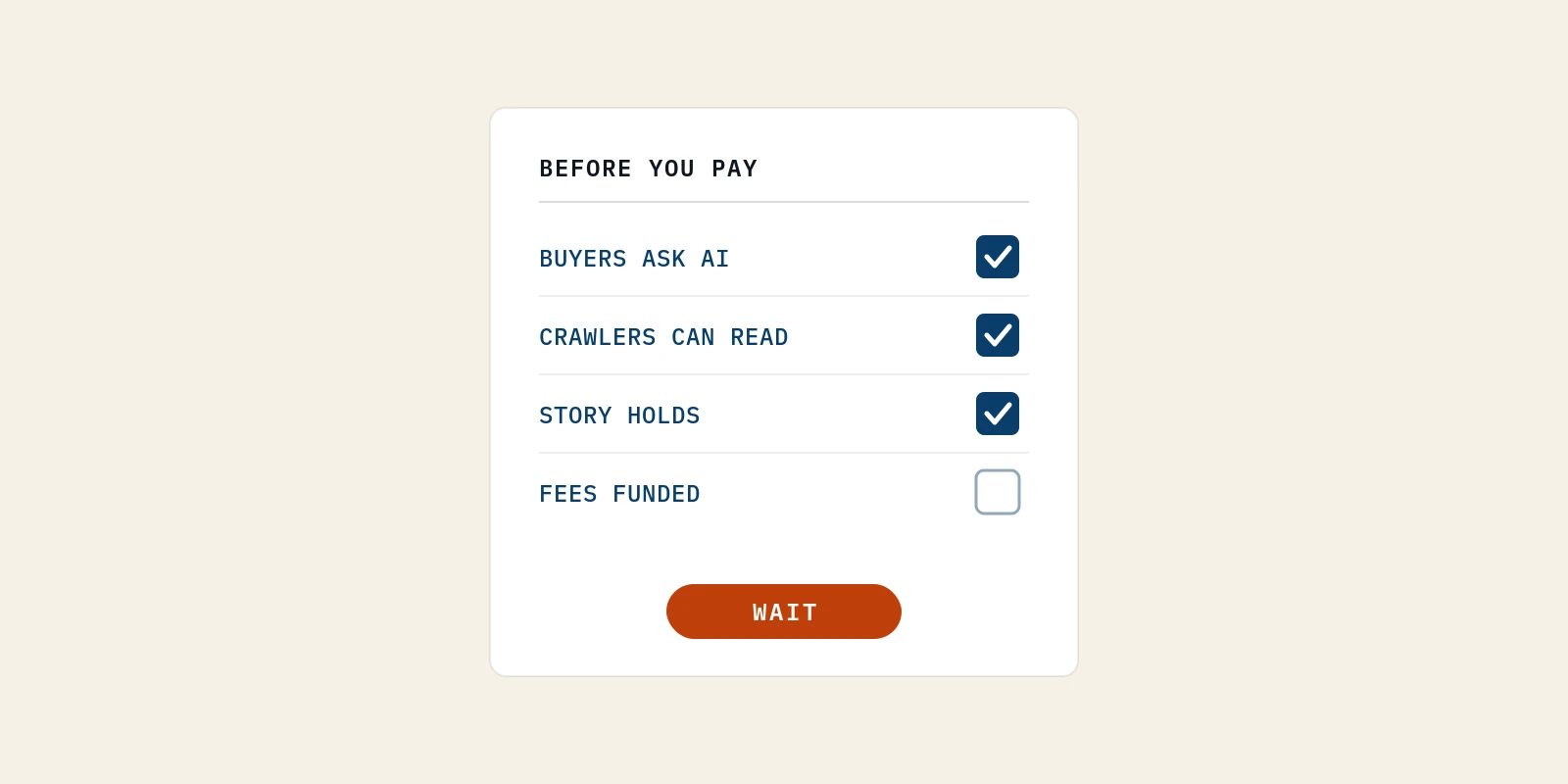
Most seed-stage SaaS teams should run generative engine optimization in-house for about 90 days before paying for AI SEO service work. Paying makes sense once four signals hold. Buyers shortlist vendors through AI answers, AI crawlers can read the site, positioning stays stable and six months of fees fit. Published US prices start near $3,000 a month, and WebFX's entry plan totals $19,800 over its six-month minimum.
Generative engine optimization is the work of getting your company named, and described correctly, when tools like ChatGPT or Google's AI features answer a buyer's question. It's the job most vendors now package as AI SEO services.
If you run a seed-stage SaaS company, the pitch may have reached you before the demand did. An agency shows you a screenshot where ChatGPT recommends a competitor, and a board member asks why.
I think the worry is fair, but the timing usually isn't. I'd tell most seed-stage teams to do the early work themselves, with a clear trigger for when to start paying.
In this blog I'll cover the four signals that say it's time to pay, what these services sell and what they cost. I'll also cover what to run in-house first and what to ask on a sales call.
Pay for AI SEO Services Only When These Four Signals Line Up
I'd pay for AI SEO services only when all four signals below are true at the same time. If two or more are false, I'd keep generative engine optimization in-house and spend the money where deals already come from.
Each signal has a free check. None of them needs a vendor's dashboard.
1. Your Buyers Already Use AI Answers to Shortlist Vendors
The first signal is demand. Generative engine optimization only pays off if your buyers ask an AI tool which vendor to pick in your category.
Across software buyers overall, the answer is increasingly yes. G2's 2026 buyer research found that 51% of B2B software buyers now start research with an AI chatbot more often than with Google. It also found 71% use one at some point.
That's a market average, not your market. I check the category directly in three ways:
Ask your last ten customers or late-stage prospects what they typed, and where, before they found you.
Add ChatGPT and Perplexity as options to the "how did you hear about us" field on your demo form.
Compare AI referrals with Google organic in your analytics.
Keep the size of that last number in view. Our read of Cloudflare Radar data put four AI assistants at 0.73% of tracked search and AI referrals in the 28 days to September 19, 2026. Those were ChatGPT, Claude, Gemini and Perplexity combined, while Google held 90.15%.
If none of your recent deals mention an AI tool, this signal is false for now. That's a reason to wait, not a reason to panic.
2. AI Crawlers Can Read Your Site Without Running JavaScript
The second signal is access. If the crawlers behind AI answers can't read your pages, no retainer fixes that until someone fixes the site.
Two checks cover most of it. First, open your robots.txt file and confirm it doesn't block OAI-SearchBot.
OpenAI's crawler documentation says OAI-SearchBot is the bot used to surface websites in ChatGPT search results. It's controlled separately from GPTBot, the crawler tied to model training.
Second, look at your raw HTML, not the rendered page. A web crawler that doesn't run JavaScript sees only what your server sends. We walk through that test in our guide to how AI crawlers read raw HTML.
HubSpot hit this exact problem. In Aja Frost's account of HubSpot's AI search experiments, the pricing pages were rendered with JavaScript. AI tools pulled HubSpot's prices from outdated third-party sites instead.
I'd make this fix before hiring anyone. It's usually a developer task, not a marketing one.
3. Your Positioning Has Held Still for Two Quarters
The third signal is a stable story. A large language model can only repeat a clear description of you if one exists across your site, your review profiles and your founder's LinkedIn.
Maybe you've changed your category, ICP or headline in the last six months. Then you haven't reached the product-market fit that generative engine optimization can amplify. An agency will only spread the current draft further.
My test is simple. Write the one sentence you want ChatGPT to say about you. Then check that your homepage, pricing page and G2 or Capterra profile all say roughly the same thing.
If they don't agree, fix that first. It costs an afternoon, not a retainer.
4. Six Months of Fees Fit Without Cutting the Channel That Closes Deals
The fourth signal is budget, measured over the minimum term rather than the first invoice. Generative engine optimization compounds slowly, and many contracts are built around that.
Companies like WebFX require a six-month commitment. Its entry Silver plan totals $19,800 over those six months when I checked on September 28, 2026.
I'd only spend that if it doesn't come out of the channel that sources most of your pipeline today. For a lot of seed-stage teams, that channel is founder-led outbound or referrals.
Here's the math I run. Divide six months of fees by your average first-year contract value. That tells you how many new customers the service has to produce just to break even.
Say your first-year contract is $12,000 and the service costs $19,800 over six months. You need two new customers from AI answers to cover it, from a channel that may be under 1% of your referrals today.
| Signals that are true | What I'd do |
|---|---|
| All four | Shortlist two or three providers and run the sales-call questions below |
| Three | Fix the missing one in-house, then check again in 30 days |
| Two or fewer | Run generative engine optimization in-house for 90 days and keep the budget in the channel that closes deals |
Pro tip: Put the four signals in your board deck as a dated checklist. It turns "why aren't we in ChatGPT?" into a plan with a clear trigger for spending.
Two Different Jobs Are Sold Under the Name AI SEO Services
The label AI SEO services covers two different jobs, and I'd confirm which one you're buying before comparing prices. One uses AI tools to do search engine optimization faster. The other is generative engine optimization, which aims to get you cited and recommended inside AI answers.
• AI-Assisted SEO Makes the Old Work Faster
AI SEO services can be described as the use of AI to improve a website's visibility in organic search results. That's classic SEO with faster research, drafting and audits.
It can be worth buying. It just won't change what ChatGPT says about you.
• Generative Engine Optimization Changes Where You Appear
A bunch of companies sell visibility inside ChatGPT, Perplexity and Google's AI Overviews under nearly the same label. When I searched "AI SEO services" on September 28, 2026, Google's own AI Overview blended both meanings into one summary.
I've argued before that ranking now comes with a second job of getting quoted. That second job is the one this decision is about.
| AI-assisted SEO | Generative engine optimization | |
|---|---|---|
| What changes | How fast the SEO work gets done | Where your brand appears inside AI answers |
| Typical deliverables | Keyword research, content drafts and audits produced with AI tools | Prompt tracking, crawler access fixes, consistent company facts, third-party mentions |
| What the report shows | Google rankings and organic traffic | Citations and mentions across AI tools, plus AI referral traffic |
| Who it suits | Teams already winning on Google who want more output | Teams whose buyers shortlist vendors through AI answers |
Most proposals mix the two. That's fine, as long as the contract for any AI SEO service says how many hours go to each.
The wording won't tell you. An AI SEO agency, an AI SEO company and a shop selling LLM SEO services can all be selling the first job under new names. Real generative engine optimization services should name the prompts, the AI tools and the fixes they'll ship.
What AI SEO Services Cost on Published US Price Lists
Published US prices for AI SEO services start around $3,000 a month for advisory work and run past $9,000 a month on larger plans. Most providers don't publish prices at all, so the few that do are the best anchor I've found for generative engine optimization budgets.
• Price Lists That Publish Their Scope
These are the published numbers I found on September 28, 2026:
| Provider | What's published | Six-month cost at that tier |
|---|---|---|
| Better Marketing | $1,499 a month for one channel, $2,499 for two, $3,499 for all three (Search & AI Visibility, LinkedIn & X, Newsletter & Email Growth); every plan includes a named campaign lead, strategy, human-written content, execution and reporting every two weeks | $8,994 for one channel, $14,994 for two or $20,994 for three |
| WebFX Silver | $8,600 for the first two months, then $2,800 a month; six-month commitment; 100 prompts and up to 30 pages | $19,800 |
| WebFX Diamond | $21,400 for the first two months, then $9,200 a month; 250 prompts and up to 60 pages | $58,200 |
| Optimist | Roadmap from $7,500; retainers from $3,000 a month for advisory or $4,000 a month for full service | $18,000 advisory or $24,000 full service, before any roadmap |
| Profound (a tool, not a service) | Free trial of 50 prompts a day for seven days across ChatGPT, Gemini and Google AI Overviews; enterprise pricing is custom | $0 for the trial week |
| Google Search Console and Bing Webmaster Tools | Free AI performance reports | $0 |
The unit I compare is the prompt list and the page count, not the monthly fee. A $2,800 month that covers 100 prompts and 30 pages is a very different purchase from an advisory retainer built around strategy calls.
• Price Ranges You Should Treat as One Vendor's View
Optimist puts the wider market at about $2,500 a month at the entry level and $12,000 a month or more for enterprise retainers. It lists Siege Media from around $11,000 a month.
I'd treat both as one agency's reading of its competitors. On the same page, iPullRank and Intero Digital show no public price at all.
Keep AI SEO packages in the same frame. A package price means little until you know which of the two jobs it pays for.
Pro tip: Ask every provider to quote the first six months as one number. That's the figure your board will compare against a hire.
What I'd Run In-House for 90 Days Before Paying Anyone
I'd run five pieces of generative engine optimization in-house for 90 days before paying for outside help. Together they take a few founder hours a week and tell you which of the four signals are true.
• Start With the Free AI Reports in Search Console and Bing
Google added Search Generative AI performance reports to Google Search Console on June 3, 2026. Google says they reached all websites worldwide on August 31, 2026, and they show impressions inside AI Overviews and AI Mode.
Bing went earlier. AI Performance in Bing Webmaster Tools launched in public preview on February 10, 2026. It counts how often Copilot and Bing's AI summaries cite your pages.
We compared these free reports with paid dashboards in six questions to ask an AI visibility tool.
• Ask the Prompts Your Buyers Ask and Log the Answers
Write 20 prompts in your buyers' own words, pulled from sales calls and demo notes. Run them in ChatGPT, Perplexity and Google once a week, and log who gets named.
A spreadsheet is enough for the first month. If you want a faster baseline, Profound's free trial runs 50 prompts a day for seven days.
• Fix the Facts AI Tools Get Wrong About You
HubSpot found AI tools quoting wrong prices and fixed it with plain pricing posts written for bots. Frost reports accuracy improved for five of six products within two months.
For the sixth product, her team corrected outdated prices on third-party sites. You can run a small version of that. Update your listings on the review sites and directories an AI answer cites when it describes you.
• Publish Pages Only Your Team Can Write
HubSpot's clearest win came from pages built for one industry and use case at a time, drawn from its own case studies. Frost reports that 92% of those pages were eventually cited, and visibility rose 49%.
Your version might be three pages, not 141. What matters is that each one answers a buyer question with product detail only you have.
• Skip the Tactics Nobody Has Shown Working
HubSpot's first experiment was an llms.txt file. Its server logs showed no bot visits, and the AI tools didn't know the details planted inside it. I'd skip llms.txt until someone publishes new evidence.
Here's what I take from HubSpot's story. The company staffed this work with two of its own SEOs meeting daily, and the wins needed product knowledge more than tools.
Pro tip: Add "Which AI tool, if any, did you use to research vendors?" to your discovery call script. Ten answers will tell you more than a month of dashboards.
Questions I'd Ask a Generative Engine Optimization Agency on the First Call
I'd ask five questions on the first call with any generative engine optimization agency, because the published roundups won't screen vendors for you. On September 28, 2026, I read the "best AI SEO agencies" lists ranking on Google.
To its credit, Optimist says so openly. Every list like it is still a sales page.
1. Ask Which of the Two Jobs the Retainer Pays For
Get the split in hours. If most of the time goes to AI-written content, you're buying faster SEO, not generative engine optimization.
Classic SEO shops often sell three different jobs under one name, and AI search offers repeat the pattern.
2. Ask Who Writes the Prompt List and From What Source
A good answer names your sales calls, support tickets or search data. A weak answer is a generic list reused across clients.
3. Ask What Ships in the First 60 Days
I want fixes and pages in that window, not only a baseline report. Crawler access, consistent company facts and a handful of pages are realistic.
4. Ask for a Client Result Measured in Pipeline
A citation screenshot proves visibility, not revenue. Ask for one named client where AI visibility showed up in deals. Then check it the way we suggest in how to audit a SaaS SEO case study.
5. Ask What You Keep If You Cancel
Pages, prompt logs and page markup should stay yours. If the tracking lives only in the agency's dashboard, your baseline leaves with them.
What Generative Engine Optimization Can Realistically Deliver in Six Months
In six months, generative engine optimization can realistically fix how AI tools describe you and get a few pages cited. I rarely expect it to become a main pipeline source for a seed-stage company in that window.
Google's guidance keeps expectations grounded. Its documentation on AI features says AI Overviews and AI Mode carry no extra requirements beyond normal SEO best practices.
HubSpot's timeline shows the order things happen. ChatGPT's crawler logged about 15,000 crawls of the new pages within a few weeks, while citations sat around 16% before climbing.
Frost sums it up as crawls first, then citations, then visibility. HubSpot also reports qualified leads from AI search rose 1,850% over the year.
I'd read that as proof the channel can matter at scale, not as a benchmark for a 10-person company. HubSpot started with years of domain authority, so I'd expect a young domain to move slower.
Run the Four-Signal Test Before You Sign an AI SEO Service Contract
An AI SEO service is worth paying for once four things are true. Buyers shortlist through AI answers, crawlers can read your site, your positioning holds and six months of fees fit. Until then, I'd run generative engine optimization in-house. Switch on the free reports, log real buyer prompts, fix wrong facts and publish pages only you can write.
Check the four signals again every quarter. If you'd like a second opinion on where your team stands, Better Marketing works with early-stage software founders on exactly this.