

Quick Answer
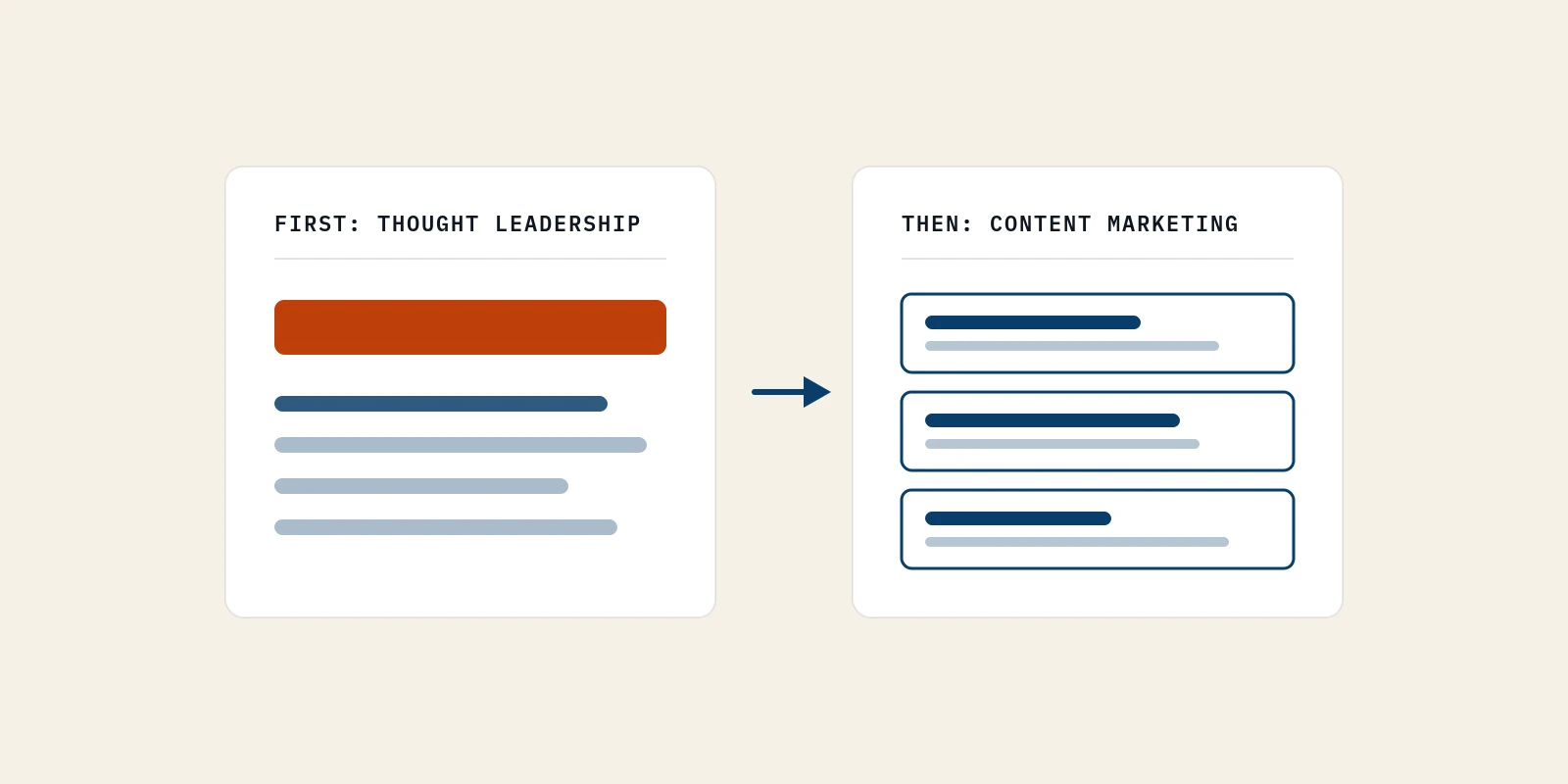
Content marketing for tech companies captures buyers already searching, while thought leadership changes how an enterprise buying group frames its problem. For a seed SaaS selling to enterprise, thought leadership usually earns trust first, but only when it rests on proof. Start with one founder-written point of view each week. Then build content marketing pages from the questions it draws, sized to the founder hours you can protect.
Thought leadership is a published argument about your buyer's problem that they have not heard before, backed by something you know first-hand. Content marketing is the wider job of answering questions buyers already ask.
The mistake I'd warn seed founders against is merging the two into one plan called "post more." Six months later the blog holds 20 posts. No enterprise buyer has mentioned one on a call. The cost is real, because every hour spent writing is an hour not spent selling.
In this blog I'll cover how the two differ inside an enterprise deal and a five-question test for which to fund first. I'll also cover what each costs in founder hours and how to run both without a marketing team.
Should a Seed SaaS Start With Thought Leadership or Content Marketing?
Start with thought leadership if you sell to enterprise and can prove one specific claim about your buyer's problem. Start with content marketing if buyers already search for your category by name and you have no proof yet. That is my default answer for a seed team.
The reason is who you are selling to. An enterprise deal is decided by a group, not a person.
The 2025 Edelman and LinkedIn B2B Thought Leadership Impact Report found that 53% of B2B decision-makers say strong thought leadership makes brand recognition matter less. A seed company has almost no brand recognition, so that is the gap you need to close first.
Content marketing still matters. It just pays back later for a company nobody searches for yet. When I checked Ubersuggest on 2 October 2026, "content marketing vs thought leadership" drew about 40 US searches a month. Your own category term may draw fewer, or none.
| Your situation | Fund first | Why |
|---|---|---|
| Enterprise buyers, a sharp claim you can prove, no search demand for your category | Thought leadership | Buyers need a reason to trust a small vendor before they search for it |
| Buyers already search your category name or your competitors by name | Content marketing | Demand exists, and pages that answer it can rank and get cited |
| No proof yet and no search demand | Neither at full speed | Sell first, write down what you learn, publish once you have evidence |
| A founder with under 2 protected hours a week | Content marketing pieces sales can reuse | Point-of-view writing needs focused founder time that you do not have |
Pro tip: If you cannot state your claim in one sentence that a prospect could disagree with, you are not ready for thought leadership yet. Keep selling and keep notes.
How Content Marketing and Thought Leadership Differ Inside an Enterprise Deal
Content marketing answers questions buyers already ask, and thought leadership gives them a question they had not thought to ask. I find that framing more useful than "awareness vs conversion," because it tells you what to write on Monday.
Here is how I separate them for a seed SaaS team selling to enterprise. This is the thought leadership vs content marketing table I'd use.
| Dimension | Content marketing | Thought leadership |
|---|---|---|
| Job in the deal | Answers a known question | Reframes the problem |
| Starting point | A query, a sales question, a competitor name | A claim you can defend with first-hand evidence |
| Who writes it | Anyone who knows the product | The founder, or someone who sat in the sales calls |
| Who it reaches | The person researching a solution | The whole buying group, including people sales never meets |
| Proof it needs | Accuracy | Evidence nobody else has |
| First signal | Search impressions and AI citations | A prospect quoting your idea back to you |
| Failure mode | Pages nobody needs | Opinions nobody believes |
1. They Answer Different Questions
Content marketing starts from demand that already exists. Wikipedia describes content marketing as creating and distributing content for a targeted audience online. In practice, I build each piece around one question a buyer types or asks on a call.
Thought leadership starts from a claim. The thought leadership content I'd want from a seed founder makes one sharp claim. For example, a founder might write, "The metric your team reports to the board is the wrong one, and here is what we saw." It gives the buyer a new question.
2. They Reach Different People in the Buying Group
This is the difference most guides skip. An enterprise purchase runs through a buying center made up of users, budget owners, finance, legal, security and procurement. Many of them never join a sales call.
Edelman's 2025 report calls these people hidden buyers. In Edelman's summary, 71% of hidden buyers say they have little or no interaction with sales teams. Yet 63% spend more than an hour a week reading thought leadership.
That changes my advice. Content marketing mostly reaches the person who searched. B2B thought leadership can reach the finance lead who will never take your call, if your champion forwards it.
It also gets you into the room. In the 2024 Edelman and LinkedIn report, 86% of decision-makers said they would likely invite a steady publisher of strong thought leadership into a request for proposal.
3. They Need Different Proof
Content marketing needs to be correct and clear. Thought leadership needs evidence nobody else has, such as a pattern from 30 discovery calls or numbers from a pilot.
Without that evidence, a point of view reads as noise. In my view, proof is where most seed founders stall, because selling leaves little time to collect it.
4. They Pay Back on Different Clocks
Content marketing compounds slowly through Google rankings and AI answers. A new domain can wait months for steady impressions. My guide to content marketing for startups built around AEO shows how to make each page answer one question.
Thought leadership can show a signal within weeks, because it travels through people. The 2024 Edelman and LinkedIn report found 75% of decision-makers say a piece of thought leadership led them to research a product they were not considering.
5. They Fail in Different Ways
Content marketing fails quietly. You publish pages, nobody searches for them, and you learn nothing for six months.
Thought leadership fails loudly. A weak opinion gets ignored, or worse, a buyer sees through it. I prefer the loud failure at seed stage, because it tells you faster that your claim is wrong.
A Five-Question Test for Which One to Fund First
I'd run this test before planning any thought leadership content strategy. Score each question 0 or 1. A score of 4 or 5 means thought leadership first, 2 or 3 means a mix, and 0 or 1 means content marketing first.
| Question | Score 1 if… | Score 0 if… |
|---|---|---|
| Search demand | Nobody searches your category name yet | Buyers already search it monthly |
| Proof | You can show evidence from calls, pilots or data | You have opinions but no evidence |
| Founder hours | You can protect 3 or more hours a week | You have under 3 hours a week |
| Buying group | Four or more roles sign off on a deal | One buyer decides alone |
| Sales cycle | Deals take 3 months or more | Deals close in weeks |
1. Check How Many Buyers Already Search for the Category
Run your category name through Google autocomplete and a keyword tool. If nothing comes back, the market has not named your problem yet. I explained why that is a positioning signal in my post on zero search volume.
2. Count the Proof You Can Show Today
List every claim you could make, then cross out each one you cannot back with a call note, a pilot number or a screenshot. What survives is your thought leadership. If nothing survives, I'd score it 0 and keep selling.
3. Measure the Founder Hours You Can Protect
Look at your calendar for the last four weeks, not the one you wish you had. Count the blocks of 90 minutes or more with no meetings. I treat that count as the real writing budget.
4. Map Who Sits in the Buying Group
Write down every role that touched your last three enterprise deals. If security, finance and procurement appear, you need pieces that reach people you will never meet. I'd lean toward thought leadership a champion can forward.
5. Look at How Long Your Sales Cycle Runs
Long cycles give an idea time to spread inside a company, which is why I weight this question. The Edelman 2025 report page cites research that more than 40% of B2B deals stall because of internal misalignment. A long cycle is where a forwarded argument does its work.
Say you sell a data compliance tool to banks. Nobody searches your category, you have pilot data from two banks, you protect 4 hours a week, five roles sign off, and deals take 6 months. That scores 5. Thought leadership comes first.
What Thought Leadership Costs a Founder in Hours Each Week
Thought leadership costs founder hours more than money. I plan for roughly 3 to 4 focused hours a week for a founder who publishes one argument and one forwardable asset. That is my planning budget, not a benchmark, and your speed will vary.
The CMI and MarketingProfs 2026 B2B Content and Marketing Trends report found that 96% of B2B marketers say their organization creates thought leadership content. It also found 39% name resource constraints as a top challenge. Even full marketing teams run short on time.
| Piece | Who writes it | My hour budget per week | What it does |
|---|---|---|---|
| One point-of-view essay | Founder drafts, editor tightens | 2 hours | States the claim with evidence |
| Two short posts cut from the essay | Editor drafts, founder approves | 30 minutes | Spreads the claim on LinkedIn |
| One forwardable asset per month | Founder and sales | 1 hour a week, spread across the month | Gives hidden buyers something to read |
• The Point-of-View Essay
This is where your founder led marketing starts, and it is not personal branding for its own sake. I write the claim in one sentence first, then add the evidence, then add what the buyer should do differently. The essay works on your site and as a long LinkedIn post.
• The Short Post Built From the Essay
Each essay holds two or three smaller ideas. An editor or a freelancer can pull them out as short posts. My post on LinkedIn strategy explains why staying on one subject matters more than posting volume.
• The Proof Asset Sales Can Forward
Edelman's 2025 hidden buyer data shows 57% of hidden buyers prefer quick takeaways over dense reports. So I keep this asset short, using a one-page brief, a short benchmark or a teardown. This is the B2B thought leadership content that reaches people outside the call. The champion should be able to forward it to finance without editing it.
Pro tip: Record a 20-minute voice memo after your best sales call each week. That memo often holds most of your next essay, and it costs you no extra writing time.
Why Most Thought Leadership Fails Enterprise Buyers (and the Proof It Needs)
Most thought leadership fails because it has opinions without evidence. In the 2024 Edelman and LinkedIn report, only 15% of decision-makers rated the quality of the thought leadership they read as very good or excellent.
The problem is not new. The 2021 Edelman and LinkedIn study found 71% of decision-makers say half or less of it gives them valuable insight. Even Wikipedia's entry on thought leaders notes that some writers treat the phrase as annoying jargon.
Google's own guidance on helpful, people-first content asks if a page shows first-hand expertise. That test applies to buyers too.
• Opinions With No Evidence
"AI will change compliance" is not a claim anyone can argue with. A claim with a count behind it, such as what most of your last 30 discovery calls said, is. I only publish the second kind.
• Reframes Buyers Have Already Heard
Edelman's 2025 report summary says 86% of hidden buyers favor perspectives that challenge their assumptions. If your point is the same one every analyst made last quarter, it does not count. I check the top results on Google and on Perplexity before I write.
• Pieces a Champion Cannot Forward
A clever LinkedIn thread rarely survives a forward to procurement. A one-page brief with sources does. I write every important argument so it survives that forward, because thought leadership that only works in the feed never reaches the people who veto deals.
How to Run Content Marketing for Tech Companies and Thought Leadership With No Team
You can run both with one founder, one part-time editor and a shared document. The trick is to make thought leadership the source and content marketing the second use. ChatGPT gave similar advice when I asked it on 2 October 2026, but it skipped the founder-hours cost and the proof problem.
This is the loop I recommend for content marketing for tech companies at seed stage.
1. Write One Point of View per Week From Sales Calls
Pull your claim from the week's calls. If you are still running those calls yourself, my guide to founder-led sales for technical founders covers the first 30.
2. Log Every Question the Essay Draws
Prospects and peers will reply with questions. I'd put each one in a single spreadsheet with the date and the role of the person who asked.
3. Turn Repeat Questions Into Content Marketing Pages
When a question shows up three times, I turn it into a page. This is your SaaS content marketing strategy in its simplest form, with real questions answered once and reused by sales.
4. Build One Asset for the Hidden Buyers
Each month, write one short piece for finance, security or procurement, such as a one-page case study with numbers they can check. My post on why enterprise deals die before meeting two looks at what goes wrong early in those deals.
5. Review the Library Every 90 Days
Cut or merge pages nobody reads. My process for a content audit on a small SaaS blog works here too.
Pro tip: Put your one-sentence claim at the top of every essay. If an AI answer engine or a busy CFO reads only that line, they still get the point.
Which Metrics Show Thought Leadership and Content Marketing Are Working
Thought leadership shows up in conversations before it shows up in dashboards, while content marketing shows up in search data first. I track them on separate scorecards so neither gets judged by the other's numbers.
The CMI 2026 report found 33% of B2B marketers name measuring effectiveness as a top challenge. Separate scorecards make that easier.
| Metric | Content marketing | Thought leadership |
|---|---|---|
| Early signal (weeks 1 to 8) | Impressions in Google Search Console | Replies and DMs from target accounts |
| Middle signal (months 2 to 6) | Clicks and citations in AI answers | Prospects quoting your claim on calls |
| Pipeline signal | Demo requests from ranked pages | "How did you hear about us?" answers naming your posts |
| Warning sign | Pages with zero impressions after 6 months | Engagement only from peers, never from buyers |
For the pipeline row, I rely on one question on the demo form. I walk through it in my guide to self-reported attribution.
Start With One Argument You Can Prove This Week
For most seed SaaS teams selling to enterprise, I'd put thought leadership first and let content marketing follow from it. Run the five-question test, protect your writing hours, and publish one claim you can back with evidence.
Then turn the questions it draws into content marketing for tech companies that sales can reuse. Review both every 90 days. If you want a second pair of eyes on your first claim, Better Marketing helps early-stage software founders with exactly this.