
Quick Answer
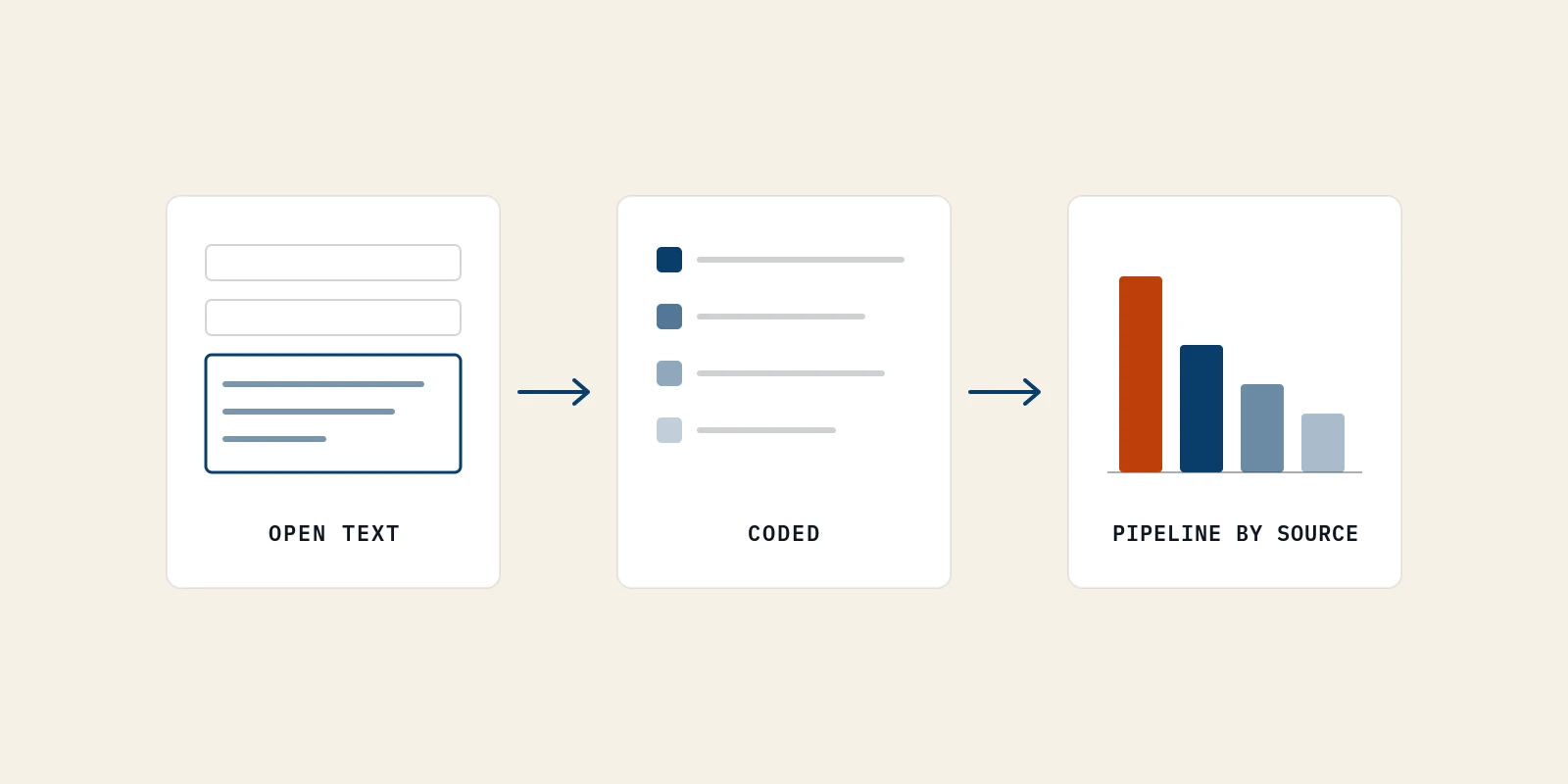
A seed-stage team can run self-reported attribution with one open-text question on the demo form, the same question on the first sales call, and a monthly pass that codes each answer into about eight categories tied to opportunities. Shares say little below 30 to 40 coded answers. The board slide should show pipeline by stated source, the unknown rate and the answer count, and the same report is worth requesting from any B2B technology marketing agency.
Self-reported attribution means asking every buyer, in their own words, where they first heard of you, then counting those answers against real pipeline. I think it is the most useful measurement a seed-stage team can add this quarter.
Here is the problem it solves. Your board asks where pipeline comes from, and your CRM says "direct traffic" or "organic search" for most deals. Nobody in the room believes it, including you.
Attribution software was built for teams with thousands of tracked clicks. At seed, you might close a handful of deals a quarter, and many of them started in a conversation no pixel saw.
In this blog I'll cover the setup, why it catches what analytics misses, and how many answers you need. Then I'll show how I handle vague answers and build the board slide.
How I Set Up Self-Reported Attribution in Five Steps Before the Next Board Meeting
I set up self-reported attribution with one open-text question at two moments, two fields in the CRM, and a monthly coding pass tied to opportunities. The whole setup takes an afternoon, and the first useful read arrives after one quarter.
Most guides stop at "add a form field." The field is step one of five, and the other four decide if the data survives a board meeting.
1. Put One Open-Text Question on the Demo Form
I add a single "how did you hear about us" question to the demo or contact-sales form. I word it as "Where did you first hear about us?" so people name the first touch, not the page they just clicked.
I use open text, not a dropdown. When Ruler Analytics inspected one client's form data, 47% of leads who picked the first option in the list were attributed to the wrong channel.
On a "how did you hear about us" form field, I mark it optional but put it high on the form. A required field adds friction on your highest-intent page, and a field buried last gets skipped.
2. Ask It Again on the First Call and Log the Exact Words
The founder or seller asks the same question in the first five minutes of every discovery call. Buyers say far more out loud than they type into a box.
Then I log the answer word for word the same day. "A friend at another startup mentioned you after your podcast episode" is worth much more than a dropdown value.
Pro tip: I phrase the call version as "Before you found our site, where had you first come across us?" The "before" stops people from answering "Google" out of habit.
For product-led signups, a one-question "how did you hear about us" survey on the welcome screen does the same job. I keep the wording identical everywhere so the answers stay comparable.
3. Store the Raw Answer and a Coded Category in the CRM
In the CRM, I create two fields on the contact, the raw answer and a coded category. HubSpot and Salesforce both let you add a custom text field and a dropdown field in minutes.
I never overwrite the raw answer. Categories change as you learn, and the raw words are what let you re-code six months of answers later.
I copy both fields onto the opportunity when it is created. Self-reported attribution only earns its place when it sits next to pipeline dollars, not next to lead counts.
4. Code Every Answer Into Eight Categories Once a Month
Once a month, I read every new answer and assign one category. This is ordinary coding, the same process social scientists use to turn open-ended responses into countable groups.
I keep the list short. Eight categories plus an unknown bucket is enough for a company with fewer than 100 opportunities a year.
| Category | What counts | Example raw answers (illustrative) |
|---|---|---|
| Referral or word of mouth | A named person, customer, investor or colleague | "My old VP uses you", "Our investor suggested it" |
| Founder or team social | LinkedIn, X or YouTube posts by your people | "Been reading your CEO's posts" |
| Search | A search engine, with or without a term | "Googled SOC 2 automation for startups" |
| AI assistant | ChatGPT, Claude, Perplexity, Gemini | "ChatGPT listed you when I asked for options" |
| Community | Slack groups, Reddit, forums, meetups | "Someone in a founders Slack mentioned you" |
| Content | Newsletter, podcast, article, webinar | "Your newsletter issue on pricing" |
| Outbound | Your email, call or DM reached them first | "Your rep emailed me" |
| Event or partner | Conferences, integrations, agencies, marketplaces | "Found you in the HubSpot marketplace" |
| Unknown | Blank, "online", "internet", gibberish | "Online", "..." |
Demand Spring's glossary entry estimates that most teams spend about two hours a month categorizing responses. At seed volume, I would expect it to take less than that.
5. Tie Each Answer to an Opportunity and Its Pipeline Dollars
The last step is the one that makes self-reported attribution useful to a board. I report stated source by opportunity count, pipeline dollars and closed-won revenue, not by leads.
Demand Spring makes the same point. The channels that show up disproportionately in won deals matter more than the channels with the most mentions. I agree, and I go one step further. I compare won and lost deals by stated source every quarter.
Why Self-Reported Attribution Sees Channels Your Analytics Misses
Self-reported attribution catches the conversations, recommendations and posts that never produce a trackable click. Software-based B2B marketing attribution can only credit what it saw, so it hands those deals to the last visible touch.
That blind area is what people call the dark funnel. Word-of-mouth marketing, podcasts and private communities all live there.
• The Gap Can Be Very Large
In a 12-month Refine Labs study published in April 2023 of 620 declared-intent conversions and $21.5 million in closed-won ARR, podcasts were credited with 53% of revenue by self-reported answers. Software attribution credited them with 0%.
AI assistants show the same pattern today. Graphite's June 2026 analysis of n8n's data found GA4 last-touch credited roughly 1% of conversions to AI answers, while n8n's post-conversion survey credited roughly 9%.
The reason is simple. According to Graphite's same analysis, 90% of those AI-driven conversions never clicked a citation link, so they landed in GA4 as direct traffic. The same undercount explains why AI search looks tiny in referral data.
• The Two Methods Answer Different Questions
I don't treat self-reported attribution as a replacement for tracking. I treat it as a second instrument pointed at a different part of the journey.
| Question | Self-reported attribution | Software attribution |
|---|---|---|
| What it records | The touch the buyer remembers as the start | The clicks and sessions it could track |
| Sees word of mouth, podcasts, communities | Yes, if the buyer names them | Rarely, they arrive as direct or branded search |
| Sees which ad, keyword or page converted | No | Yes |
| Works with a few dozen deals | Yes, with wide error bars | Poorly, models need volume |
| Main weakness | Memory, vague answers, blanks | Blind to anything without a click |
• Your Own Mix Decides What Shows Up
Self-reported answers mirror your go-to-market. HockeyStack's report, published in December 2025, covers 8,528 answers from mostly mid-market and enterprise software brands.
In HockeyStack's data, search drew 45% of mentions, social 20% and word of mouth 18%.
Podcasts drew only 12 mentions in HockeyStack's dataset, even though 46% of the companies had a podcast. So I never borrow another company's mix as a benchmark. Your answers describe your market, nobody else's.
How Many Self-Reported Attribution Answers You Need Before a Number Means Something
I don't act on a self-reported attribution share until I have at least 30 to 40 coded answers, and I prefer two quarters of data. Below that, a single deal can swing a channel's share by double digits.
This is where most seed-stage reports go wrong. They show "LinkedIn at 40%" from ten answers, and the board makes a budget call on noise.
1. Count Coded Answers, Not Form Fills
Self-reported attribution is a small self-report study, and like any survey it loses people along the way. The response rate on the field is only the first cut.
Dreamdata ran the test on 100 demo requests. About 70 people filled the field, and only 49 answers were usable.
HockeyStack found roughly 20% of its responses were invalid or too generic to use. Ruler Analytics counted 72% of its demo answers as vague or missing. I plan for half of form fills to become coded answers, and I let the call question make up the gap.
2. Read Every Share Through a Margin of Error
A channel share from a small sample carries a wide margin of error. I use the standard rough formula for a proportion at 95% confidence to show the board how wide.
| Coded answers | A channel at 30% could really be |
|---|---|
| 10 | about 2% to 58% (plus or minus 28 points) |
| 20 | about 10% to 50% (plus or minus 20 points) |
| 40 | about 16% to 44% (plus or minus 14 points) |
| 100 | about 21% to 39% (plus or minus 9 points) |
These are my own calculations using the normal approximation, which is itself loose at very small counts. The point holds anyway because at 10 or 20 answers, you cannot rank channels that sit close together.
Pro tip: I put the answer count in the slide title, such as "Pipeline by stated source (n = 34)." Board members read the n before they read the chart.
3. Wait for Two Quarters Before Moving Budget
I treat one quarter as a hypothesis and two quarters in the same direction as a signal. Budget moves wait for the signal.
This matches how I think about any small-number metric, including counting attempts per incremental customer. When a channel holds its share across two quarters, I shift hours toward it in the budget split.
What to Do When Self-Reported Attribution Answers Say Google, Online or Nothing
When self-reported attribution answers come back vague, I ask a follow-up on the call, keep an honest unknown bucket, and separate "first heard" from "why now." Vague answers are normal, not a sign the method failed.
"Google" is the most common problem answer. It could mean a paid ad, an organic result, a branded search after a podcast, or a guess.
• Ask a Follow-Up on the Call
When the form says "Google," the seller asks, "What did you search for?" The search term usually reveals the real first touch.
If they searched your company name, they had heard of you already. I recode that answer after one more question about where the name came from.
• Keep an Unknown Bucket and Report Its Size
I never force a vague answer into a real category. "Online", "internet" and blanks go to unknown, and I report the unknown share on the slide.
A rising unknown share tells me the question needs work. It is also the most honest line on the page.
• Split First Heard From Why Now
Recall bias pulls answers toward the latest or most memorable touch. A buyer who saw your founder's posts for a year may still write "ChatGPT" because that was the final nudge.
So I ask one second question on the call, "What made you reach out this month?"
HockeyStack suggests a similar follow-up, asking how prospects got to the site today and if that differs from how they first found you.
On "how did you hear about us" options, I avoid preset lists for the same reason. A list tests the buyer's patience, not their memory.
Pro tip: I read the raw answers from lost deals too. When lost deals cluster in one source, that channel is attracting people who are not ready to buy.
What the Self-Reported Attribution Slide in Your Board Deck Should Show
The self-reported attribution slide should show opportunities, pipeline and closed-won revenue by stated source, the unknown share, and the number of coded answers. Three plain sentences underneath explain what changed and what you will do.
I keep it to one slide. A board wants a view of where demand starts, not a dashboard tour.
1. One Table of Opportunities and Pipeline by Stated Source
Here is the layout I use. The numbers below are a hypothetical illustration for a seed-stage company, not real data.
| Stated source | Opportunities | Pipeline | Closed-won ARR |
|---|---|---|---|
| Referral or word of mouth | 9 | $270,000 | $60,000 |
| Founder or team social | 7 | $190,000 | $24,000 |
| Search | 5 | $120,000 | $18,000 |
| Outbound | 8 | $150,000 | $0 |
| Unknown | 5 | $90,000 | $12,000 |
Before the CRM fields exist, a simple "how did you hear about us" tracking sheet with the same columns works fine. I move it into the CRM once there are more than 20 opportunities.
2. The Unknown Share and the Number of Coded Answers
Two numbers sit under the table, the count of coded answers and the unknown share. In the illustration above, that is 34 answers and 15% unknown.
These numbers tell the board how much weight the table can carry. I would rather show a small n honestly than defend a confident chart later.
3. Three Sentences on What Changed and What You Will Do
I end with three sentences. What moved since last quarter, what I think explains it, and the one change we will make.
For example, "Referrals produced the most won revenue for the second quarter running. Outbound creates opportunities that stall. We are moving four founder hours a week from outbound to customer intros." I track the same numbers next to the other early signals in my post on demand generation vs lead generation.
What to Ask a B2B Technology Marketing Agency to Report Alongside Self-Reported Attribution
If you hire a B2B technology marketing agency, I would ask for self-reported attribution in its monthly report, next to its tracked numbers. An agency that reports only last-click results is grading its own homework with the tool that sees least.
Here is what I would put in the contract or the first-month plan.
• The Raw Answers, Not Only the Categories
I ask to see the raw answers, not a pie chart. The words show if the agency's work is being remembered by buyers.
• Pipeline by Stated Source, Not Leads by Last Click
I ask for opportunities and pipeline by stated source every month. Leads by last click reward whatever channel sits closest to the form.
• The Unknown Rate and the Answer Count
I ask for the unknown share and the n on every report. If the agency hides either, I assume the table is thinner than it looks.
Add the Question This Week and Show the First Slide Next Quarter
Self-reported attribution costs one form field, one call question and an hour a month, and it shows where demand starts before any software can. I would add the question this week, code answers monthly, and hold budget moves until two quarters agree.
Ask the same of any B2B technology marketing agency you hire. If you want help turning those answers into a channel plan, Better Marketing works with seed-stage founders on exactly this.