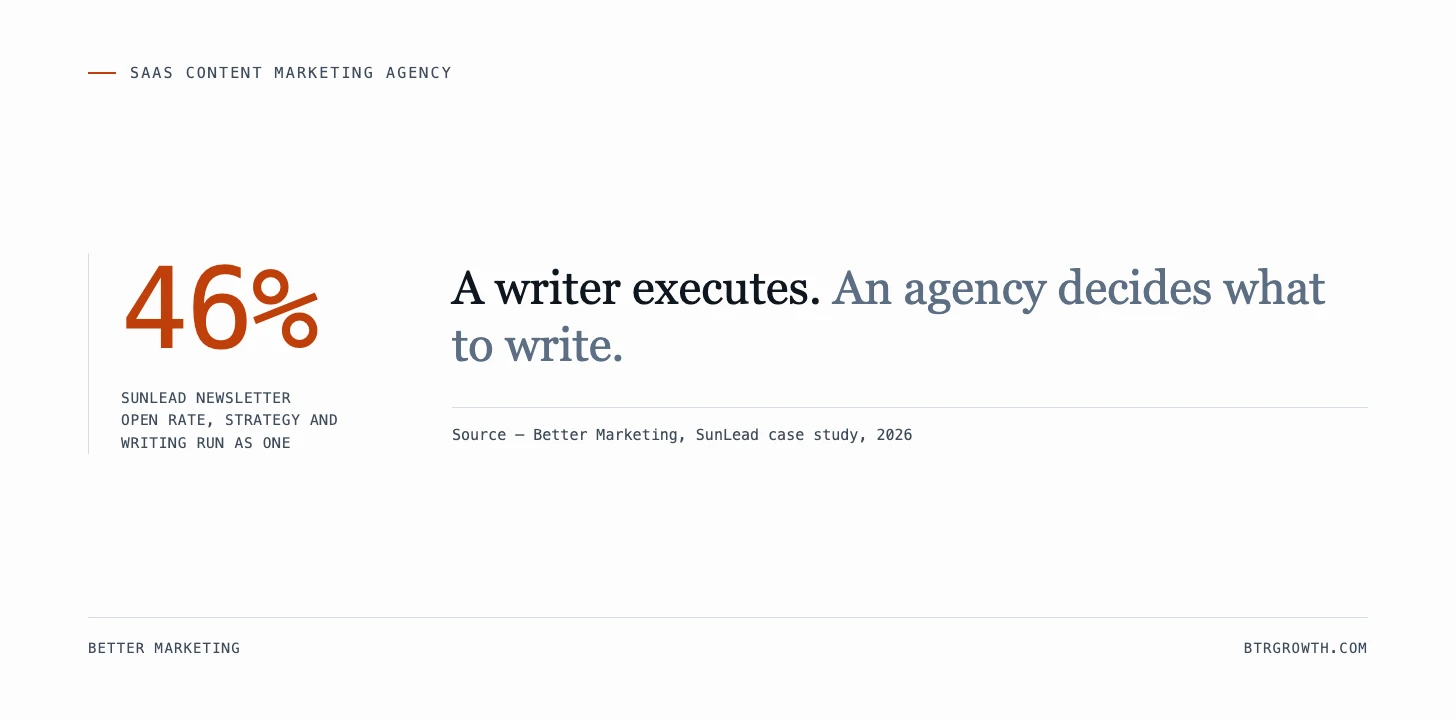
A single freelance writer or copywriter and a SaaS content marketing agency solve different problems, and the search terms for all three get typed by the same buyer on the same afternoon. A writer is the right hire when the strategy already exists and someone just needs to produce the pages. An agency is the right hire when the strategy does not exist yet, because writing without it produces good sentences aimed at nothing. Most companies searching this term are earlier than they think, which is why the agency is usually the answer, but not always.
What makes SaaS content different from content marketing in general.
A generic content writer can produce a readable page about almost anything with enough research time. A SaaS company is buying something narrower: someone who can sit with a product that has real technical depth, understand what it actually does before writing about what it does, and write for a buyer who will notice if a sentence is wrong. Google's own guidance on helpful content is explicit about this: it rewards "first-hand expertise and a depth of knowledge," and warns against content produced by someone without real experience of the subject, which is exactly the failure mode of a generalist writer dropped onto a technical product with a two-day brief. It is the same standard Google holds its own engineers to when writing for developers: its developer documentation style guide exists because writing about a technical product accurately is a discipline, not a talent you either have or fake.
A SaaS content writer versus a SaaS content marketing agency.
A writer, sometimes called a SaaS copywriter, executes. Give a good SaaS content writer a keyword, a brief and access to your product, and they will produce a clean, accurate page. What a writer does not usually do is decide what to write about, why that topic matters to your specific buyer, or how the page fits the fifteen other pages around it. That is strategy, and it is where a solo writer relationship quietly breaks down: the founder ends up writing the brief every week, which is the job they were trying to hire out.
An agency, at least a real one, runs research, strategy, writing and structure as one job rather than three handoffs. It decides what to write before anyone writes it. That sequence is close to how our own AI SEO service works, and it is also the difference between hiring a hand and hiring a decision-maker. Running it as one system is what took SunLead, a solar SaaS company, to a 46 percent newsletter open rate and a 9 percent click-through rate, roughly 2.2 times the 21.3 percent B2B benchmark, a gap that a writer alone, however good, cannot produce without the strategy underneath it.
When a single writer is genuinely enough.
Hire a writer, not an agency, if you already have a keyword strategy, a content calendar and a clear brief format, and the actual bottleneck is production capacity. That is common once a company has an in-house marketer who can direct the work. Paying agency rates for execution you could get from one skilled freelancer at a third of the cost is the mistake this section exists to prevent.
When a writer alone will not get you there, and why we say so.
Hire an agency instead if nobody in the company can currently answer "what should we publish next, and why." A writer without that answer will still deliver pages on schedule, and every one of them will under-perform, because production without direction is just faster drift. We should say plainly where our own model has limits too: we do not run high-volume content factories, so if the actual need is twenty generic posts a month rather than a smaller number that are each accurate and specific, a production shop is the better fit than an agency built around depth. And we do not run paid ads, so distribution outside search and the newsletter is not something this model buys you.
What to check before hiring either one
Ask to see one piece the writer or agency produced about a genuinely technical product, not a general SaaS explainer, and check whether it holds up to someone who knows the product.
Ask who decides what gets published next, and on what basis. If the honest answer is "you send us topics," you are buying execution, not strategy, and should be pricing it that way.
Ask how long it takes them to get accurate about your product before the writing improves. A writer who never asks a clarifying question is not doing the work.
Ask what a bad month looks like and what changes afterward, not just what a good month looks like.
We wrote a related breakdown of the same decision from the agency side, covering when SEO and content marketing should sit under one contract or two, which is worth reading alongside this if the writer-versus-agency question turns into a build-versus-buy one.