

Quick Answer
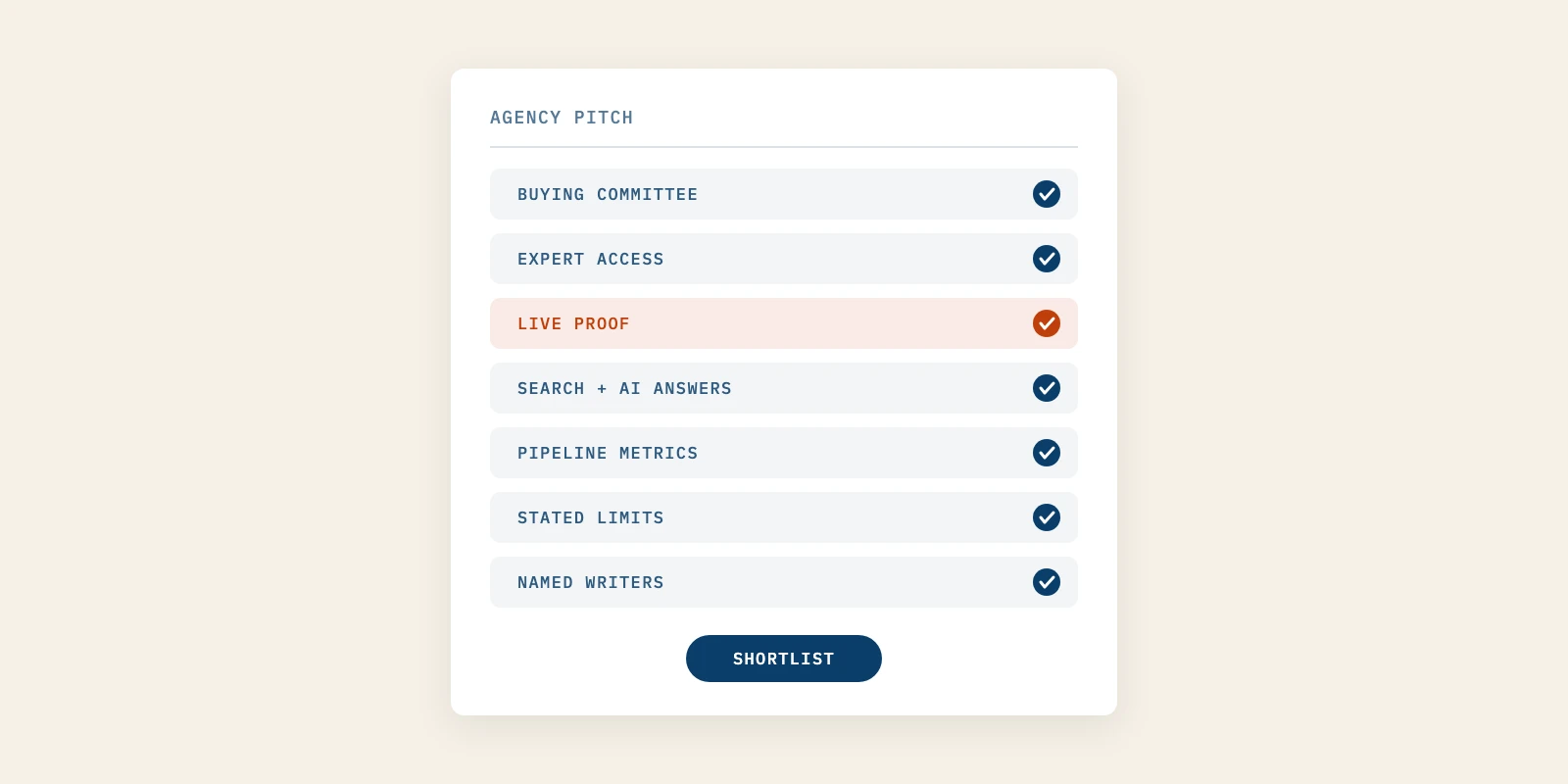
A B2B content marketing agency decides what your buyers need to read before they talk to sales, writes it with your subject-matter experts, and makes it findable on Google and inside AI answers. Choose one by running seven checks: a plan for your buying committee, regular expert access, proof tied to live pages, a findability plan, measurement against pipeline, stated limits and named writers.
Search for this category and roughly half the organic results are "best agencies" lists published by agencies. Ubersuggest's September 2026 snapshot of the US results puts a Reddit thread asking for trustworthy B2B agencies second among the organic results, above most of the agencies themselves.
When buyers go to a forum for an honest answer, the category has a trust problem rather than an information gap. The fix is to stop reading rankings and start testing agencies against the job B2B content has to do.
This guide defines that job for a group of buyers, then gives you seven checks to run, the four agency types they sort into and the pitch lines that should end a call early.
What a B2B Content Marketing Agency Does for a Buying Committee
A B2B content marketing agency does three jobs for you: it decides what your buyers need to read, writes it with people who understand the problem, and makes it findable long before anyone asks for a demo. Most agencies are strong at one of the three and sell all of them.
The B2B part changes each job. You're rarely writing for one buyer with a card. You're writing for a buying committee: the engineer who finds the problem, the manager who owns the budget and the finance lead who signs.
That makes the subject-matter expert the scarce input. The engineer on the committee can tell within a paragraph if the writer has never run the system being described, and a forwarded page that fails that test quietly ends the deal.
Timing changes the job too. LinkedIn's B2B Institute calls it the 95-5 rule: 95 percent of your potential buyers aren't ready to buy today. Ty Heath, the institute's director of market engagement, puts it plainly: "So most of the time, most category buyers are not 'in-market.'"
So the content has to be useful to people who won't buy this quarter, and still be the page they remember when they do. A lot of content marketing for tech companies misses this by writing only for the buyer who is already comparing vendors.
How B2B Content Differs From Consumer Content Marketing
B2B content differs from consumer content in who reads it, how long the decision takes and what the page has to survive. A consumer piece usually persuades one person. A B2B content marketing agency writes pieces that get forwarded to people who were never in the first conversation.
| Factor | B2B Content | Consumer Content |
|---|---|---|
| Who reads it | A buying committee | One buyer |
| Decision time | A long sales cycle with several reviews | Often a single session |
| What the page must survive | Being forwarded without context | A quick scroll |
| Where the substance comes from | Subject-matter experts | Brand and product teams |
| What counts as proof | A named page, result and date | Reviews and reach |
Read the rows as a hiring filter. An agency whose portfolio is mostly consumer work can write clearly and still miss the forwarding test.
Ask for two pieces it wrote in your category, then ask how long the sales cycle was for the company that published them. An agency that can't answer the second question wasn't close enough to the buyer.
Seven Checks for Choosing a B2B Content Marketing Agency
Choose a B2B content marketing agency by running seven checks before you sign, each one testable on a sales call or in a week of trial work. The checks follow the order the work tends to break in: planning, substance, proof, findability, measurement, scope and staffing.
Treat any check an agency can't answer with a specific as a failed check, not a follow-up for later.
1. It Maps Content to Your Whole Buying Committee
A good plan names each role in your deals and the question that role needs answered before it says yes. The engineer asks if the product works with the current stack. The budget owner asks what it replaces.
Test it by describing one deal you closed last quarter and asking which pieces each person in that deal would have needed. A strong answer lists different pieces for different people, while a weak one offers a content calendar written in one voice for one reader.
You'll know the plan works when your sales team starts forwarding pages to specific people inside a deal. The common mistake is briefing the agency on your ideal customer profile and never on the committee inside it.
2. It Gets Regular Time With Your Subject-Matter Experts
B2B content is only as specific as the expert behind it, and that expert is usually a founder or an engineer. A writer who never speaks to either can only rearrange what's already published elsewhere.
Google's guidance on creating helpful content asks site owners a blunt question: "Does your content clearly demonstrate first-hand expertise and a depth of knowledge?" That's hard to answer yes to when the writer works only from a brief.
Ask how many hours a month the agency needs from your subject-matter expert and how it runs those interviews. Be wary of an answer near zero. The mistake is treating expert time as a cost to minimize, when it's the one input no agency can supply.
3. It Proves Results With a Live Page, a Query and a Date
A percentage with no page behind it can't be checked, which is often why it's presented that way. Ask for the live URL, the query or metric it moved and the month the work started.
Then check it yourself by searching the query and opening the page. Proof worth trusting names a client, a channel and a number: the SunLead newsletter we write runs at a 46 percent open rate and a 9 percent click-through rate.
The check passes when every claimed result opens in a browser tab. The mistake is accepting a traffic chart with the axis labels cropped and no page named.
4. It Plans for Google Search and AI Overviews Together
Findability now has two surfaces: the ranked links and the AI-written answer that sometimes sits above them. Google's guidance on AI features says "There are no additional requirements to appear in AI Overviews or AI Mode, nor other special optimizations necessary."
That cuts both ways. An agency selling a secret method for AI answers is overselling, and one that ignores them is skipping a surface buyers see before the links.
Ask what the agency checks before it writes: that your pages are indexed in Search Console, and that each piece answers its question plainly enough to be quoted. Better Marketing's AI SEO service starts there too, with the questions your buyers ask answered plainly on pages crawlers can read, since Google only uses indexed pages as supporting links in AI Overviews.
The check passes when the plan names both surfaces and the indexing step comes first. The mistake is paying for a separate AI SEO service before your pages are even indexed.
5. It Measures Content Against Pipeline, Not Traffic
Measurement is where content programs often stall. In the Content Marketing Institute's 2026 trends research, a survey of 1,015 B2B marketers, 40 percent put creating content that prompts a desired action among their top three challenges, and 33 percent named measuring content effectiveness.
Ask the agency to name the three numbers it will report at ninety days. Good answers tie pages to buyers doing something: demo requests that mention an article, sales calls where a prospect cites a page, replies to a founder's post.
The check passes when every metric connects to a person taking an action. The mistake is signing off on a report of sessions and rankings with no line for pipeline.
6. It Names the Work It Will Not Do
An agency that does everything has no method, only a price list. Ask what it turns down, and listen for a real refusal: buying links, rewriting competitors' archives, publishing without expert review.
Scope matters most at the edges. Content creates the reason a buyer replies, but it doesn't book the meeting, so outbound belongs to a B2B demand generation agency or your own team, and the plan should say which.
You've got a clear answer when the refusals line up with your own constraints. The mistake is reading a long service list as range rather than as a missing point of view.
7. It Tells You Who Writes and Who Edits Each Piece
Ask for the names of the strategist, the writer and the editor on your account, and ask who joins the expert interviews. The people on the sales call aren't always the people doing the work.
Then pick one published piece and ask the agency to trace it back through the interview it came from, the first draft and the edits. An agency that works this way can show that chain in a few minutes.
The check passes when the person interviewing your expert is the person writing the draft. The mistake is meeting a senior team in the pitch and a junior one at kickoff.
Four Kinds of B2B Content Marketing Agency Compared
Most firms selling B2B content fall into four shapes, and each fits a different gap in your team. Match the shape to the gap before you compare any B2B content marketing agency inside it.
| Agency Type | What You Get | Fits When | Main Risk |
|---|---|---|---|
| Writing service | Articles written to your brief | Strategy is set, output is short | Pieces with no expert input |
| SEO content agency | Keyword-led articles | Site is indexed, search demand is clear | Traffic from readers who never buy |
| Strategy-led content agency | Plan, expert interviews, writing and findability | No settled plan, experts are available | A slower start while research runs |
| B2B demand generation agency | Outreach and conversion work | Content exists, pipeline is thin | Outreach with nothing worth reading |
If the real choice is a single subject-matter expert who writes versus a team, the SaaS writer versus agency trade-off works through that call. If search is the gap, one agency running SEO and content covers when a combined team fits.
Red Flags in a B2B Content Marketing Agency Pitch
A few pitch lines should end the call early, because each one predicts how the work will go. Watch for these in any B2B content marketing agency proposal:
- A guaranteed ranking, or a promised lead count in the first month.
- A price per article with no line for research or expert interviews.
- Case studies built on percentages with no page, client or date behind them.
- A plan to publish at high volume from week one, before any topic has been tested.
- No answer on AI Overviews, or a secret method for them.
None of these proves bad intent. Each is a sign the agency is selling output, and output is the easiest thing in content to count.
If you want a named shortlist to run these checks against, this review of content marketing agencies applies similar tests to firms that rank for the category.
When Hiring Any B2B Content Marketing Agency Is Premature
Hiring a B2B content marketing agency is premature in three situations, and a better agency fixes none of them.
If you can't yet say who buys, content won't find out for you. That's a positioning problem, and a library written into it gets rewritten later.
If you need revenue this quarter, content is the slower lever for a long sales cycle. A B2B demand generation agency working warm accounts, or your own founder outreach, will reach buyers sooner, and content can follow once those conversations show what to write.
If nobody on your team can give an expert an hour a month, any agency will write from public sources. The result reads like every other page on the subject, which is exactly what a buyer skims past.
Run the Seven Checks Before Signing a B2B Content Marketing Agency
Before any proposal arrives, write down the roles in your last closed deal, the expert hours you can give each month and the three numbers you'd accept at ninety days. Then run the seven checks on every B2B content marketing agency you meet, and drop any that can't show a live page. Better Marketing approaches content marketing for tech companies in that order, starting from your buying committee's questions and your experts' answers.