
Quick Answer
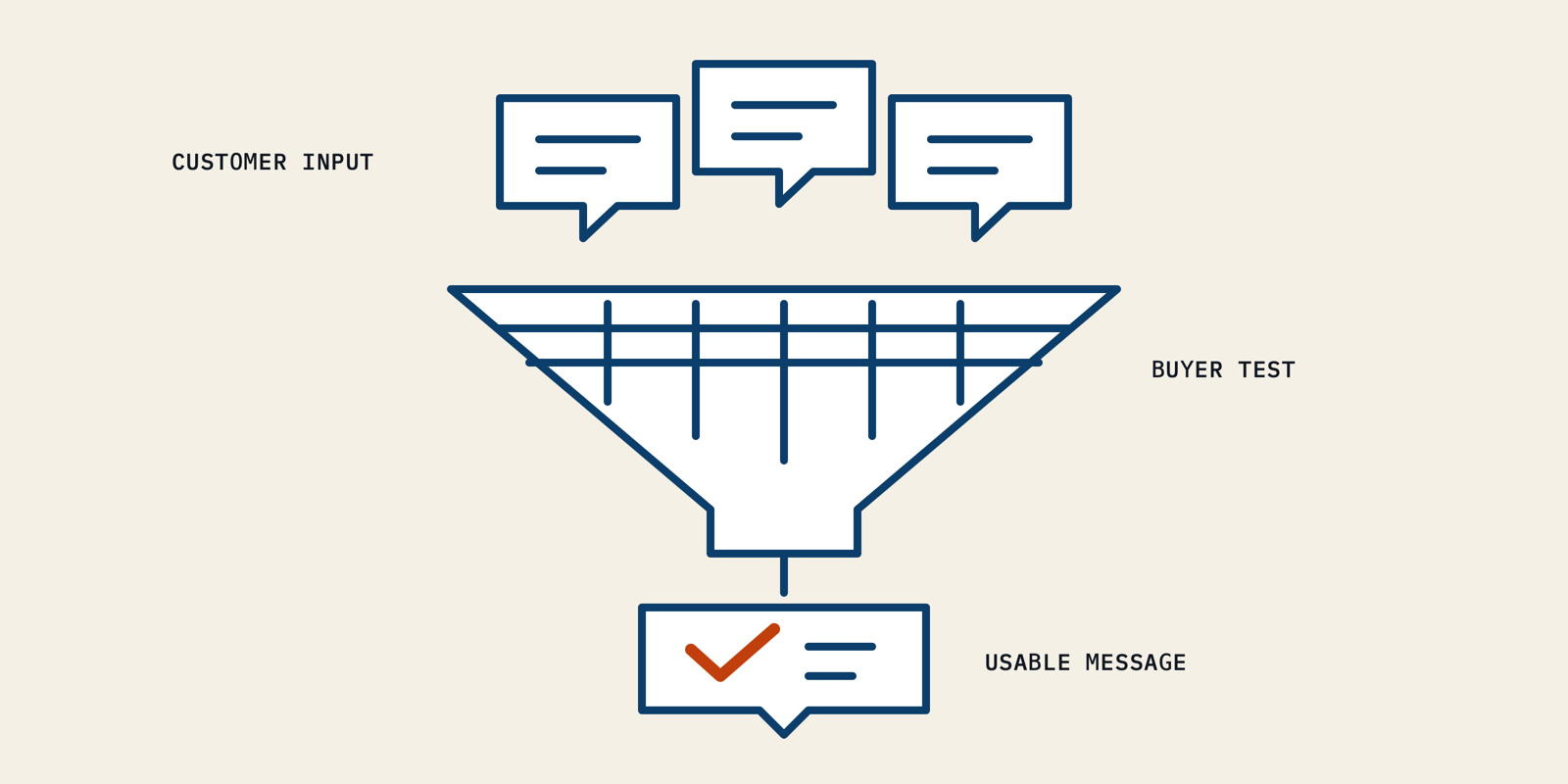
Use customer advisory board feedback to identify marketing questions, then test the answers with people who have not bought. Capture individual input before group discussion, preserve disagreement, and record what each statement can support. A B2B technology marketing agency can turn that evidence into a focused research brief. Customer approval alone cannot establish demand, justify a broader claim, or prove that new messaging will convert prospects.
A customer advisory board is a recurring group of customers invited to advise a business on its direction. We want its advice to improve decisions.
For a seed-stage software founder, enthusiastic feedback can feel like the missing proof behind a marketing plan. Yet a customer already knows the product.
A prospective enterprise buyer may still be deciding if the problem deserves attention. We would keep that difference visible before changing the message.
This guide shows how we would record feedback, choose the action it supports, and test its relevance beyond the meeting.
How We Turn Customer Advisory Board Feedback Into Marketing Decisions
We turn customer advisory board feedback into marketing decisions by preserving the source, checking the inference, and naming the next evidence needed. Our method starts before the group discussion.
The useful output is a decision record someone else can inspect. A transcript alone does not explain which conclusions the team is entitled to draw.
1. Name the Marketing Decision Before the Meeting
We would write the decision in plain language before asking for feedback. Changing a homepage promise, selecting a webinar topic, and explaining a product limitation need different evidence.
We would also name what remains open. A team that has already committed to a campaign should not invite customers to pretend they can redirect it.
Pragmatic Institute's guidance draws a useful boundary. “This is an input session, not a decision-making body.” We would carry that boundary into our decision record.
Our starting record contains the proposed decision, the audience it affects, and the uncertainty preventing a choice. We keep the desired answer out of the question.
For product positioning, we would ask about the customer's actual buying context before showing our preferred wording. Otherwise, we risk collecting reactions to language we supplied.
We would link the decision to a positioning hypothesis that can be tested. The customer advisory board discussion contributes evidence to that work. It does not complete the test.
2. Capture Individual Input Before Group Discussion
We would ask each participant for an initial response before showing other people's answers. The purpose is to preserve the origin of an idea.
Our record would retain the question as asked and the customer's exact response where permission allows. We would distinguish that response from our interpretation.
We would note if the person had already seen the proposed message, a colleague's answer, or an earlier presentation. Exposure matters when interpreting apparent agreement.
This is our recommended research practice, not a claim that a particular meeting format eliminates bias. A customer still has an existing relationship with the vendor.
We would keep a private route for input that someone does not want to discuss in a group. An empty public answer should not become agreement by default.
A useful question asks about a concrete past decision. We would ask what made the purchase worth considering and which information helped the person evaluate it.
We would avoid turning that question into a request for praise. The record should help us understand the decision, including the parts our product did not influence.
3. Keep Account, Role, and Exposure Attached
We would label each statement with the account and the speaker's role in the relevant decision. Several comments from the same account are not several independent accounts.
We would also separate an individual's initial answer from comments made after discussion. Repetition can reflect shared experience, agreement with a peer, or a useful new idea.
Those possibilities deserve different treatment. We would not assign a confidence score merely because a phrase appeared repeatedly in the transcript.
ProductPlan's voice of customer guidance stresses contextualizing feedback and avoiding overrepresentation from one group. We would apply that principle at the statement level.
Here is the worksheet we would use. Its fields are instructions for recording real evidence, not a fictional customer example.
| Field | What We Record | Decision It Protects |
|---|---|---|
| Decision under review | The specific marketing choice and intended audience | Keeps feedback tied to an actual task |
| Source location | Recording timestamp or approved note reference | Makes the statement retrievable |
| Account and role | Organization and role in the purchase or use | Separates account evidence from headcount |
| Original statement | The speaker's wording, distinct from our interpretation | Prevents an interpretation becoming a quotation |
| Exposure | Before discussion, after discussion, or unknown | Preserves how the response arose |
| Supporting context | The event, workflow, or decision the speaker describes | Distinguishes an experience from a preference |
| Contrary evidence | Different accounts, roles, or conditions that disagree | Prevents a summary from erasing a boundary |
| Allowed use | Internal question, customer insight, or candidate buyer hypothesis | Limits what the statement currently supports |
| Missing evidence | The audience or behavior still unobserved | Defines the next research task |
| Decision and follow-up | The action, accountable person, and review point | Gives the feedback a visible destination |
We would leave unknown fields explicitly unknown. Filling them with a plausible account story would make the record less useful than the original uncertainty.
Pro tip: We keep original wording and interpretation in separate columns. A polished summary should never silently replace the statement it summarizes.
4. Preserve Disagreement Before Writing a Theme
We would write down the disagreement before composing a theme such as “customers want simpler messaging.” A theme is an interpretation, not the raw evidence.
We would then examine the conditions attached to each account. A product user describing daily work may be answering a different question from a purchasing stakeholder.
We would retain both accounts of the problem until the difference is understood. Averaging them into a broad statement could remove the information marketing actually needs.
Our summary would identify the scope of the pattern and the exceptions. If a pattern appears only after a group discussion, that timing remains visible.
We would also preserve the absence of evidence. Silence about a buying concern does not show that the concern is unimportant to people outside the room.
This step produces a more useful research question. We can investigate the condition behind the disagreement instead of asking another group to vote on our preferred answer.
5. Match the Proposed Action to the Evidence
We would assign an action based on what the source supports. We would not promote a statement from customer insight to acquisition evidence by changing its label.
The following decision table is our recommended routing test. It deliberately allows a useful outcome without approving a new marketing claim.
| Evidence Available | Action We Would Allow | What We Would Still Withhold |
|---|---|---|
| An account describes a specific product-use problem | Investigate that problem and its context | A claim that the whole target market shares it |
| Several speakers repeat a theme after discussion | Record a group theme and investigate independently | A count presented as independent buyer validation |
| Accounts disagree under different conditions | Separate the conditions and design a focused follow-up | A blended message claiming universal relevance |
| Customers explain a past buying decision | Develop a hypothesis about that buying context | A conclusion about today's unfamiliar prospects |
| A prospective buyer recognizes the problem | Test the relevance of the proposed response | A claim that recognition proves willingness to buy |
| A marketing test produces an observable buyer action | Record the action and the conditions of the test | A revenue claim the observation does not establish |
We would require the proposed wording to survive this test, not just its supporting notes. A careful internal record cannot rescue a sentence that overstates the evidence.
6. Write the Next Test Before Closing the Record
We would finish each usable record with the question still unanswered. The next test needs an audience, an observation to collect, and a decision it could change.
We would specify what would weaken the hypothesis as clearly as what would support it. Otherwise, almost any positive comment can become a reason to continue.
We would keep the test proportionate to the decision. A small copy clarification needs a different commitment from repositioning the product around a new buyer group.
We would also record the cost of waiting. If the evidence is thin and the decision is easy to reverse, a limited test may be reasonable.
If the claim could materially mislead a buyer, we would hold it until the supporting evidence is adequate. That is an editorial decision the meeting cannot make for us.
Give the Customer Advisory Board an Agenda That Protects Useful Input
We would design the customer advisory board agenda around the uncertainty the team can act on. The meeting should create usable evidence without becoming a presentation about our preferred answer.
• State the Scope Before Asking for Advice
We would use the customer advisory board charter to explain the discussion's remit and how feedback will be considered. CRV's startup guide includes a charter and a documented follow-through process.
We would identify the marketing decision that is open, the product constraints that are fixed, and the questions requiring private discussion. Those boundaries help participants use their time well.
We would avoid promising an implementation simply because someone raises an important concern. We can commit to reviewing the concern and explaining the resulting decision.
• Give Discussion a Useful Sequence
We would collect individual input first, then discuss the conditions behind it. We would show proposed wording only after understanding the customer's own description of the problem.
Our meeting sequence would be:
- Restate the open decision and the limits of the discussion.
- Collect initial responses without displaying the group's answers.
- Explore differences in context and buying experience.
- Review proposed interpretations and invite corrections.
- Record the unresolved questions and the next review point.
We would treat this sequence as a practical starting point, not a universal timing prescription. The amount of discussion should follow the complexity of the decision.
• Route Product Requests Without Losing Them
We would preserve a request for the product roadmap even when it does not answer the marketing question. Redirecting it should not mean dismissing it.
We would record the underlying problem and give it a separate destination for product review. That keeps the customer advisory board discussion useful without turning every requested feature into a campaign promise.
We would put participant input and expectations in the debrief. We would add the evidence limits before anyone writes copy.
Brief a B2B Technology Marketing Agency on What the Evidence Supports
We would give a B2B technology marketing agency a bounded research brief from the customer advisory board, including what remains unknown. A polished transcript summary is not enough to direct a campaign.
• Deliver the Decision Record With the Agency Assignment
We would include the proposed audience, the customer statements that informed the hypothesis, and the conditions attached to those statements. We would also include the strongest contrary evidence.
For a B2B technology marketing agency, the useful assignment is to test a particular interpretation. A broad instruction to “use the customer voice” leaves too much room for unsupported generalization.
We would distinguish material approved for internal analysis from material approved for public use. Permission to participate in a discussion is not an instruction to publish someone's words.
• Review the Inference Before Polishing the Copy
We would ask the writer to state what a new buyer could reasonably conclude from the proposed copy. Then we would compare that conclusion with the actual evidence.
We would return wording that turns a customer's preference into a market-wide claim. We would also return wording that changes the audience or removes an important condition.
A pricing-page rewrite based on customer language has a specific source and task. Customer advisory board input needs the same clarity about the decision it is meant to improve.
We would approve an interpretation only when its wording and evidence fit. Making the sentence more persuasive comes after that review.
Pro tip: We ask for the strongest contrary observation beside the proposed message. It makes a useful challenge visible before the campaign earns momentum.
• Keep Research and Production Decisions Separate
We would commission further research when the missing evidence could change the message. We would commission production when the evidence already supports the intended use.
We would not treat a well-designed asset as confirmation of its underlying hypothesis. Production quality and evidence quality answer different questions.
The founder's brief should make the acceptance decision clear. A reviewer needs to know what must be true before the team spends more time adapting the message.
We would budget founder review time even when a writer handles production. Our guide to LinkedIn ghostwriter costs explains why founder input remains part of outsourced writing.
Test Customer Advisory Board Insights With People Still Deciding
We would test customer advisory board insights with people who still face the relevant buying decision. Customer advisory board benefits include useful questions; those questions do not arrive as proven acquisition messages.
• Choose Evidence That Fits the Remaining Question
We would match the research source to the uncertainty. ProductPlan's customer development framework treats assumptions as things to test with customers and potential customers.
We would keep those groups visible in the research record. Their perspectives can complement each other without being interchangeable.
| Remaining Question | Evidence We Would Seek | Limit We Would Preserve |
|---|---|---|
| What happened after adoption? | Accounts with relevant product-use experience | Their experience does not describe every account |
| What made the purchase worth considering? | People involved in the actual buying decision | Recollection may differ from today's buying conditions |
| Does the proposed message make sense to an unfamiliar buyer? | Prospects in the intended audience | Understanding a message does not prove purchase intent |
| Does the message help a buyer take the intended next step? | Observed behavior in a defined marketing test | The result belongs to that audience and test context |
We would document how participants were found. Recruiting only through enthusiastic customers could reproduce the relationship bias the separate research was meant to examine.
• Define a Meaningful Observation Before Launch
We would choose the intended buyer action before reviewing the test result. A relevant question from a prospect can teach something different from an impression count.
We would record the message version, audience, channel, observation period, and action measured. We would keep those details with the conclusion instead of reporting an isolated conversion figure.
We would not set a universal sample size or success percentage for every seed-stage company. The decision's consequences and the available evidence determine what is adequate.
For a small qualitative test, we would report the observations as qualitative. We would not convert a handful of responses into a claim about the whole market.
• Keep Attribution Claims Narrow
We would use self-reported attribution as another source of context when a buyer says what influenced them. It does not establish that one customer advisory board insight caused a sale.
Among customer advisory board best practices, we would include keeping learning separate from revenue attribution. A useful messaging correction can be worth making without a defensible revenue estimate.
Pro tip: We write the possible stop decision before a test begins. If nothing could change our plan, we are documenting a commitment rather than testing an idea.
Keep the Customer Advisory Board Informed About Decisions
We would tell the customer advisory board what changed, what remains open, and what the team declined. Feedback deserves a visible outcome even when it does not become a campaign.
• Report the Decision With Its Reason
We would connect the update to the original question. A list of completed marketing tasks can look productive while leaving participants unsure what happened to their advice.
We would explain the evidence behind the choice and the limit that prevented a broader action. We would avoid implying that the group approved something it merely discussed.
For an unresolved issue, we would state what evidence is missing and when the team intends to review it. We would not disguise an indefinite hold as progress.
• Check Learning Before Expanding the Program
We would review the decisions improved by the discussion and the time required to reach them. More meetings do not automatically mean more useful customer feedback.
We would look for records that produced a clear next test, corrected an unsupported assumption, or revealed a meaningful difference between audiences. Those are specific learning outcomes.
If the records repeatedly end with no decision anyone can change, we would revisit the discussion's remit. The customer advisory board charter should describe work the team can actually use.
Turn Customer Advisory Board Input Into a Testable Next Step
We would start with an open marketing decision and carry customer advisory board input into a record others can inspect. Preserve the original statement, its context, and the evidence still missing.
Give a B2B technology marketing agency a question it can test. Keep agreement, understanding, and buying behavior distinct when reviewing the result.
If your team needs help turning that research into a focused marketing brief, Better Marketing can help define the work and the evidence it needs.