
Quick Answer
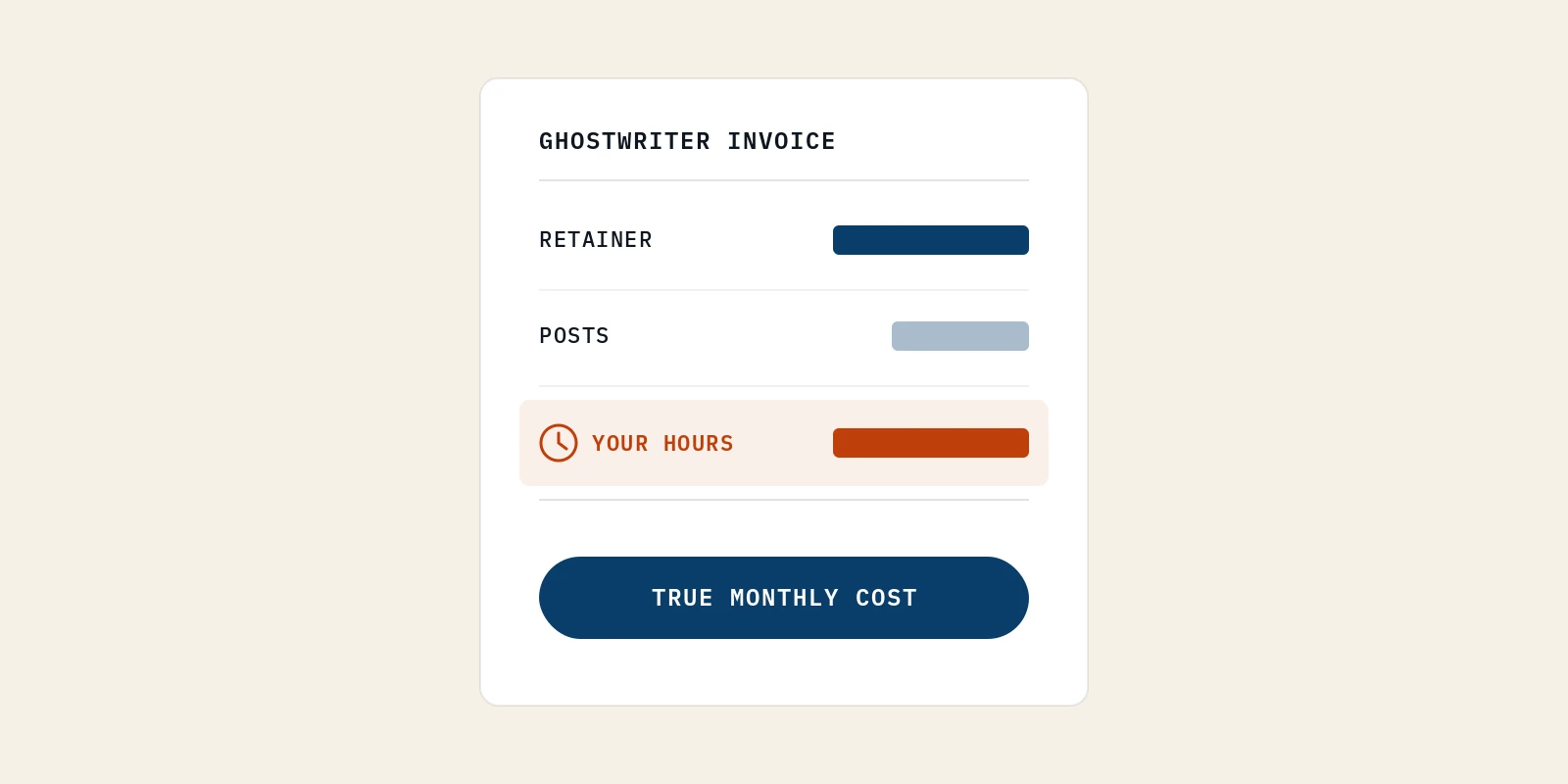
Published 2026 prices for a LinkedIn ghostwriter run from about $500 to over $10,000 a month, with most quotes between $2,000 and $5,000. Every published price list comes from sellers. The cash is only half the cost, since the founder still supplies the ideas, the interviews and the replies. Before revenue, writing posts yourself is usually the better first move, with a paid editor as the middle step.
A ghostwriter is someone you pay to write words that go out under your name. I understand why founders who would never hire a B2B technology marketing agency look at a LinkedIn ghostwriter instead. The price looks smaller and the job looks simpler.
Here's the problem. You have no revenue yet, your old network has stopped sending intros, and LinkedIn feels like the obvious next channel. A $2,000 monthly retainer would be $24,000 a year of savings spent on posts.
I'll cover what each price tier buys and the founder hours a ghostwriter still needs. Then I'll give you a four-part pay-or-write test, a cheaper middle option, the contract terms I'd insist on and a 90-day review.
What a LinkedIn Ghostwriter Costs in 2026, Tier by Tier
A LinkedIn ghostwriter costs between $500 and $10,000 or more a month in 2026, and most founders are quoted $2,000 to $5,000. Per-post rates run from about $50 to $1,000. I pulled that LinkedIn ghostwriter pricing from four pages that rank on Google, all published by firms that sell LinkedIn ghostwriting.
| Tier | Monthly price | Posts per month | What the seller says you get |
|---|---|---|---|
| Budget freelancer | $500 to $1,500 | 8 to 12 | Basic research, template-based writing |
| Freelance writer, writing only | $500 to $1,500 | 4 to 8 (1 to 2 a week) | Writing only, aimed at pre-seed founders testing LinkedIn |
| Mid tier writer or small agency | $2,000 to $4,000 | 12 to 16 | Voice interviews, topic planning, some tracking |
| Agency entry package | $2,000 to $4,000 | 4 to 8 | Strategy call, profile edits, monthly report |
| Agency growth package | $4,000 to $7,000 | 8 to 12 | Calls every two weeks, 3 to 5 hours a week of commenting |
| Premium full service | $8,000 to $15,000+ | 12 to 20 | Video, photography, paid ads, senior strategist |
I checked every source above on 1 October 2026. Notice that two sellers quote the same price for very different post counts. That gap is the first thing to ask about on a sales call.
1. Budget Freelancers Sell Volume, Not Judgment
The $500 to $1,500 tier buys consistency. Windmill Growth sells ghostwriting itself. It says posts at this level "often lack personality and strategic depth." I read that as an honest warning, and I agree with it.
2. Specialist Ghostwriters Sell Interviews
The $2,000 to $4,000 tier is where a LinkedIn ghostwriter starts interviewing you to capture your voice. You are paying for someone who turns a 30-minute call into four posts. That only works if you have something specific to say on the call.
3. Agencies Add Commenting and Reporting
A LinkedIn ghostwriting agency adds commenting at this level. Foundera's growth package includes three to five hours a week of it on your behalf. I'd treat that line carefully. Comments in your name are still you speaking, and a buyer who replies expects you to answer.
4. Premium Programs Are Built for Known Executives
At $8,000 to $15,000 a month you are buying video, photography and paid ads. Foundera itself pitches this tier to founders "serious about thought leadership as a core business development tool." That is a later-stage purchase, not a first-customer one.
5. Every Price List Comes From a Seller
Every page I read was written by a firm that sells LinkedIn ghostwriter services or a ghostwriting tool. If you search how much does a ghostwriter cost, most results are about books.
Mylance's comparison table repeats Foundera's agency tiers almost word for word. Mylance credits the figures to "2026 industry pricing guides." Foundera also quotes freelancers at $300 to $800 per post, yet $500 to $700 for four posts a month. That works out to $125 to $175 a post.
I don't think anyone is lying here. These are list prices from the people who set them, so treat them as an opening quote. We use them as a ceiling when a founder asks us what is fair.
Pro tip: Ask every LinkedIn ghostwriter for their price per published post, not per month. It is the only number you can compare across quotes with different post counts.
The Hidden Cost of a LinkedIn Ghostwriter Is Your Own Time
A LinkedIn ghostwriter does not remove you from the work. You still supply the ideas, approve the drafts and answer every comment. Sellers state this ask on their own pages, and it is never zero.
Windmill Growth's page says the work gets done with "45 minutes a week with us." Separately, Mylance prices its done-for-you plan at $997 a month and describes the ask as "Thirty minutes of your brain a month." Those are the sellers' own estimates. I'd add the time you spend replying, because that part cannot be outsourced honestly.
Here is how I'd price the three options for a founder posting twice a week. The founder hours are my estimates, not sourced figures, so adjust them to your pace.
| Option | Cash per month | Founder hours per week (my estimate) | Who owns the ideas |
|---|---|---|---|
| Write it yourself | $0 | 2 to 3 | You |
| Paid editor working from your notes | Per post, see below | 1 to 1.5 | You |
| Full LinkedIn ghostwriter | $2,000 to $4,000 | 0.75 to 1.5, plus replies | Shared |
The table shows the trade plainly. A ghostwriter saves you roughly one to two hours a week. At $2,000 a month, that is about $230 to $465 for each hour saved, based on 4.3 weeks a month.
Say you run a three-person SaaS team on savings. Your evenings already go to support tickets and demos. If one extra hour a week costs you $465, I'd look hard at what else that money buys first.
On Indie Hackers, founder Tom Han wrote in June 2026 that he paid $1,200 a month and kept rewriting the drafts. Six weeks in, he had 40 new followers and zero inbound leads.
His post then promotes a software tool, so I take the ending with care. The rewriting is the cost I'd expect when a writer does not know the product.
Freelance Ghostwriter vs B2B Technology Marketing Agency for a Founder With No Revenue
A freelance LinkedIn ghostwriter is cheaper and more personal. A B2B technology marketing agency costs more but runs the whole channel, from the posts to the outreach. Before revenue, I'd pick by the job you need done, not by the price.
| Factor | Freelance LinkedIn ghostwriter | B2B technology marketing agency |
|---|---|---|
| Published monthly price | $500 to $4,000 | $2,000 to $15,000+ (agency packages above) |
| What you get | Posts in your voice | Posts plus strategy, commenting, reporting, often other channels |
| Your time | Interviews and approvals | Calls every week or two, approvals, replies |
| Risk | Writer gets busy or leaves | Junior writer on your account, slower changes |
| Fits best when | You know your subject and lack writing time | LinkedIn is one part of a wider plan |
A freelancer works when you already know what you want to say. That is the core of founder led marketing, with the founder's view in the founder's name.
An agency works when you need someone to decide what to say, where and in what order. If you are weighing the second, our page on what a B2B technology marketing agency does for founder brands explains the wider scope.
The mistake I'd watch for is hiring a writer to fix a positioning problem. If you cannot name one subject a buyer would repeat back to you, a writer will produce polished posts about nothing. I've written about that subject test in our LinkedIn marketing strategy guide.
A Pay-or-Write Test Before You Hire a LinkedIn Ghostwriter
I'd hire a LinkedIn ghostwriter only when all four checks below pass. If any one fails, I'd keep writing and fix that check first.
1. Your Own Posts Already Start Buyer Conversations
Write for eight weeks before you pay anyone. If your posts bring messages from people who match your customer profile, a writer can scale something real. If only other founders and marketers react, better writing will not change who reads.
2. Time Is Your Bottleneck, Not Ideas
List ten post ideas in fifteen minutes. If you can, your problem is hours, and a writer helps. If you stall at three, the writer will invent the other seven, and they will sound like everyone else.
3. One Deal Covers Six Months of Fees
Take your expected annual contract value and compare it with six months of the retainer. At $2,000 a month, six months is $12,000. A $6,000 contract needs two deals from LinkedIn to break even. A $25,000 contract needs one, with room to spare.
4. You Can Give 45 Minutes a Week for a Quarter
The sellers' own estimates start at about 45 minutes a week. If launch work will eat that time, the writer will guess at your views. Guessed views are how founder accounts end up sounding generic.
Pro tip: Run the test on paper before your first sales call with a ghostwriter. If you fail check one, skip the call and spend the money on the hours you already have.
The Middle Option Is an Editor Who Works From Your Notes
The cheapest useful step up from writing alone is a paid editor. You record the raw idea, and the editor shapes it into a post. You keep the thinking and lose the blank page.
Windmill Growth lists budget writers at $50 to $100 per post. An editor at that rate for eight posts would cost $400 to $800 a month. That is a fraction of a full LinkedIn ghostwriter, and the ideas stay yours.
• Record One Voice Note per Post
Talk for three minutes about a customer call, a bug you fixed or a view you hold. I prefer voice notes to a questionnaire because they keep the founder's own phrasing.
• Have the Editor Cut, Not Invent
Give the editor one rule. Shorten and clarify, but add no claims. Any number or story must come from your note. That rule keeps your LinkedIn personal branding tied to things you can defend in a reply.
• Post and Reply From Your Own Account
You publish, and you answer the comments. The replies are where buyers decide you are real, so I'd keep that part with the founder every time.
Four Terms to Put in a LinkedIn Ghostwriter Contract
A LinkedIn ghostwriter contract should protect your account, define a post, allow a fast exit and settle who owns the drafts. The pricing pages I read cover price and volume in retainer agreements and say little about the rest.
1. You Keep the Login
LinkedIn's User Agreement took effect on 3 November 2025. It asks members to keep their password confidential and "not share or transfer your account or any part of it." I'd never hand a ghostwriter my password. They send drafts, and you post them yourself.
2. A Post Count With a Definition
Write down what counts as one post. A text post, a carousel and a reshare are different amounts of work. Without a definition, a 12-post month can quietly become six posts and six reshares.
3. A 30-Day Exit
Windmill Growth calls long contracts with no performance guarantees "another warning sign," and it flags 12-month commitments with no way out. I agree. I'd ask for month-to-month terms after the first 90 days, with 30 days' notice.
4. You Own Every Draft
The drafts, notes and interview recordings should belong to you. If you part ways, you keep the archive. We've written before about why the founder account is an asset that cannot be transferred, so the material behind it should stay with you too.
How to Tell After 90 Days If a LinkedIn Ghostwriter Is Paying Off
Judge a LinkedIn ghostwriter by conversations with buyers, not by followers or likes. Ninety days is the shortest fair window. Fewer than a handful of buyer conversations by then means the channel or the voice is not working.
The long window matters for a reason. The Edelman and LinkedIn B2B Thought Leadership Impact Report notes that 95% of business clients say they are not actively seeking goods or services at any given moment. Most of your readers are not buying this quarter.
• Count Messages From People Who Match Your Buyer
Keep a simple sheet of every message, comment and connection request from someone who fits your customer profile. That count is the number I'd bring to the renewal conversation.
• Ask New Leads Where They First Heard of You
One open question on your intake form tells you more than impressions do. I explain how to run it in our guide to self-reported attribution.
• Check the Voice, Not Only the Volume
Read the last ten posts aloud. If you would not say a line on a sales call, cut it. Thought leadership that sounds borrowed costs you more trust than silence does.
Pro tip: At day 90, compare the cost per buyer conversation with what your other content marketing costs per conversation. Keep whichever channel is cheaper, not whichever feels busier.
Price the Hours Before You Price the Ghostwriter
A LinkedIn ghostwriter costs $500 to $10,000 or more a month on published price lists, and most quotes land between $2,000 and $5,000. Before revenue, I'd write my own posts for eight weeks, then pay an editor and hire a full writer only once posts start buyer conversations.
If LinkedIn is one piece of a wider plan, compare the writer against a B2B technology marketing agency on scope, not price. If you want a second opinion on which route fits your stage, Better Marketing works with early-stage software founders on exactly this.