
Quick Answer
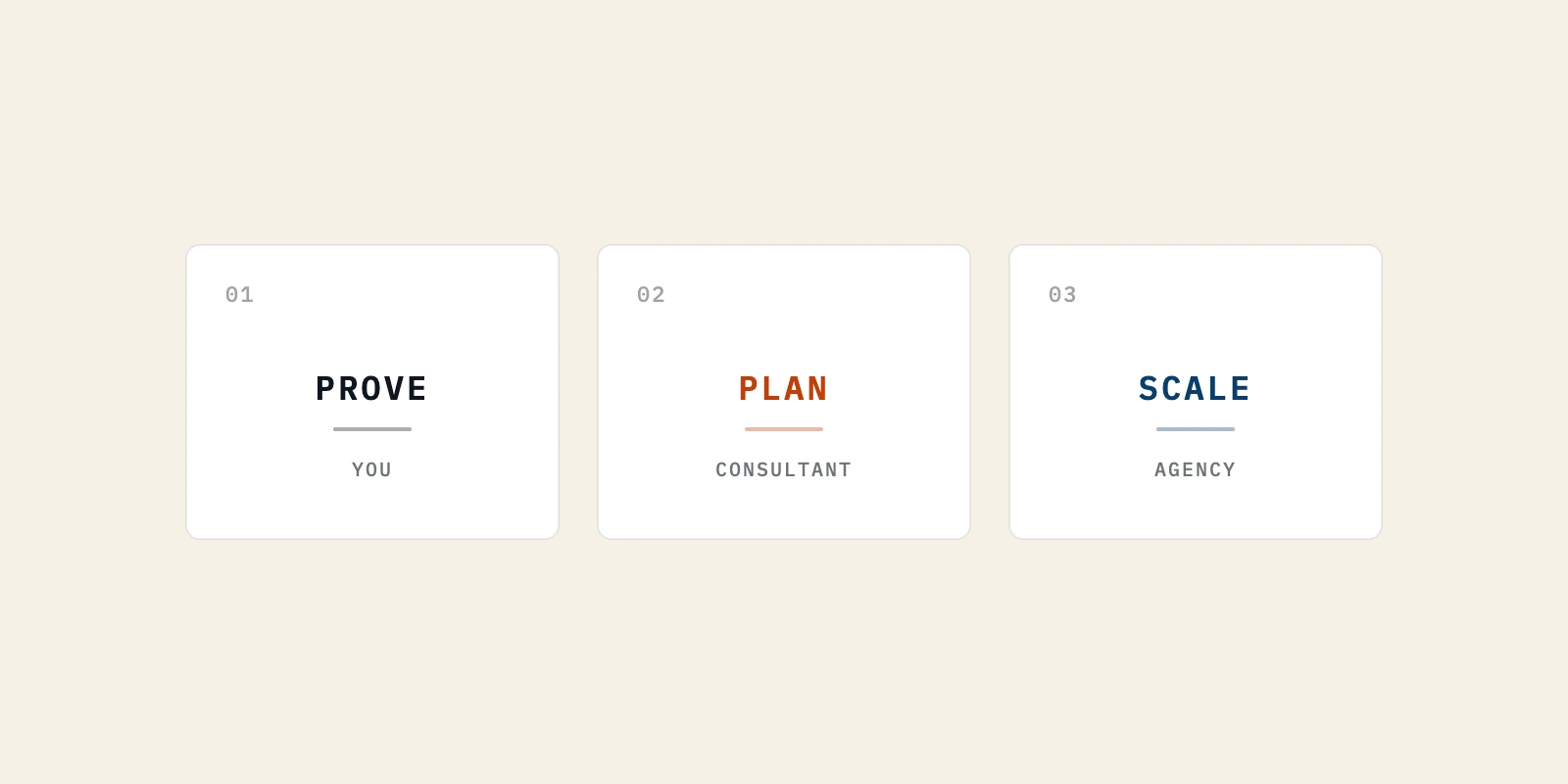
A seed-stage B2B founder usually needs a demand generation consultant before a B2B demand generation agency or a full-time hire, but only after proving one channel personally. A consultant buys a diagnosis and a plan, an agency buys execution capacity for a channel that already works, and a first marketing hire buys ownership. Pick the model that matches the missing piece, proof, a plan, hands or an owner.
The question behind “demand generation consultant” is rarely about consultants. I hear it when a founder has one budget line, a board asking for sales pipeline, and three vendors each arguing for a different answer.
Demand generation is the work of making the right buyers aware of your product and interested enough to engage before they are ready to buy. Wikipedia defines demand generation as “the focus of targeted marketing programs to drive awareness and interest in a company's products and/or services” in its entry on demand generation.
I would not treat a demand gen consultant, a B2B demand generation consultant, a demand generation consultant for B2B teams, a demand generation consultant for startups, and a full-time marketer as interchangeable choices. This post covers what each model buys and does not buy, the stage test that picks one, the questions I would ask before signing, and the signs that you chose wrong.
What Each Model Actually Buys
A consultant sells judgment, an agency sells hours, and a hire sells continuity, and each is the wrong purchase when demand generation is missing something else. I use this split because it stops the founder from comparing proposals by polish instead of by job.
Wikipedia describes a consultant as a professional “who provides advice or services in an area of specialization” and notes that consulting services generally fall under professional services as contingent work in its entry on consultants. That matters because a consultant can advise or design the work, but that does not mean they will run every weekly task.
A marketing agency is different. It gives you people, process and production capacity. A marketing manager is different again because they carry memory inside the company and build demand generation into the operating rhythm.
Use the table this way:
| Model | What It Buys | What It Does Not Buy | Right When |
|---|---|---|---|
| Doing it yourself | Proof that one channel works for your buyer | Scale or a second channel | Nothing has worked yet |
| Consultant or fractional lead | A diagnosis and a written plan | Anyone to run the plan | One channel works but you do not know why |
| Marketing agency | Execution capacity on a proven channel | Your positioning or your buyer insight | The plan exists and the founder is the bottleneck |
| First marketing hire | Ownership and memory inside the company | Senior strategy on day one, usually | The motion is repeatable and needs a full-time owner |
I like this table because it makes the missing asset visible. If you lack proof, no outside team can skip buyer learning for you. If you lack hands, another strategy document will not fix the calendar.
The Four Models in the Order Most Founders Need Them
Most seed-stage B2B founders should prove one channel themselves, bring in a demand generation consultant to diagnose and plan, add an agency for capacity, and hire in-house last, when the motion is repeatable enough to own. I would reorder this only when the founder already has strong marketing context or the sales cycle forces a different cadence.
Founders often hire an agency to avoid a decision only they can make, which is who the buyer is and why they buy. No outside model can make that decision for you, and paying one to try is the most common way this budget line is wasted.
1. Doing It Yourself Buys Proof
Doing demand generation yourself buys proof that one channel can create named buyer conversations. I mean founder-led outreach or founder posts aimed at a narrow ideal customer profile, not a vague month of content activity.
Say you sell compliance software to fintech security leads. I would write to 40 named heads of security and test which of three problems gets replies. The point is not to become a full-time marketer. The point is to learn which problem makes a real buyer answer.
This is where I would pick one demand generation channel first and resist the urge to add a newsletter, webinars and search at the same time. One channel gives cleaner evidence. Three channels give more places to hide from the answer.
Measure named replies and conversations per week, not activity. A spreadsheet of sent messages does not prove demand generation. A founder who can name the buyer, the problem and the reason they replied has something an outside operator can build on.
The mistake is skipping this step and paying someone to find a buyer you have not met yet. I would rather see an awkward founder message that gets buyer language back than a polished campaign aimed at a guessed persona.
Pro tip: Keep the founder notes messy but specific. Save the exact phrases buyers use when they reply, because those phrases often become the first message an agency or hire can scale.
2. A Consultant Buys a Diagnosis and a Plan
A demand generation consultant usually diagnoses and advises, while a fractional lead usually owns execution decisions part-time over a longer engagement. I see fractional demand gen as closer to a part-time operator, and I see consulting as the clearer fit when demand generation already has signals but no written plan.
Google's AI Overview for “demand generation consultant”, checked 2026-09-29, describes consultant pricing as ranging from modular 90-day roadmaps to monthly advisory retainers. I would use that as a scope clue, not as a reason to buy advice when you need weekly execution.
Back to the compliance founder. The founder has replies but cannot tell if the security-lead angle or the audit-deadline angle is winning. A consultant reads the replies, interviews five buyers and writes a one-channel plan that names the ICP, the message and the channel.
That plan might recommend content marketing for tech companies, founder-led email, partner education, or a newsletter. The channel matters less than the reasoning. I want the consultant to show why this buyer, this pain and this route fit the sales motion.
Measure the engagement by the artifact. I want a written plan the founder could hand to anyone, with the ideal customer profile, message and one channel named. If the plan needs the consultant in every meeting to explain it, the plan is not done.
The mistake is hiring a consultant when the founder has no hours to execute the plan. That creates the classic complaint that a consultant just hands you a deck and leaves. Sometimes the deck was the deliverable, and the real miss was buying advice without reserving execution time.
3. A First Marketing Hire Buys Ownership
A full-time marketing hire costs a salary, time from the founder and the risk of asking one person to own demand generation before the motion is ready. The US Bureau of Labor Statistics says “The median annual wage for marketing managers was $166,790 in May 2025. The lowest 10 percent earned less than $90,260” on its marketing managers page.
This section comes third because the cost comparison belongs near the consultant decision, even though I usually put the hire last in the operating order. BLS reports marketing managers, a broader and often more senior role than a first demand gen hire, and salary is not the full cost of a hire.
I would hire when the compliance founder has outreach, a newsletter and a monthly webinar that all need weekly tending. At that point, the founder spends the day on sales calls and cannot keep the demand generation system alive without dropping sales work.
A first marketing hire buys ownership and memory. They remember which fintech segment answered, which webinar topic brought qualified conversations, and which objection keeps appearing in sales calls. That memory matters once the motion repeats.
I would still use the founder threshold test before signing an offer. A founder who hires too early often turns a junior generalist into an accidental strategist, and that is unfair to the person and expensive for the company.
Measure the hire by ownership of a named sales pipeline number within their first quarter. I do not mean blame them for revenue they cannot control. I mean they should own the inputs and learning loop tied to that number.
The mistake is hiring a junior generalist to invent the strategy. A first hire can improve a known motion. They rarely arrive with enough context to discover the buyer, prove the channel, write the strategy and run execution alone.
4. An Agency Buys Capacity
An agency buys capacity for demand generation when the channel already works and the founder has become the bottleneck. I would not hire one to discover the buyer from scratch, because agencies scale patterns more reliably than they invent them.
The compliance founder's plan now says to run a newsletter every two weeks and founder posts to 300 target accounts. An agency can produce and distribute that work while the founder keeps the sales calls and approves the buyer point of view.
This is where a scoped retainer makes sense, and I would read what a demand generation agency really costs before comparing proposals. Some agencies may bundle a specialist service like an AI SEO service, but the bundle only helps if it supports the proven channel.
Measure the agency by how well the channel's output holds quality at higher volume. I would judge that with the same named-account counts the founder used before hiring help, then connect it to a demand generation funnel you can count.
The mistake is expecting the agency to supply the buyer insight the founder never wrote down. If the agency asks what to say every week, that is not always incompetence. It can mean the company bought hands before it had a message.
The Stage Test That Picks a B2B Demand Generation Agency or Another Model
Ask what is missing right now, proof, a plan, hands or an owner, and buy only that. A B2B demand generation agency is too early when no channel has produced named buyer conversations and no one can explain why a buyer replied.
When the plan exists and the founder is the bottleneck, that is the point a B2B demand generation agency earns its cost. Before then, I would expect the agency to spend too much time extracting basic positioning from the founder.
I use these questions before I let a founder compare retainers, job descriptions or consultant scopes.
1. Channel Proof
Has one channel produced named buyer conversations?
2. Written Buyer Reason
Can you explain in writing why those buyers replied?
3. Weekly Execution Time
Do you have the weekly hours to run the plan?
4. Daily Ownership Need
Does the motion need someone every day for the next year?
If the first answer is no, do it yourself. If the first is yes and the second is no, hire a demand generation consultant or fractional executive. If the first two are yes and the third is no, hire capacity. If the fourth is yes, start the in-house search.
Buy the thing you are missing, not the thing that sounds most senior. I have seen founders gravitate to senior-sounding models because they want certainty. Demand generation gets more reliable when the purchase matches the gap, not when the title sounds safer.
Pro tip: Write the missing asset in one sentence before a sales call. If the sentence says “we do not know who answers,” do not buy execution capacity yet.
Five Questions to Ask Before You Sign Anyone
Before you sign a consultant, an agency or a hire, ask each the same five questions, because the answers show if they sell what demand generation is missing. I would ask them in writing, because vague answers sound better live than they read later.
1. Written Deliverable
What will I have in writing at the end? A consultant should name the plan, the ideal customer profile, the message and the channel. An agency should name the operating assets. A hire should explain what they will document as they learn.
2. Weekly Work Owner
Who does the work each week? I want names or roles, not a promise that the team will handle it. For a demand generation consultant, the honest answer may be that the founder does the work after the plan. That is fine if everyone admits it before signing.
3. Founder Workload
What do you need from me each week? This question catches hidden founder workload. If the founder must approve every post, rewrite every email and join every planning call, the model may not free the hours that made the founder look for help.
4. First Month Failure Signal
How will we know in the first month that it is not working? I would look for a learning signal, not a vanity report. Named buyer conversations, message clarity and pipeline movement beat a dashboard full of activity that nobody can connect to sales.
5. Scope Boundary
What will you not do at this price? This is the question founders skip because it feels awkward. I ask it because every demand generation model has a boundary. A consultant may not execute. An agency may not fix positioning. A hire may not bring senior strategy on day one.
Signs You Picked the Wrong Model
The clearest sign you picked the wrong model is that the thing demand generation was missing is still missing after the first month. I do not expect a full sales pipeline to appear instantly, but I do expect the missing asset to become more real.
• Consultant Plan Nobody Runs
If you hired a consultant and nobody runs the plan, you bought diagnosis when you needed capacity or founder time. The plan may be good, but it will not create conversations while it sits unread.
• Agency Needs Your Message Every Week
If you hired an agency and it asks you what to say every week, you may have bought hands before you had a message. A strong agency can sharpen execution, but it still needs buyer insight, offer clarity and a channel choice.
• Hire Rebuilds the Strategy
If you hired a marketing manager and they rebuild the strategy from scratch, you may have hired ownership before the motion was repeatable. That person now carries discovery risk, execution work and internal education at the same time.
• Stage Order Does Not Fit Every Founder
The default order has a weakness. A founder with a strong marketing background, or a very long enterprise cycle, may reasonably skip or reorder a step. I would still make the missing asset explicit before changing the order.
• Common Objections Still Need Stage Clarity
The objection that a consultant just hands you a deck and leaves is fair when the scope ends at diagnosis. I would solve that by deciding who executes before signing, not by pretending consulting and execution are the same product.
The objection that an agency is cheaper than a full-time hire misses the stage question. A lower commitment can still waste money if demand generation has no proven channel, no message and no founder decision behind it.
The objection that fractional is just a new word for consultant is partly right and partly wrong. I treat a fractional executive as a part-time owner of decisions, while a consultant may only diagnose, advise and hand over a plan.
The objection that the founder has no time to do demand generation personally is the hardest one. I still want the founder close enough to hear buyer language before outsourcing, because the first pattern is a founder-level decision.
Buy What Is Missing in Order
Prove one channel, plan it, add capacity, then hire someone to own it, and pay each model only for the thing it is built to supply. I would rather see a founder buy a modest plan at the right moment than a larger engagement that hides the missing decision.
Demand generation does not improve because the vendor category sounds more complete. A B2B demand generation agency, consultant or hire helps only when the buyer is clear, the message is written down, the channel is proven and the operating owner matches the stage.
If you want help building demand without paid ads, we run zero ad spend and focus on the trust and outreach work that creates first customer conversations. You can see how we think about that work at Better Marketing.