

Quick Answer
Three B2B demand generation examples show the pattern clearly. PostHog launched a deployable product on Hacker News and reached 1,000 users in three months. Plausible published a contrarian essay where its buyers read and got more trials in a week than in the previous four months. SavvyCal put its name on every booking link. Each engine rode an asset the founders already had.
Most lists of demand generation examples are lists of tactics, which is why they are hard to act on when you are deciding if a B2B demand generation agency can help. I use demand generation to mean the work that makes the right buyers aware, curious and trusting before they ask for a sales call.
Wikipedia defines demand generation as "the focus of targeted marketing programs to drive awareness and interest in a company's products and/or services." That definition is useful, but I think founders need something more practical than a category label.
When I checked Google on 2026-09-30, the page-one pattern was mostly tactic lists and vendor-owned examples. So this post covers three engines traced to the founders' own numbers, what they share, what an agency can run from each, and where they stop transferring.
What Counts as a Demand Generation Example
A demand generation example is a specific thing a company did that made the right buyers aware and interested before they were ready to buy, with a result you can check. I use three tests before I trust one of these stories enough to learn from it.
First, I want a named company. PostHog, Plausible and SavvyCal are useful because I can tie each demand generation story to an actual product, not a category like webinars or ungated guides.
Second, I want the founders' own published numbers. An example without a checkable outcome can still inspire ideas, but I would not use it to plan a board-visible pipeline bet.
Third, I want an engine someone else could repeat. The exact community, essay or product loop may not transfer, but the operating logic should. That is the difference between studying B2B demand generation examples and copying a tactic list.
When a founder asks me for a demand generation example, I usually translate the request this way. Show me the asset, show me where buyers encountered it, and show me what happened next.
Pro tip: If an example only names the channel, write it down as a tactic idea, not as a demand generation model. The engine sits underneath the channel.
Three Examples, Traced to the Founders' Own Numbers
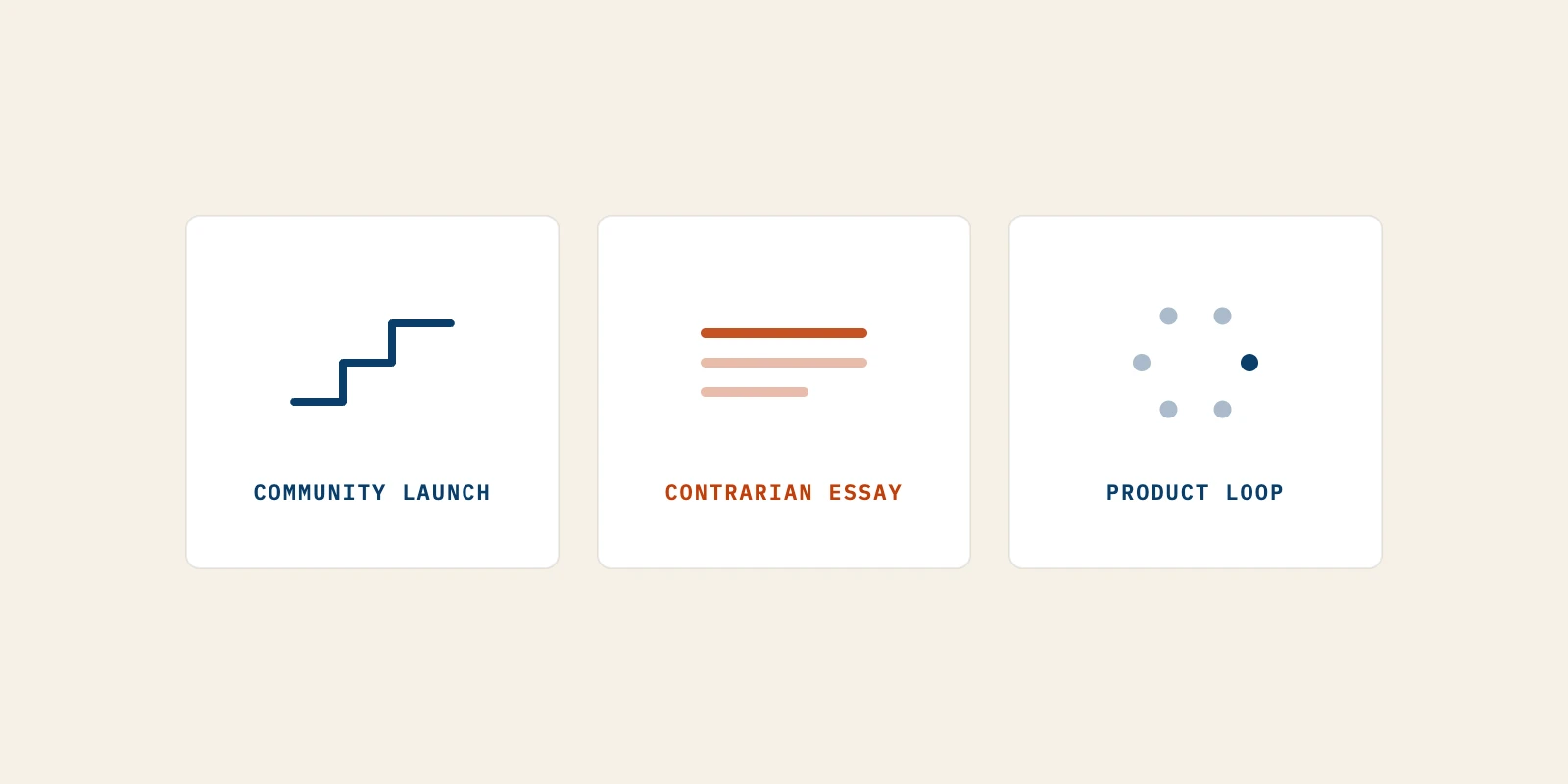
PostHog, Plausible and SavvyCal built early B2B demand without big ad budgets, each through a different engine: a community launch, a contrarian essay and a product loop. The numbers come straight from the founders' own accounts.
The catch is that each one rode an asset the founders already had: a product people used, a view they held, or a feature that spread on its own. Borrowed tactics fail without that asset. Find yours first, then let an outside team multiply it.
1. PostHog Built a Community Launch on Real Usage
PostHog's demand engine was a Hacker News launch for an open-source product developers could deploy themselves. I read it as a launch built around usage.
In James Hawkins's account (Jun 21, 2024), the team asked friends first, then posted on Hacker News and hit 300 deployments within a couple of days, five weeks into building according to PostHog. They reached 100 users in four weeks and 1,000 in three months. The product worked on day one, so the attention turned into usage.
It also fit the surface: built for developers, self-hostable, open source, easy to deploy and free at launch.
There were costs. PostHog spent about $2,000 promoting the repo on Twitter, which, with Hacker News, got it trending on GitHub, and the team spent weeks building before launch. If your product needs a custom demo, procurement review or private onboarding, build the launch around something buyers can use that day.
What transfers is the launch surface: go where your ideal customer profile gathers and bring something usable. For the full mechanics, see our full PostHog teardown.
2. Plausible Shared a Contrarian Essay Where Its Buyers Read
Plausible's demand engine was one strongly argued essay, shared by hand in the communities its buyers read. It works as a model for tech companies because the essay led with a point of view.
Before the push, Plausible had 27,300 unique visitors in about 15 months according to Plausible. After the relaunch, it got more than 48,000 in the first week, plus 166 new trials, more than the previous four months combined.
The founders posted it on Twitter, Mastodon, Indie Hackers, Lobsters, Hacker News and Reddit, and Rand Fishkin and April Dunford were among those who shared it. It worked because it argued a position buyers already half-held, in the places they already read.
The cost was the time to write and defend a real position, with no control over whether communities picked it up.
What transfers is writing the view your buyers argue about. Mine sales calls, support threads and founder conversations for a recurring tension, then turn it into a sharp essay. For the trust layer behind this example, read what Plausible's numbers teach about trust.
3. SavvyCal Built a Loop Into Every Booking Link
SavvyCal's demand engine was a product-led viral loop. Every booking link carried the product's name to a new person, so normal use created distribution.
Founder Derrick Reimer said, "This 'viral loop' drives traffic and awareness, every time someone uses SavvyCal, they are getting it in front of another potential customer" in a Product Hunt AMA.
A "Scheduling by SavvyCal" link appears on every booking link unless a Premium customer switches it off. Links embedded on users' websites also raised savvycal.com's domain authority, which helped SEO.
The loop works because the recipient is often a potential customer who sees the product's value in a real workflow. The cost is product design: the loop has to be built into the product.
What transfers is finding the moment your product touches a non-user, such as an invitation, report, shared dashboard or booking link. For more, read how SavvyCal designed for the link recipient.
| Example | Engine | Asset It Rode | Repeatable Part |
|---|---|---|---|
| PostHog | Community launch | A product people could deploy on launch day | Launch planning and distribution to the right communities |
| Plausible | Contrarian essay | A clear view buyers already half-held | Writing, editing and hand distribution of each new essay |
| SavvyCal | Product loop | A link that reached non-users every day | Pages and content that turn loop traffic into trust |
What the Three Examples Share
All three examples paired one asset the founders already had with distribution to a place their buyers already were, and none of them ran several channels at once. That is the demand generation pattern I would take from PostHog, Plausible and SavvyCal.
The tactic is the easy part to copy. The asset underneath it is the part you have to find.
PostHog had a product developers could deploy. Plausible had a point of view its buyers already cared about. SavvyCal had a feature that carried the product into another person's workflow.
I would also notice the focus. Each example had one main surface at the start. Hacker News mattered for PostHog, community distribution mattered for Plausible, and booking links mattered for SavvyCal.
That focus makes the work easier to inspect. If the launch does not convert, you can check the product and the community fit. If the essay does not travel, you can check the argument and the distribution. If the product loop does not create trust, you can check the recipient experience.
The shared mistake I see founders make is starting with channel volume. They ask for a podcast, webinar, newsletter and social calendar before naming the asset those channels will carry. I would reverse that order.
Pro tip: Write the asset in one sentence before choosing the channel. If the sentence is vague, the demand generation plan will usually spread too thin.
What a B2B Demand Generation Agency Can Run From Each Example
Once the founder has found the asset, a B2B demand generation agency can run the repeatable part of the engine every week, which is where most founder-led demand generation stalls. I see the founder's role as supplying the raw truth, while the agency turns it into a steady operating rhythm.
For a PostHog-style community launch, I would not ask an agency to invent developer credibility from nothing. I would ask it to plan the launch sequence, shape the landing page, prepare the community posts, write follow-up content, and capture buyer questions after the first wave.
For a Plausible-style essay engine, the founder supplies the view. The agency can interview the founder, sharpen the argument, edit the essay, prepare community-specific versions, and build the next search layer. An AI SEO service can also extend the essay's reach in search and AI answers after the original community spike fades.
For a SavvyCal-style product loop, the agency does not own the product decision. It can build the pages, help docs, comparison content and trust content that receive loop traffic. That matters because a non-user who clicks from a shared link often needs proof before they remember the product later.
I would hand the engine to an agency without losing the buyer by keeping three founder inputs close to the work:
The asset, a product people can try, a view, or a feature that travels
The buyer language from real conversations
A weekly slot to answer questions the engine creates
This is also where I draw a firm line around budget. We run zero ad spend, so I think of demand generation as trust-first execution, not buying attention and hoping it converts.
The agency job is repetition with taste. Founders often do the first version well because they care deeply. The hard part is turning that first version into weekly planning, writing, distribution and follow-up without flattening the founder's judgment.
Where These Examples Stop Transferring
These examples break when you copy the channel without the asset. The models still transfer, but the surfaces change with your market.
Your buyers may be enterprise. Keep the engine and change the room: a PostHog-style launch becomes a private roundtable where a named group sees a working artifact.
PostHog and Plausible may look lucky on Hacker News. Luck helped with reach, but it needed something to grab: a deployable product and an argument worth passing along.
To cut dependence on one community, turn a Plausible-style essay into a point-of-view memo for a named list of buyers, partners and influencers.
Your product may lack a natural loop. Create a shared artifact instead, such as a report, assessment or dashboard export that buyers forward to colleagues.
Three software examples make a small sample. Enterprise founders should translate the engine and adapt the channel.
That makes a good agency assignment. The founder brings market judgment, and the agency maps the motion to the buyer's environment.
Find the Asset, Then Scale the Engine
The best demand generation examples are not tactics to copy but engines to understand, one asset, one place the buyers already are, run consistently. I would use PostHog, Plausible and SavvyCal as prompts for finding your own asset, not as scripts.
If you are weighing a B2B demand generation agency, ask what part of the engine you already have. Then ask what needs to happen every week so more of the right buyers encounter it.
That is the work I would scale first, and it is the trust-first demand generation work we build at Better Marketing.