Most companies looking for a content marketing agency and an SEO agency are shopping for two vendors to do one job. A combined SEO content marketing agency does the job as one system: the same team researches what your buyers are asking, writes the pages that answer it, and builds the technical foundation that lets Google and AI assistants actually find and quote it. That is the right setup more often than not. It is the wrong one when the real problem is not content at all, and the honest version of this guide says so.
Why "SEO agency" and "content marketing agency" became two different pitches.
The split is mostly historical. SEO agencies grew out of link building, technical audits and rank tracking, disciplines that used to require almost no writing at all. Content marketing agencies grew out of editorial and brand storytelling, disciplines that used to treat search as someone else's problem. Google's own SEO starter guide makes the overlap plain: it spends more time on writing content people actually want than on anything technical, because ranking was never separable from what the page says. Two industries built around one job is still an odd way to buy the work, and most buyers researching this question are really asking whether they still need both vendors at all.
What a combined SEO content marketing agency actually does.
One team runs four things as a single sequence instead of a handoff between two vendors: buyer and keyword research, writing that answers the real question instead of describing the product, on-page structure built so Google and AI assistants can both read and quote it, and a measurement pass against what was actually promised. That sequence is close to how our own AI SEO service is built, because the alternative, a content team that writes first and hands the page to an SEO team afterward, is where most buyer-language pages quietly drift away from what people search.
When one team for both is the right call.
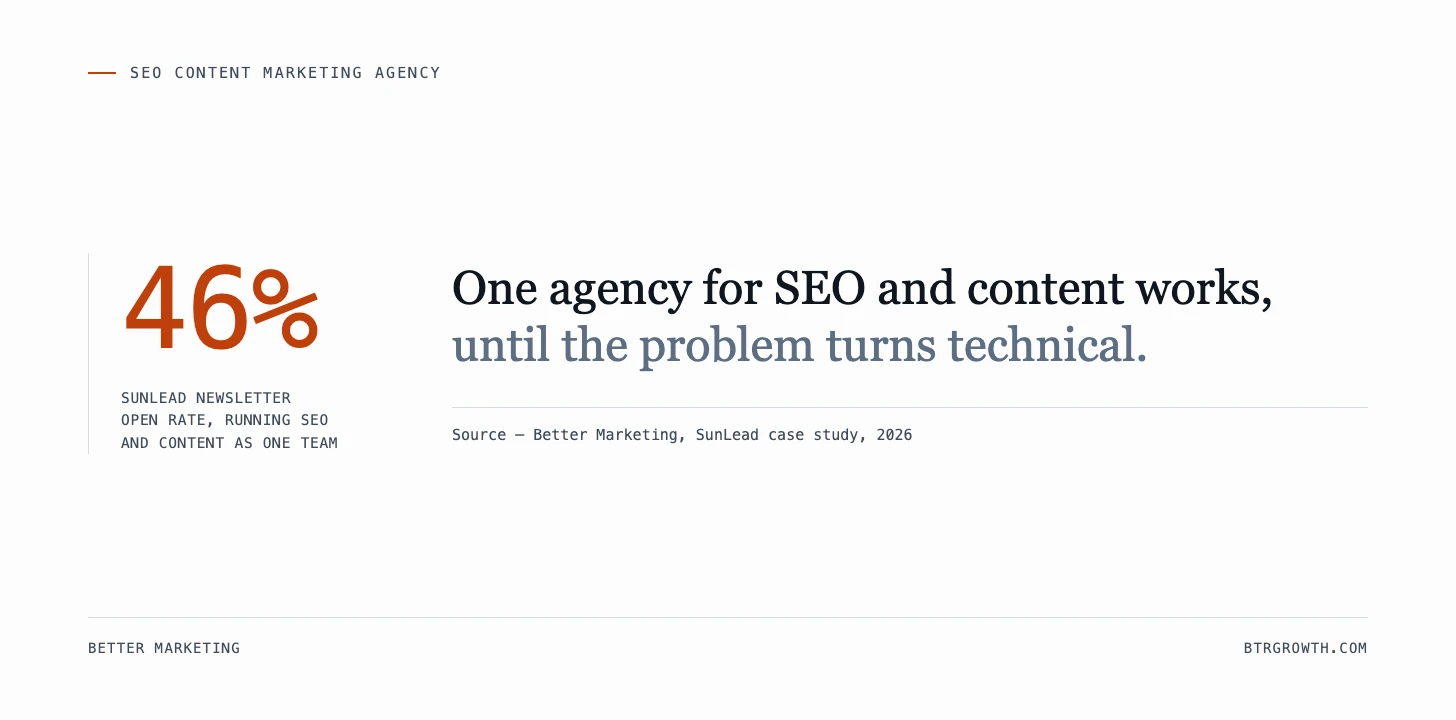
Combining the two works best for a company with no content engine yet, where the keyword research and the buyer research are the same research. There is no existing SEO to protect and no content backlog to clear, so there is nothing for a second vendor to inherit. We ran SEO and content as one system for SunLead and saw a 46 percent newsletter open rate and a 9 percent click-through rate, roughly 2.2 times the 21.3 percent B2B benchmark, the kind of gap that shows up when the same team that found the topic also wrote it and structured it, rather than three different people touching it in sequence.
When it is not the right call, and why we say so.
A combined agency is the wrong hire if your actual problem is technical: Core Web Vitals failing, a migration that broke rankings, or a crawl budget issue on a large site. None of that gets fixed by better writing, and a content-led shop, including this one, is not built to diagnose it. Google's own Core Web Vitals documentation is a reasonable test: if you cannot describe your LCP, INP and CLS scores, that is a signal you need a technical specialist first, not another content plan.
We should also say where our own model is weak, since a buying guide that only flatters its own approach is not one you can trust. We do not run paid ads, so if the goal is fast, purchased traffic while organic content compounds in the background, this is not that agency. And content-led SEO is slow by design. It does not produce a ranking move in a month, and it should not be sold as if it does.
What to check before you sign a combined retainer
- Ask to see one real technical fix they shipped for another client, not a slide describing their process.
- Ask what publishing cadence they can sustain publicly for three months, not what they can promise for the pitch.
- Ask whether one person does the research and the writing, or whether it is quietly split between two internal teams anyway, which puts you back where you started.
- Ask what happens if nothing is ranking in six months: a revised plan, or the same plan repeated.
For the content-evaluation half of this same question, we wrote a longer breakdown of how to vet a content marketing agency specifically, including when not to hire one at all.