
Quick Answer
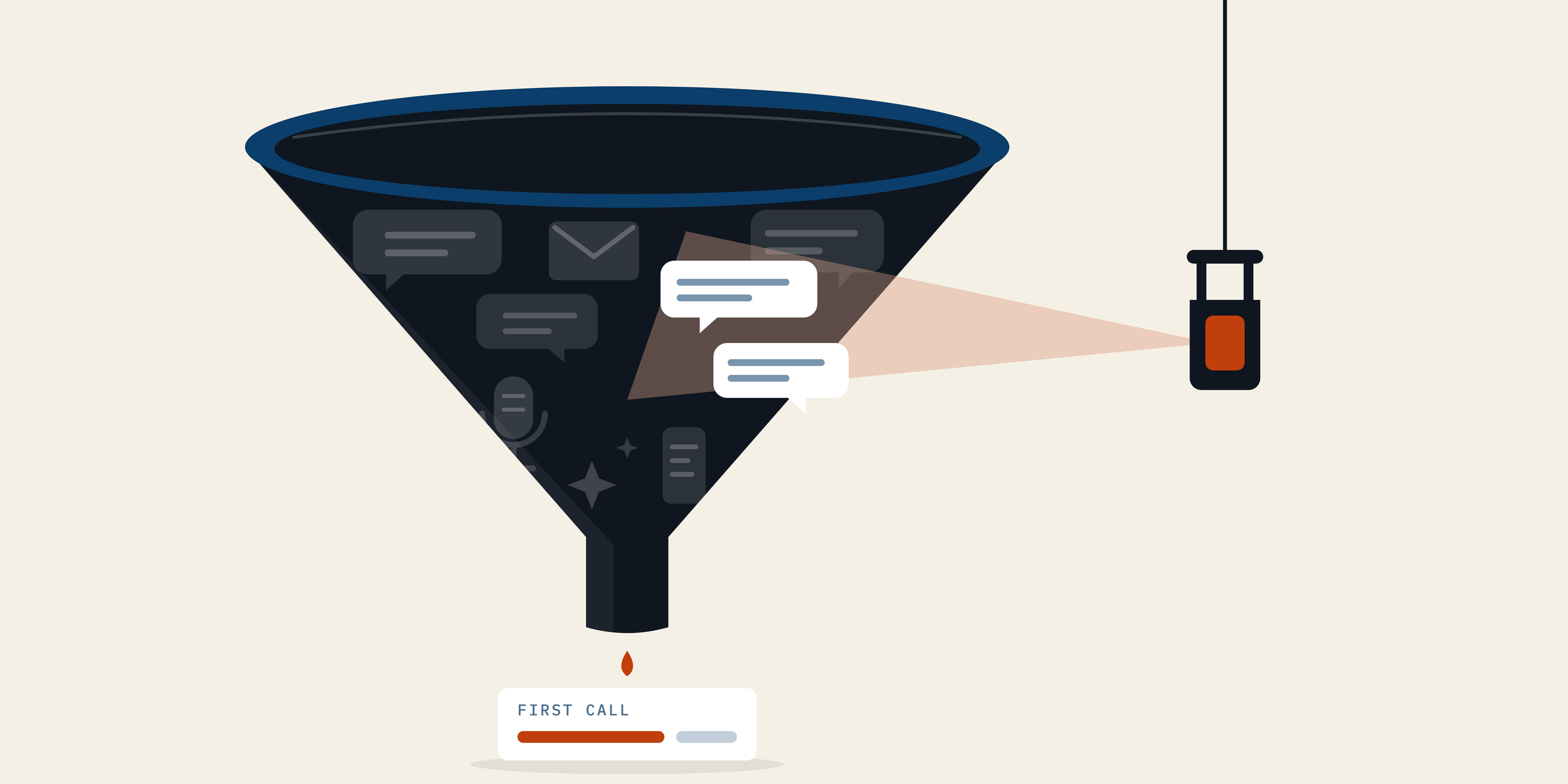
The dark funnel is the part of a B2B buying decision that happens where analytics cannot see: peer advice, private chats, communities, podcasts and AI answers. A seed-stage founder can work it without intent software by mapping where buyers talk, putting something worth repeating into those places, and asking every new prospect what they heard and where. A B2B demand generation agency fits once that loop produces named conversations.
Your CRM says the last three demos came from Google or Direct. I would bet none of those buyers first met you on Google.
The dark funnel covers everything that shaped their choice before that click: a colleague's recommendation, a Slack thread, a podcast, an answer from ChatGPT. It grew out of dark social, a term for shared links that carry no referral data, which Wikipedia credits to Alexis Madrigal at The Atlantic.
When I checked Google for "dark funnel" on 13 October 2026, five of the eight results came from companies that sell data, attribution or AI-tracking software. Their answer is more tracking, which a seed-stage company has neither the budget nor the traffic to use.
In this post I cover three ways to work the dark funnel without buying tools, a map of where it sits for a small B2B company, what software can and cannot see, and how to tell it is working.
How to Work the Dark Funnel Without Buying Tools
You work the dark funnel without tools by doing three things in order: find the rooms where your buyers talk, give them something worth repeating there, and ask every new prospect what they heard. None of the three needs software, and all three get better each month you run them.
The reason to bother is that the shortlist forms in the dark. In the 6sense 2025 Buyer Experience Report, 77.0% of buyers said their first vendor conversation was with the vendor they finally chose. The same report found the winner was already on the day-one shortlist 95% of the time.
1. Map Where Your Buyers Talk Before They Call
Start by listing the places your buyers ask each other for advice. Ask your last ten customers and prospects which Slack groups, newsletters, podcasts, forums and people they trust when they look at a tool like yours.
Look for the answers that cluster. If the same online community, newsletter or podcast comes up in three separate conversations, it matters more than any channel list you could buy.
Map the buying center too, not only the person who booked the call. A finance lead and an engineer often discuss you in a channel you will never see, so I want to know which rooms each of them sits in.
2. Put Something Worth Repeating Into Those Rooms
The dark funnel runs on word-of-mouth marketing, so the job is to give buyers something they will repeat without you. That might be a clear point of view on their problem, a useful template, or an honest teardown of a common mistake.
Show up in the rooms as a person, not a brand. A founder who answers questions in a community for three months gets mentioned in dark social threads that a company account never reaches.
I also write for the second reader. Most pieces that spread inside a company are forwarded to someone who never saw the original post, so each one has to make sense without context.
3. Ask Every New Prospect What They Heard and Where
The dark funnel surfaces on the first call, so ask about it there. I ask two questions: what made you start looking, and where did you first hear about us.
Write the answers down in the buyer's words, including names of people, podcasts and groups. After twenty answers you will see which rooms are working, and I explain how to collect and report this in a guide to self-reported attribution.
Pro tip: Add a free-text "How did you hear about us?" field to your booking form, never a dropdown. A dropdown forces the buyer to pick a channel, and the dark funnel lives in the names they would have typed.
Where the Dark Funnel Sits for a Small B2B Company
For a small B2B company, the dark funnel sits in seven places, and each leaves a different trace you can learn to read. The table is my map of the b2b buyer journey before first contact, with one move a founder can make in each place.
| Place | What happens there | Trace it leaves you | One move to make |
|---|---|---|---|
| Peer recommendations | A buyer asks someone they trust what to use | "A friend told me about you" on a first call | Ask happy customers who else has the problem |
| Private Slack, Discord and WhatsApp groups | Threads compare tools and vendors | A spike of direct visits after a mention | Join two groups and answer questions for a quarter |
| The buying group's internal chat | Your link is forwarded with a one-line comment | Several visitors from one company in a week | Write pieces that work without you in the room |
| Podcasts and recorded talks | A buyer hears your view while commuting | A branded search days later | Pitch two niche shows your buyers name |
| AI assistants such as ChatGPT | A buyer asks for options and gets a short list | Often nothing at all | Publish clear, specific answers AI can quote |
| Review sites and comparison pages | A buyer reads about you without signing in | Little or nothing | Ask early customers for honest, specific reviews |
| Founder posts read without a like | A buyer follows you quietly for months | "I've been reading your posts" on the call | Post on one problem, every week, for months |
The AI row is the newest and the least visible. When a buyer asks ChatGPT for options, the answer often arrives with no click to your site at all, which I looked at in what AI search referral numbers leave out.
Notice that most traces are words, not numbers. That is why a founder who listens on calls sees more of the dark funnel than a dashboard does.
What Intent Data and Attribution Software Can and Cannot See
Intent data and attribution software can show which companies read about your category and which pages they visited. They cannot show the conversation where a peer recommended you, and that conversation is the dark funnel.
Attribution means identifying which actions contributed to an outcome, and it can only credit actions it recorded. Web analytics records visits, so a deal started by a podcast mention gets credited to the branded search that came weeks later.
The tools also need volume. Account-level signals and model-based scoring work when hundreds of target accounts produce enough activity to rank, and a seed company selling to fifty accounts rarely has that. Most dark funnel marketing advice skips this point, because most of it is written by the companies selling the tools.
Timing matters as well. The 6sense report found buyers made first contact at 61% of their journey in 2025, down from 69% the year before, so even an early contact arrives after much of the shortlisting is done.
Pro tip: Before buying any intent data tool, ask the vendor how many of your named target accounts it could identify last month. If the answer is a handful, your call notes already know more.
How to Tell the Dark Funnel Is Working for You
You can tell the dark funnel is working when buyers arrive already knowing what you think, and first calls start in the middle of a conversation rather than at the beginning. These signs show up in notes and inboxes long before they show up in a report.
Prospects quote your phrasing for their problem
"A colleague sent me your post" appears in call notes
Branded searches and direct visits rise after you appear in a community or on a podcast
Several people from one company read you in the same week
How-did-you-hear answers name people and groups, not channels
I count these monthly, as named examples rather than percentages. With a small number of deals, the stories tell you more than any rate, a point I make in more detail in the demand generation metrics that matter.
When a B2B Demand Generation Agency Should Run the Loop
A B2B demand generation agency should run this loop once your map, your content and your first-call questions produce named conversations, and your own hours have become the limit. Before that point, the founder holds most of what makes the dark funnel work: the relationships and the point of view.
Keep the founder in the rooms where buyers know them by name. Hand over the writing, the distribution, the community calendar and the monthly count of signals.
Ask any agency how it would learn where your buyers talk before it plans a single post. A good answer starts with interviews and call notes, and a weak one starts with an ad budget or a tracking tool.
Map the Rooms, Then Give Buyers Something to Repeat
For a seed-stage company, the dark funnel is a listening and presence problem. I would map the rooms your buyers trust, put one useful, repeatable idea into them each week, and ask every prospect where they heard about you. When that loop produces conversations and your calendar fills, a B2B demand generation agency can carry it, and that no-ads, trust-first work is what we do at Better Marketing.