
Quick Answer
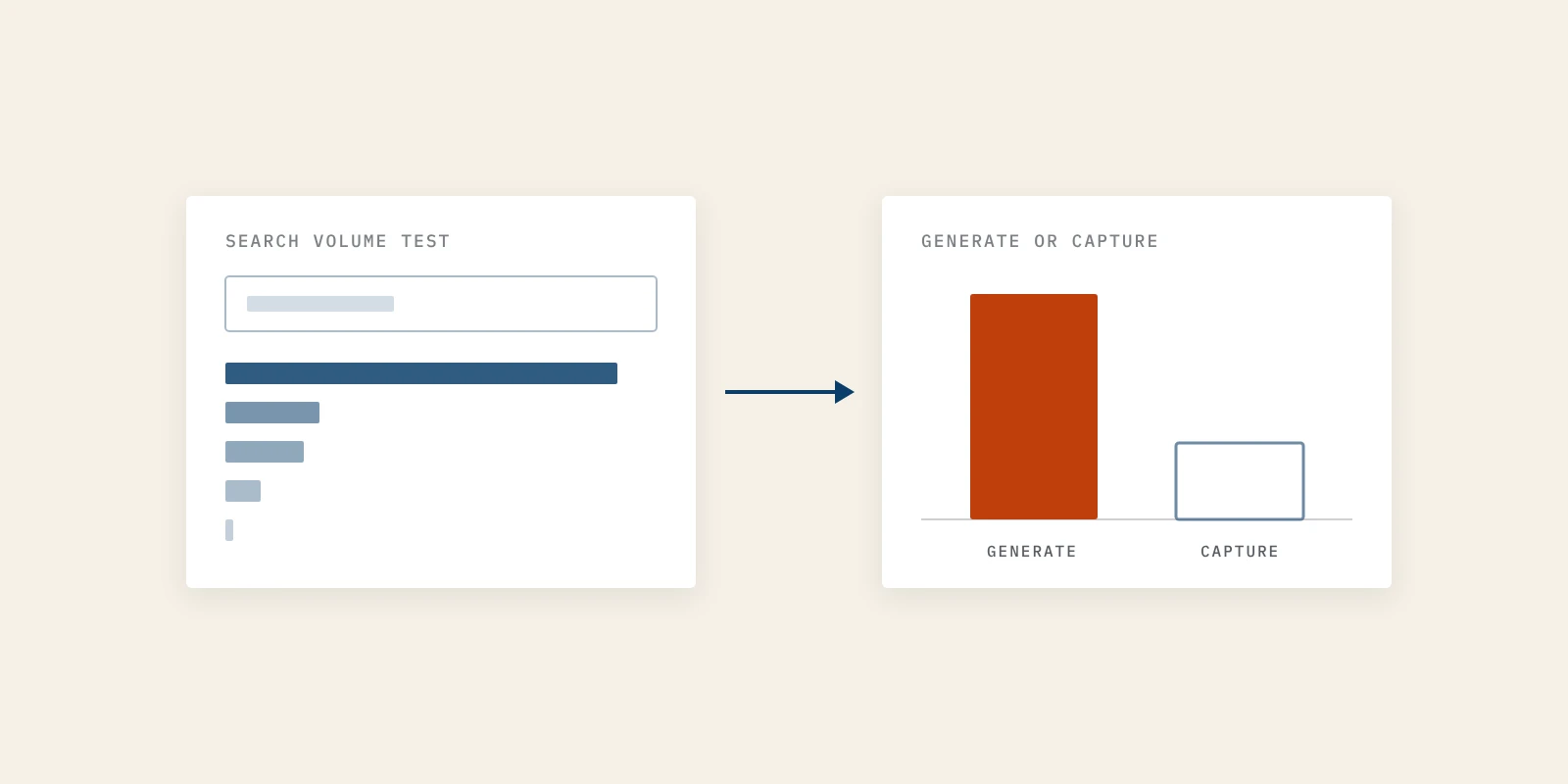
Demand generation builds interest among buyers who are not looking yet, while demand capture converts buyers who are already searching for a fix. For a founder with no ad budget, a short search volume test on the buyer's own phrases decides the order: near-zero volume means generation comes first, and real volume means organic capture pages come first. Anyone hiring a B2B demand generation agency should ask how it splits the two.
Your first customers came from old colleagues, and that list has now run out. Demand generation is the work of making people who are not shopping yet know and trust you, so you are on their list when they start. Demand capture is the other half, which means being easy to find and easy to pick when someone is already looking.
When I researched demand generation vs demand capture on 6 October 2026, Google's AI Overview listed pay-per-click ads and retargeting as capture tactics, and Perplexity called capture cheap and fast. That speed is real for paid search, which a founder without an ad budget cannot buy.
In this post I cover what separates the two, a search volume test that tells you which to fund first, how to capture and create demand without ads, how to measure each, and what to ask an agency.
What Separates Demand Generation From Demand Capture
Demand generation reaches buyers before they are looking, and demand capture converts the ones who are looking now. The split matters because most of your market sits in the first group on any given day.
The LinkedIn B2B Institute puts a number on that. Its 95-5 rule page says the research "shows that 95% of your potential buyers aren’t ready to buy today." The same page notes that 80% of companies change banking services once every five years.
The rule comes from John Dawes, whose chapter on it sits in the How B2B Brands Grow report, joint research by the Ehrenberg-Bass Institute and the LinkedIn B2B Institute. I treat it as a direction, not a forecast for your market.
| Question | Demand generation | Demand capture |
|---|---|---|
| Who it reaches | Buyers who are not looking yet | Buyers searching or asking for a fix now |
| What it builds | Memory, trust and brand awareness | A place on the shortlist at the moment of choice |
| No-ad channels | Founder posts, a newsletter, podcast guest spots, original data | Comparison pages, review sites, replies to recommendation threads, referrals |
| How fast it shows | Months, often longer than one sales cycle | Weeks, once a page ranks or a thread gets an answer |
| What to count | Replies, named accounts engaging, how new leads say they heard of you | Demo requests, trials and opportunities sales accepts |
| Main risk | Attention that never turns into a conversation | A ceiling set by how few people search |
You will also see the pair written as demand capture vs demand generation, or as demand creation vs demand capture. Some teams use demand generation as the umbrella for both halves. I use it for the creating half only, because that is the half founders skip.
Lead generation is a different job again, because it collects contact details on either side. I compared it with demand generation in demand generation vs lead generation for seed-stage founders.
Run a Search Volume Test Before You Choose a Side
The quickest way to choose is to check if anyone searches for your problem in the words your buyers use. If they do, there is demand to capture today. If they do not, demand generation has to create it first.
Perplexity and ChatGPT both told me to capture first when I asked them on 6 October 2026. That advice holds only when there is something to capture. The test below needs one keyword tool and a list of five phrases.
1. Write Down Five Phrases Your Buyer Would Type
List the problem in the buyer's words, not in your category name. Include one phrase for the pain, one for the job, one for the tool type, one for a competitor's name plus "alternative" and one for the price question.
I take these from sales call notes and support emails when they exist. A founder who sold to old colleagues usually has those notes already.
2. Check Monthly Searches for Each Phrase
Run each phrase through a keyword tool set to your buyer's country. Google's Keyword Planner has a "Get search volume and forecasts" option, though its help page says you must enter billing information to reach its basic features. We use Ubersuggest set to the United States, and we write down each number with its date.
Pro tip: Record a zero as a zero. Google's help page says keywords with very low search volumes are not discoverable or forecastable, so a blank result belongs in your notes too.
3. Read the Pattern Across All Five Phrases
One phrase tells you little. Five phrases show you where buyers already have words for the problem and where they do not.
Here is the test run on this post's own topic, measured in Ubersuggest for the United States on 6 October 2026.
| Phrase | US searches a month |
|---|---|
| demand generation | 2,900 |
| demand capture | 50 |
| demand generation vs demand capture | 40 |
| demand creation vs demand capture | 10 |
| demand capture strategy | 0 |
The idea of demand generation has wide search demand. The capture side has a little, and its strategy phrase has none. If I sold a demand capture service, this pattern would tell me to generate demand for the idea before I build pages for it.
4. Decide Where Your First Ninety Days Go
Match your pattern to a row and spend most of the next ninety days on the side it names. I use 10 searches a month as the floor, because it is the same floor we use before we write a post.
| Pattern | What it tells you | Where the first ninety days go |
|---|---|---|
| No phrase reaches 10 searches a month | Buyers do not search for this yet | Demand generation: founder posts, a newsletter and direct conversations |
| One or two phrases reach 10 or more | A small group already searches | Capture those phrases with pages, then generate demand for the rest |
| Most phrases reach 10 or more, competitor names included | The category is known and shopped | Capture first with comparison and alternatives pages, with one generation channel running |
A zero does not always mean nobody wants the product. Often it means buyers use other words, which I explain in why zero search volume is a positioning issue. Re-run the test with their words before you give up on capture.
The test has limits. It reads search only, so it misses demand that shows up in Slack groups, private referrals and AI assistants. Treat it as the first cut, then check one of those places by hand.
How to Capture Demand Without Paying for Ads
You can capture demand without ads by being findable in the places buyers check when they are ready. The catch is that organic capture starts slower than paid search, so the fast items below matter most in month one.
These are the capture channels I would run with no ad budget, fastest first:
Replies to recommendation threads on Reddit and LinkedIn, where someone asks which tool to use.
Referrals from current customers, asked for directly after a good result.
Listings on the review sites and directories your buyers already browse.
Comparison and alternatives pages built through search engine optimization, which can take months to rank on a new domain.
Plain answers on your own site that AI assistants can quote when a buyer asks them for options.
Organic capture still costs something. It costs founder hours instead of ad spend, so your customer acquisition cost shows up in your calendar.
Pro tip: If your test showed volume for a competitor name plus "alternative", build your first capture page around that phrase. A buyer on that page already knows the category and is comparing.
I start here when the test shows real volume, because a capture page keeps working after the founder stops posting. Demand generation does not work that way, which is why it needs the steady channels in the next section.
Which Demand Generation Channels Work When Your Network Runs Dry
The demand generation channels that work without ads are the ones a founder can run alone, in their own voice, every week. They are slow, and none of them shows results in the first month.
Founder Posts That Teach One Problem
Post about one problem your buyer has, using what you saw while building the product. Content marketing on a founder's own account reaches people who would never search for your category. It builds brand awareness with the right few hundred people rather than with everyone.
A Newsletter for Buyers Who Are Not Ready
A newsletter keeps you in front of people during the months before they buy. Its job is memory, not clicks, so I judge it by replies.
Guest Spots on Shows Your Buyers Already Hear
A podcast or newsletter that your buyers already follow lends you its audience's trust for one episode. Pick shows by who listens, not by download counts.
Original Data From Your Own Work
Publish one number you measured yourself that nobody else has. We do this on our own blog, and the search volume table in this post is an example.
How to Measure Demand Generation Metrics and Capture Results
Measure demand generation by who starts talking to you, and measure capture by what converts. Both should end in the same place, which is a sales pipeline of named accounts with a next step.
| Side | Count every week | Do not trust on its own |
|---|---|---|
| Demand generation | Replies, named accounts engaging and what new leads say when asked how they heard of you | Impressions, follower counts and page views |
| Demand capture | Demo requests, trials and opportunities sales accepts | Clicks and form fills with no follow-up call |
The cheapest way to see demand generation working is to ask every new lead how they found you, in an open text box. I explained how to run that in self-reported attribution for seed-stage teams. With small numbers, read the answers one by one instead of turning them into rates.
What to Ask a B2B Demand Generation Agency About the Split
If you hire help, ask how the agency divides its hours between creating and capturing demand. A good answer names the test it would run first and the side it would fund in month one.
Then ask what capture means in its plan. If the answer is search ads and retargeting, you are buying a paid media program, not the no-ad work I describe here.
I would put that question to any B2B demand generation agency, ours included. Ask to see the split in writing, with one weekly number beside each side.
Run the Search Test, Then Fund One Side First
Demand generation and demand capture do different jobs, and a founder with no ad budget cannot fund both at full strength. Run the search volume test on your buyer's own words, put the next ninety days into the side it points to, and keep one channel alive on the other side.
If you would rather have a team run that work, a B2B demand generation agency should show you the split before it starts. That is how we plan it at Better Marketing, with no paid ads in the mix.