
Quick Answer
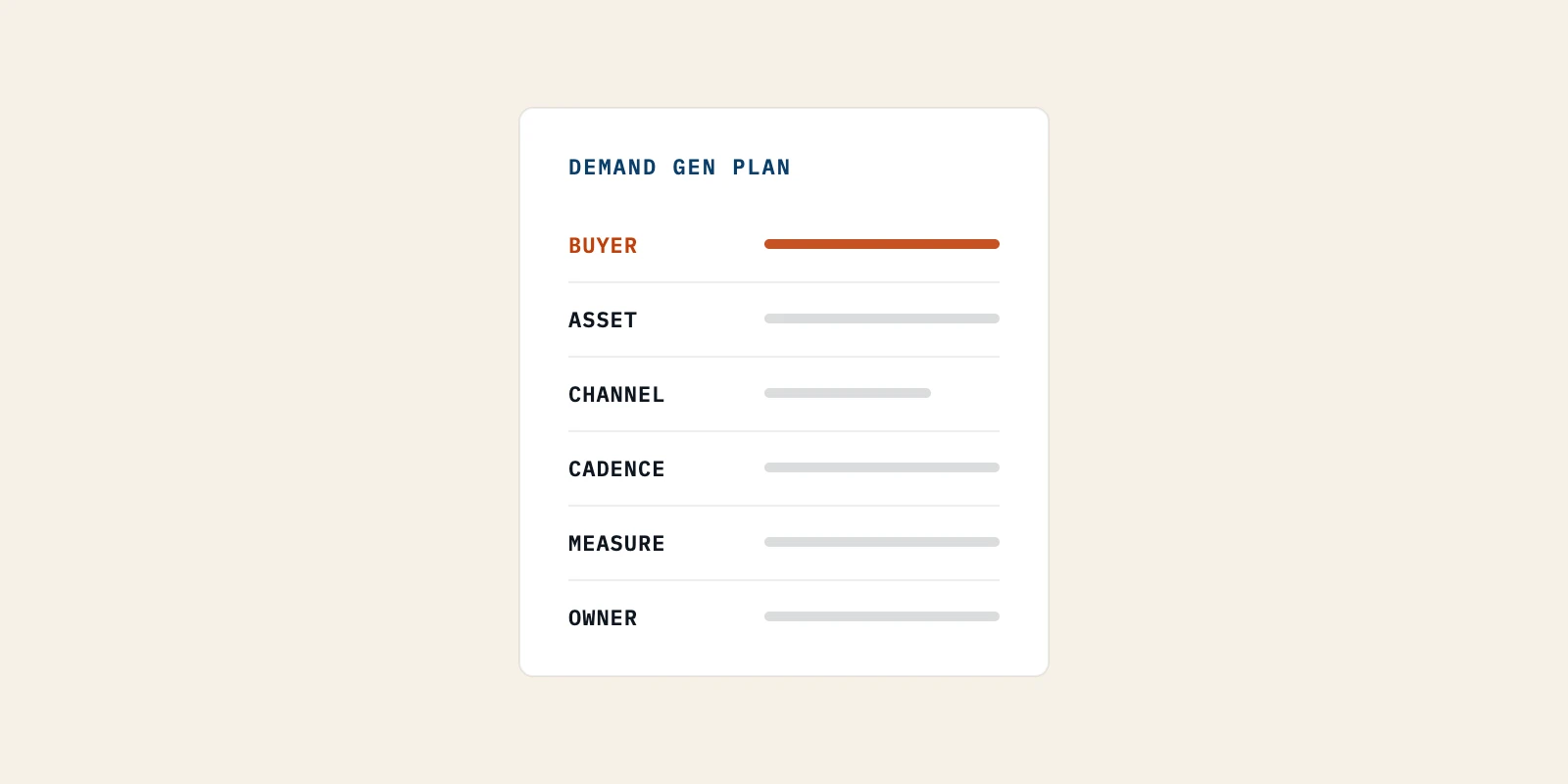
A one-page B2B demand generation plan needs seven lines, the buyer, the asset, one channel, the cadence, task owners, a goal with measures and a review rhythm. Each line must be specific enough to check. A team with no ad budget can run it with founder-led content and outreach, while a B2B demand generation agency can take over repeatable production, distribution and reporting without changing the plan.
Most demand generation plan templates feel wrong at seed stage because they read like campaign sheets for teams with ad budgets, automation and a full marketing bench. I want a B2B demand generation plan that a founder can fill in this week and defend in a board conversation.
In plain English, demand generation means creating the right attention before a buyer asks for a sales call, and Wikipedia defines demand generation as "the focus of targeted marketing programs to drive awareness and interest in a company's products and/or services." I use that definition because it keeps the plan focused on awareness, interest and buyer movement, not a pile of channel activity.
This post gives you the seven lines of the plan, a filled-in demand generation plan example, a weekly and monthly operating rhythm, the lines an agency can own and the places where one-page plans usually break.
What a Demand Generation Plan Is For
A demand generation plan decides who you are earning attention from, with what, where and how you will know it is working, and it is narrower than a full marketing plan. I use it as the operating page for earning interest from a specific buyer, not as the master document for every market decision.
Wikipedia says "A marketing plan is a strategic document developed to achieve specific marketing objectives." It outlines advertising and promotional activities for a defined period, the current marketing position, the target market and the marketing mix. A demand generation plan leaves out pricing, product packaging and brand architecture because those decisions need a different document.
| Document | What It Holds | What I Leave Out |
|---|---|---|
| Marketing plan | Marketing objectives, position, target market and marketing mix | The weekly demand generation routine |
| Demand generation plan | Buyer, asset, channel, cadence, owner, measures and review rhythm | Pricing, product roadmap and brand architecture |
One page is enough at seed stage because the question is not how many tactics you can name. The question is whether the founder, the person helping with production and the board can see the same buyer, the same asset and the same measure.
The Seven Lines of the Plan, With a Filled-In Example
A one-page B2B demand generation plan with no ad budget has seven lines: buyer, asset, one channel, cadence, owners, goal and measures, review rhythm. Each specific enough someone else could check it. No second page until one buyer, one asset and one channel produce a repeatable pattern.
Most plans fail on the first line. They name a market instead of a buyer, and everything after inherits the vagueness. An agency can run a routine, not guess a buyer nobody will name.
One example carries the template: contract-review software sold to heads of legal at US software companies with 200 to 1,000 employees. No ad budget, but a strong view, LinkedIn access and named accounts.
1. The Buyer
The buyer line says the ideal customer profile as a person and a trigger, not a market. I would write the buyer as the person who feels the problem and the event that makes the problem urgent.
For the contract-review founder, the entry is heads of legal at US software companies with 200 to 1,000 employees who have just hired their first in-house counsel. That line gives the founder a buyer, a company type and a trigger that can be checked in public profiles and company news.
The common mistake is writing mid-market companies and calling it specific. I cannot build useful demand generation from that line because it does not say who cares, why now or what pain has changed.
2. One Asset
The asset line says what you already have that can earn attention. I look for a view, a product people can try, data, or a feature that travels from one buyer to another.
For this example, the founder's asset is the view that most contract review time is spent on six clauses, plus a free clause checklist. That is stronger than a generic ebook because it carries a claim, gives the buyer something useful and invites a specific conversation.
If you need more examples of what counts as an asset, I would start with three founders who found their asset. The mistake is listing content types instead of naming the asset. Blog posts, webinars and newsletters are containers, not the reason a head of legal pays attention.
Pro tip: Write the asset as a sentence before you choose a format. If the sentence is weak, the format will only make the weakness easier to publish.
3. One Channel
The channel line says the single place the buyer already is. I want one channel because a seed-stage founder can learn faster from one tight loop than from a scattered calendar.
For this demand generation plan example, the channel is founder-voice LinkedIn posts plus direct notes to a list of 60 named heads of legal. Those 60 named heads of legal are the example founder's target list, not a benchmark for every company.
This is where content marketing for tech companies often gets too broad. The channel is not social media, search, events and email at once. It is the place where this buyer can see the founder's view and respond with a buyer's question.
If you are unsure where the first channel belongs, I would use a separate process for how to pick the first channel. The mistake is planning five channels on one page to feel safe. That usually gives the founder five ways to avoid learning which buyer signal matters.
4. Cadence
The cadence line says how often each piece ships, small enough to keep. I would rather see a dull cadence that survives than an impressive cadence that disappears after the first month.
For the contract-review founder, the entry is one post a week, ten personal notes a week and one checklist update a month. That is enough to create a weekly rhythm without pretending the founder has a marketing department hidden under the desk.
The common mistake is writing a cadence that only works during a launch week. Demand generation needs repeated buyer contact, so I treat cadence as a promise to the market and to the team.
5. Owners
The owners line says who does each task, by name, and who decides. I do not accept marketing as an owner because marketing cannot answer a buyer, join a sales call or decide the founder's point of view.
For this example, the founder owns the view, replies and sales calls. Whoever runs production owns drafts, scheduling and the weekly report. A short service-level agreement between them should say when drafts are due, who approves them and what gets reported each week.
The mistake is hiding every task under one vague owner. Demand generation breaks when the founder thinks production owns the point of view and production thinks the founder will somehow send the notes.
6. Goal and Measures
The goal and measures line says what success looks like by when, using SMART criteria and named accounts moving through stages. I want a goal that a board can inspect without needing a lead-scoring model.
Wikipedia says "SMART is a mnemonic acronym used to establish criteria for goals and objectives that are specific, measurable, assignable, realistic, and time-bound." It also says the term was first proposed by George T. Doran in the November 1981 issue of Management Review. I use specific, measurable, assignable, realistic and time-bound because they force a cleaner demand generation goal.
For this example, the goal is that by the end of the quarter, 12 named heads of legal have asked a buyer's question and 4 are in the sales pipeline. Those are the example founder's targets, not benchmarks. The point is that each movement can be tied to a named account.
If you need to define the stages before you count them, I would use four stages you can count. The mistake is measuring followers or impressions as the main proof. Those numbers can help diagnose reach, but they do not show which accounts moved closer to a sales conversation.
7. Review Rhythm
The review rhythm line says when the plan is checked and who changes it. I want the rhythm written into the plan because demand generation gets vague again when nobody owns the review.
For the contract-review founder, the entry is a 20-minute weekly check on the named-account list and a monthly review of what to keep, change or stop. The weekly check protects the cadence. The monthly review protects the strategy.
The mistake is never changing the plan, or changing it every week. If the founder rewrites the whole page after every post, the team cannot learn. If the founder never revisits the page, the plan becomes a relic.
| Line | What It Answers | Example Entry (Contract-Review Founder) | Owner |
|---|---|---|---|
| Buyer | Who exactly, and what just happened to them | Heads of legal at US software companies with 200 to 1,000 employees who just hired their first in-house counsel | Founder |
| Asset | What you have that earns attention | A view that most review time goes on six clauses, plus a free clause checklist | Founder |
| Channel | Where the buyer already is | Founder-voice LinkedIn posts and direct notes to 60 named heads of legal | Founder and production help |
| Cadence | How often each piece ships | One post and ten notes a week, one checklist update a month | Production help |
| Owners | Who does what, who decides | Founder owns the view, replies and calls, production help owns drafts, scheduling and reporting | Founder |
| Goal and measures | What success looks like by when | 12 named buyer questions and 4 pipeline accounts by quarter end (example targets) | Founder |
| Review rhythm | When it is checked and changed | Weekly 20-minute account check, monthly keep, change or stop review | Founder with production help |
How to Run the Plan Each Week and Each Month
Check the named-account list every week and decide what to keep, change or stop every month, so the demand generation plan stays one page and stays true. I would run this as a small operating habit, not as a marketing status meeting.
Each week, I would check:
Which named accounts moved a stage
Which replies asked a buyer's question
What shipped against the cadence
What the founder heard on calls that should change the asset or message
That weekly check should be short enough to survive a busy sales week. If the founder cannot explain which accounts moved, I would not let the team hide behind a shipped-post count.
The monthly review has a different job. I would ask what to keep, change or stop. The buyer line should rarely change. The asset and message can change when sales calls show a sharper pain. The cadence can change when the team proves it cannot keep the promise.
Pro tip: Keep the monthly review on the same one-page B2B demand generation template. If the review creates a separate document, the operating page loses authority.
The Lines a B2B Demand Generation Agency Can Own
A B2B demand generation agency can own the cadence, production, distribution and reporting lines of the demand generation plan, while the founder keeps the buyer, the asset and the sales calls. I like this split because it protects the founder's judgment and still removes the weekly drag.
A B2B demand generation agency turns the plan into a weekly routine from day one. The agency can draft from the founder's view, schedule the agreed pieces, distribute the asset, keep the named-account list clean and report what changed.
The plan is yours. The weekly routine is what you can hand over.
I would not hand over the buyer line. The founder hears the market before anyone else does. I also would not hand over the final point of view, because the asset needs the founder's commercial judgment. The agency can shape it, package it and keep it moving.
A written plan also makes quotes easier to compare. I can see if production, distribution and reporting are included, instead of accepting strategy meetings without shipping ownership. For the money side, I would use what an agency really costs rather than guessing from a vague scope.
An AI SEO service can also extend the asset's reach in search and AI answers after the first channel starts producing buyer language. I would add that as an extension of the asset, not as a replacement for founder-led demand generation. We do not run paid ads, so the plan has to earn attention before it can ask for a call.
Where One-Page Plans Go Wrong
One-page plans go wrong when a line stays vague, the page grows a second page of channels, or nobody reviews it. Founders fail with the format when they treat one page as permission to be shallow instead of pressure to be specific.
"A real plan needs an ad budget line."
Not at this stage. The plan needs time, ownership and a channel the buyer already uses first.
"One page is too thin for a board."
One page forces the board to react to the buyer, asset, channel, cadence and measures in a single view. Context goes in an appendix, the operating plan stays visible.
"Plan every channel at once to be safe."
Five channels in the first template means nobody can tell which message, asset or buyer signal worked.
"Without lead scoring we cannot measure anything."
Named accounts that asked buyer questions, replied with urgency or entered the pipeline are measurable without it. Scoring comes later, once the team knows which behaviours matter.
One real weakness: a single page cannot hold a multi-segment or multi-product motion without going vague. Selling to several buyer types means one plan per buyer, each page kept strict.
Seven Lines, One Page, Reviewed Every Month
A B2B demand generation plan that fits on one page forces the specific answers that longer plans let you avoid. I want the founder to name the buyer, choose the asset, pick one channel, set a cadence, assign owners, define a SMART goal and review the page every month.
That is enough to brief a board, guide production help and show which work a B2B demand generation agency can run. If you want a team to turn that page into a trust-first weekly routine, talk to Better Marketing.