Quick Answer
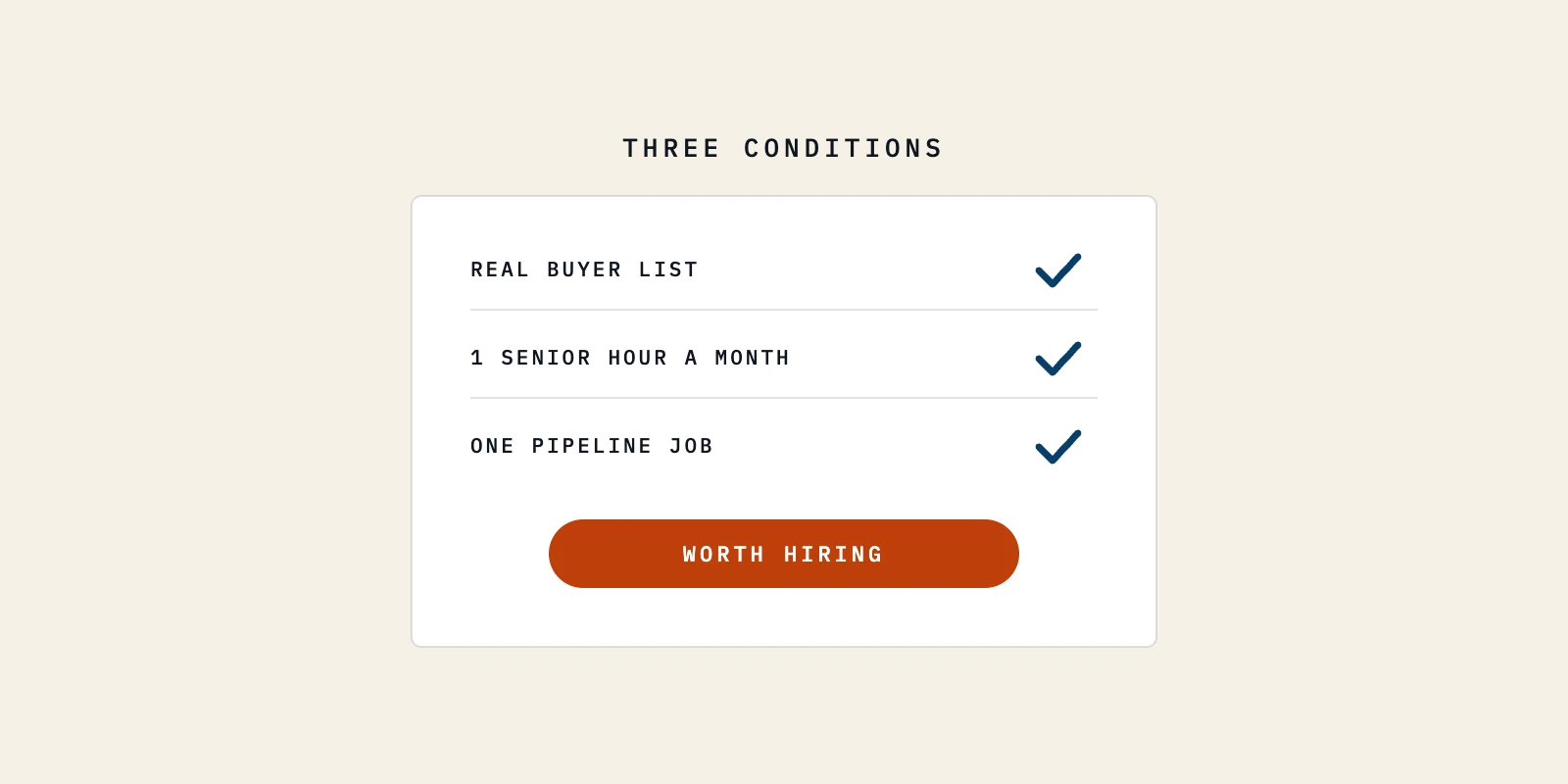
Outsourcing a B2B newsletter to an agency pays off for an early-stage startup once three conditions hold. The startup needs a list of real buyers, one senior hour a month and a clear pipeline job for the newsletter. Published agency prices checked on 22 September 2026 run from $700 to $4,999 a month. Six contract terms, led by list ownership, should be settled before signing.
Your board wants to know where pipeline will come from, and someone has suggested a newsletter. Nobody on your team has spare hours to write it, so the next idea is to pay an agency.
I see the same gap every time. The agency gets hired before anyone decides what the newsletter is for. In the Content Marketing Institute's 2026 B2B trends report, 19% of B2B marketers plan to spend more on agencies and outsourcing.
That money is easy to waste. In this blog I'll cover when outsourcing pays off, what an agency does each month, what it costs, and the terms I'd settle before signing.
When Outsourcing Your B2B Newsletter Pays off for an Early-Stage Startup
Outsourcing a B2B newsletter pays off when three conditions hold at the same time. If any one of them is missing, I'd keep the newsletter in-house for another quarter and revisit the decision then.
Here is the test I'd run, with what to do when a condition fails.
| Condition | How I'd test it | If it fails |
|---|---|---|
| You have a list of real buyers | Export the list and mark every subscriber whose company matches your ideal customer profile | Build the list first; an agency writes well to nobody |
| Someone senior gives one hour a month | Put a recurring hour in the founder's or sales lead's calendar before the kickoff call | The issues will read like anyone's newsletter |
| The newsletter has a pipeline job | Write one sentence naming the sales outcome the newsletter should move | You will judge the agency on open rates and argue about them |
1. You Already Have a List of Real Buyers
An agency can write, design and send. It cannot give your first issue an audience.
Stat Digital's own site showcases client newsletters with 10,000 to 75,000+ subscribers. The audience was there for the writing to reach.
For an early-stage startup, the count that matters is not total subscribers. I'd count only the people who match your ideal customer profile, meaning the right company size, the right role and the right industry. Those are the readers who can turn an issue into a sales conversation.
If that count is small, the better first project is building the list. I walk through that in our guide to starting a newsletter that wins first customers. Outsourcing a newsletter with no audience buys you well-written issues that almost nobody reads.
2. Someone Senior Can Give the Agency One Hour a Month
The better agencies ask for your time on purpose. Future Forest says its plans for startups take "one hour a month" of your time, and storyarb's published pricing builds monthly strategy sessions into every tier.
That hour gives the agency what it cannot research. Which deals stalled, which objection keeps coming up, and what the product team shipped. Without it, the writing drifts toward generic industry news.
For a funded founder selling to enterprise, I think this matters more than price. Enterprise buyers read a newsletter to hear how you think. I'd name the person who gives the hour before I'd shortlist a single agency.
3. The Newsletter Has a Pipeline Job
A newsletter with no job gets judged on open rates, and open rates will not tell your board anything about pipeline. I'd give the newsletter one job in one sentence before any agency sees the brief.
Good jobs for an early-stage B2B newsletter are specific. I would pick one of these:
- It keeps open opportunities warm during a long enterprise sales cycle.
- It reactivates closed-lost deals.
- It turns webinar sign-ups into booked calls.
Each of those is a form of lead generation you can count in your CRM.
Some agencies now sell against exactly this. Money Marketers targets SaaS founders with dormant pipelines. It promises "a reactivated deal or meaningful pipeline lift inside 90 days," or another 90 days of work free.
What a B2B Newsletter Agency Does Each Month
A B2B newsletter agency takes over four jobs for a business-to-business company, and outsourcing can cover some or all of them. I searched "B2B newsletter agency" on Google on 22 September 2026. The AI Overview listed strategy, content and design, and list operations as the core services.
• Strategy and Positioning
The agency decides who the newsletter is for, what each issue argues, and how it fits your wider content marketing. Stat Digital starts with an onboarding interview and runs a shared Slack channel it calls a "Newsroom" for ongoing input.
• Research and Writing
This is the part most founders picture. A dedicated writer drafts each issue, often from interviews with your team. NewsletterAsAService drafts its B2B SaaS editions from the client's product changelog, roadmap updates and industry news, in the client's voice.
• Design and Production
Production covers the template, formatting, testing and scheduling. Future Forest sells this layer on its own as "Production Only," starting at $1,500 a month, for teams that write their own issues. That is the closest thing to a done for you newsletter service without handing over the voice.
• List Operations and Compliance
An email newsletter agency also handles list hygiene, segmentation and deliverability inside your email service provider. It should know the CAN-SPAM Act of 2003, which requires opt-out requests to be honored within 10 business days. Small lists have their own sending problems, which I cover in our piece on deliverability below the bulk-sender threshold.
Three Pricing Models Behind What Newsletter Outsourcing Costs
Newsletter outsourcing is priced in three ways. An agency charges per issue, sets a scoped monthly retainer, or sets a retainer with a minimum term. I checked every price below on the vendor's own site on 22 September 2026.
| Vendor | Pricing model | Published price | Term |
|---|---|---|---|
| Stat Digital | Per issue | $700 per monthly issue; $600 per issue biweekly ($1,200 per 4 weeks); $500 per issue weekly ($2,000 per 4 weeks) | Month-to-month |
| NewsletterAsAService | Per edition | $500 for one edition; $750 a month for two editions | Not stated |
| Future Forest | Scoped retainer | From $1,500 (production only), $2,000 (production and curation), $3,500 (end-to-end) a month | Not stated |
| Money Marketers | Retainer with minimum | $3,000 a month | 3-month minimum |
| storyarb | Scoped retainer | From $4,999 a month, team of three | Not stated |
| Fame, Spacebar Studios, The Haven Agency, Lunne | Quote on request | No published price | Not published |
1. Per-Issue Pricing
Per-issue pricing is the easiest way to test an agency. Stat Digital charges less per issue as you send more often, and its plans run month-to-month. I like this model for a first quarter, because you can stop without penalty if the issues miss.
2. Scoped Monthly Retainers
Scoped retainers price the work you hand over, not the number of sends. Future Forest's three tiers show this clearly. The price climbs from $1,500 to $3,500 as the agency takes over curation, then writing and strategy. storyarb starts at $4,999 and assigns a strategist, a writer and a client success manager.
3. Retainers With a Minimum Term
Money Marketers asks for three months at $3,000 a month, then lets you cancel. A minimum term is not a red flag on its own. It does mean the first three months should be judged against the pipeline job you wrote down.
Be careful with prices an AI assistant gives you. When I asked ChatGPT on 22 September 2026, it quoted NewsletterAsAService at $399 a month.
The vendor's own page says $750 a month for two editions. Always price from the vendor's page.
To compare any of these with a scoped B2B newsletter program, ask every vendor three things. Issues per month, founder hours per month, and the notice period.
A general B2B email marketing agency often prices by send volume instead. LYFE Marketing, for example, lists $500 to $1,400 a month for two to eight email blasts, which is a different product.
Which of Four Ways to Staff a Newsletter Fits Your Startup?
Outsourcing is one of four ways to staff a newsletter, and the right one depends on who holds the knowledge your buyers want. Here is how I'd compare them.
| Option | Who writes | Founder time | Voice control | Best when |
|---|---|---|---|---|
| Full-service agency | Agency writer | About an hour a month | Shared | The list exists and the founder has no writing time |
| Production-only partner | Your team | Several hours an issue | Full | You write well but hate templates and sending |
| In-house marketer | Your hire | Review time | Full | Newsletter is one of several channels they run |
| Founder-written, edited | Founder | Several hours an issue | Full | The list is small and every reader matters |
• Full-Service Agency
A full-service newsletter marketing agency owns strategy, writing, design and sending. It suits a funded team with an established list and no spare writing capacity.
• Production-Only Partner
You keep the writing and hand over the production. This is the cheapest form of outsourcing that still removes the operational work.
• In-House Marketer
A first marketing hire can run the newsletter alongside other channels. I'd only do this if the newsletter is a small part of their week, or it will crowd out everything else.
• Founder-Written, Edited Newsletter
In my view, many early newsletters work because the founder writes them. If yours stalled, our piece on why founder newsletters die at issue four covers the usual causes. An editor can fix the drafts without taking the voice.
Six Terms I'd Settle With a Newsletter Agency Before Signing
Outsourcing goes wrong in the contract more often than in the writing. These are the six terms I'd agree in writing before the first issue.
1. The Subscriber List Stays in Your Email Service Provider
The list should live in an account you own, not the agency's. If the relationship ends, you keep every subscriber, every segment and the sending history.
2. The Retainer Is Judged on a Pipeline Metric
Pick one number the agency reports every month, such as replies from target accounts, meetings booked or reactivated deals. B2B newsletter marketing judged on opens alone leaves you nothing to show the board.
3. Founder Time Is Written Into the Scope
Put the monthly hour in the statement of work. If the agency says it needs no input from you, I'd read that as a warning about how generic the issues will be.
4. Unsubscribes Are Honored Within the Legal Window
The agency should confirm how it handles opt-outs and who is responsible for honoring them within 10 business days under CAN-SPAM. I'd want that answer in writing.
5. The Notice Period Matches Your Runway
Month-to-month terms, like Stat Digital's, fit a startup testing the channel. A three-month minimum, like Money Marketers', is fine if you plan to run the newsletter for at least that long anyway.
6. The Voice Belongs to a Named Person
Agree whose name goes on the issue and who approves each draft. NewsletterAsAService builds this in with "one named approver" on its recurring plan.
Run the Three-Condition Test Before You Sign a Newsletter Retainer
Outsourcing your B2B newsletter makes sense once three things are true. You have real buyers on the list, one senior hour a month, and a pipeline job for every issue.
Published prices run from $700 to $4,999 a month, so price from vendor pages, not AI answers. Settle list ownership, metrics, founder time, compliance, notice and voice before the first send.
I'd run the test this week. If you want a partner for it, that is the work we do at Better Marketing.