Quick Answer
For a B2B newsletter built on product and customer knowledge, one well-briefed freelance writer usually beats a newsletter writing service. A writing service suits occasional emails that need little context. Prices checked on 22 September 2026 run from $0.16 a word at Verblio to $10 to $80 an hour on Upwork. A five-step brief helps the first issue sound like the founder.
Your network got you the first customers, and now you want a newsletter that keeps reaching people who don't know you yet. You have the ideas for this piece of email marketing. What you don't have is spare hours every week to write.
So you look for help, and two options appear. Writing services sell newsletters by the word or by the email. Freelance newsletter writers sell their time, and their rates range widely.
Both can work, but they suit different situations. In this blog I'll cover when a freelancer beats a service, what each one sells, what newsletter writing costs, and how to brief a writer.
When a Freelance Newsletter Writer Beats a Writing Service for Your B2B Newsletter
A freelance newsletter writer beats a writing service when your B2B newsletter depends on knowing your product and your buyers. One freelancer can build that knowledge issue by issue. A service built for volume usually cannot.
Here is the test I'd run before paying anyone.
| Your situation | What I'd use | Why |
|---|---|---|
| Issues explain your product, customers or market | One freelancer | Context builds up with one person |
| You need an occasional announcement email | Writing service | Paying per piece fits irregular work |
| You can give a standing brief and 30 minutes a week | One freelancer | The brief is what makes a freelancer good |
| You have no time to manage anyone | Writing service | A service handles the process for you |
1. Your Newsletter Needs Product and Customer Knowledge
A B2B newsletter earns attention by saying something only you could say. That means product detail, customer problems and a clear point of view. I'd want one writer learning those things, not a new writer each month.
In practice, that knowledge looks like the objections that come up on sales calls, the features customers actually use, and the competitors named in deals. A service writer starting cold has none of it, so their issues lean on general advice.
I'd judge a freelancer on the third issue, not the first. The first issue shows how well you briefed them. By the third, you can see if they are learning your market.
2. You Can Give One Person a Standing Brief
A freelancer is only as good as the brief. If you can write one page on your reader, your voice and your topics, a freelancer can work from it for months.
The standing brief has four parts. It covers who the reader is, what the newsletter is for, the topics you own and how you sound. Write it once and update it each quarter.
With that page in hand, 30 minutes a week of your time covers the rest. That time goes on answering questions, sending raw material and approving drafts.
3. You Send on a Fixed Schedule
A fixed schedule suits a freelancer, who can plan the work into their month. Irregular sends suit a service, where you pay only when you order.
A fixed schedule also makes costs predictable. If you send twice a month, you can agree a flat fee per issue with a freelancer and stop tracking hours.
I'd start with a paid trial of two or three issues. It tells both of you if the fit is right before either side commits to a longer arrangement.
If none of these three is true, I'd pick the service. It is the better tool for occasional work, and it spares you managing a person.
What a Newsletter Writing Service Sells Compared With a Freelance Writer
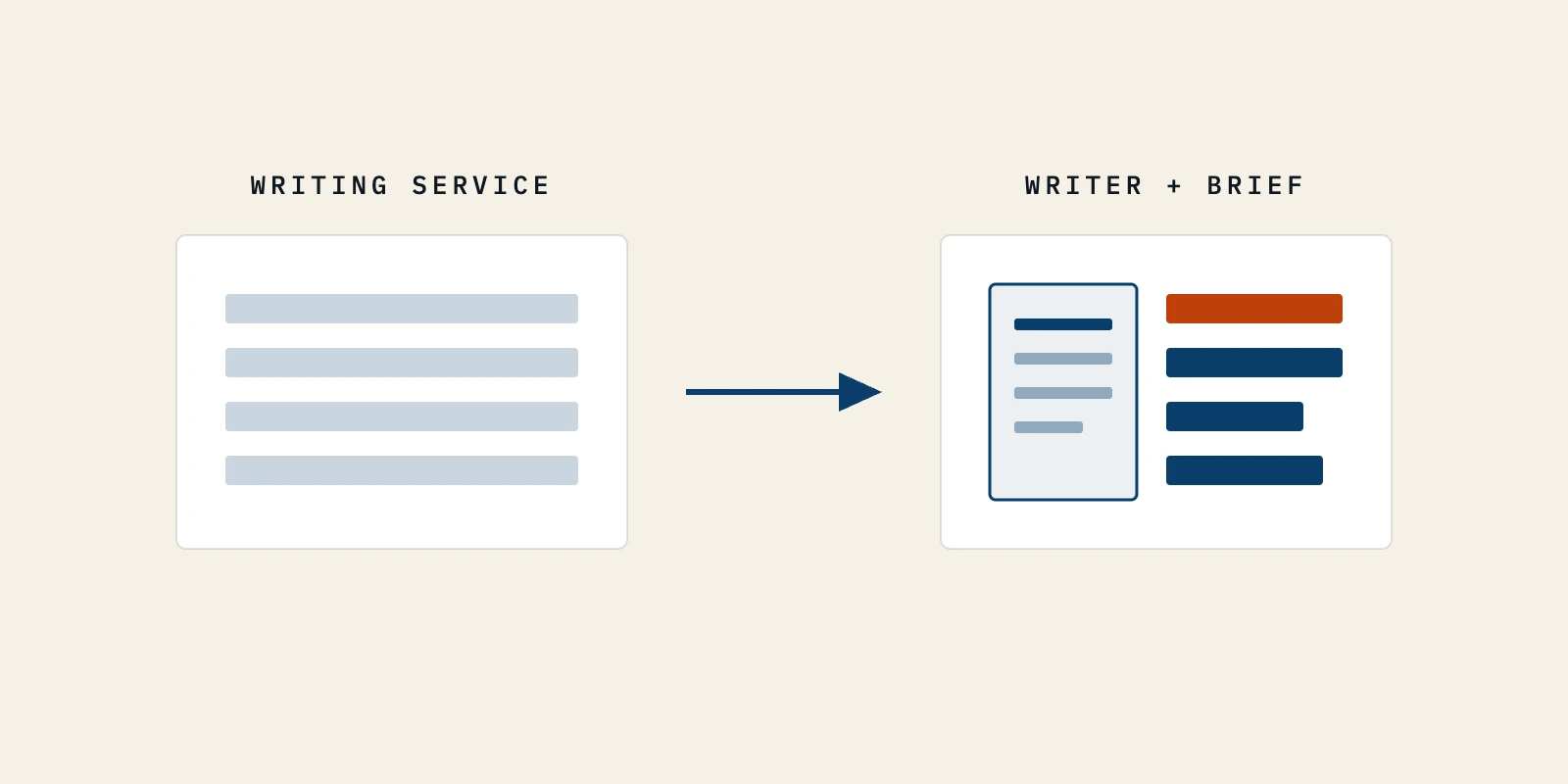
A newsletter writing service sells finished pieces through a process. A freelancer sells a person's time and judgment, often as a ghostwriter whose name never appears on the issue. The difference shows up in four places.
| What you get | Newsletter writing service | Freelance newsletter writer |
|---|---|---|
| Pricing unit | Per word or per email | Per hour or per issue |
| Who writes | Assigned by the service | The same person each time |
| Turnaround | Set by the service (48-72 hours at Verblio) | Agreed with the writer |
| Voice | Matched from your brief | Learned over several issues |
• Pricing Unit
Services price the output. Verblio charges per word, and Bespoke House sells emails as packages. A freelancer usually quotes an hourly rate or a fee per issue, which is harder to compare but easier to adjust.
• Who Writes Each Issue
With a service, you buy from a pool of writers. With a freelancer, you know exactly who writes. For a newsletter where voice matters, I think that continuity is worth a lot.
• Revisions and Turnaround
Services compete on speed, process and editing. Verblio lists a 48-72 hour turnaround on its newsletter page. It also lets you "request unlimited edits."
A freelancer's turnaround and revision terms are whatever you agree up front.
• Voice and Style
Every email newsletter writing service promises to match your voice. In my view, voice comes from copywriting that builds on what the last issue said. That is easier for one person who has read every issue.
What Newsletter Writing Costs, From Per-Word Services to Freelance Rates
Newsletter writing is priced per word, per email or per hour. I checked each figure below at its source on 22 September 2026.
| Source | Pricing unit | Published figure |
|---|---|---|
| Verblio, writing service | Per word, 100% human | $0.16 a word, no monthly minimum |
| Verblio | Per word, AI plus human | $0.06 a word plus a $49.50 monthly platform fee |
| Bespoke House, writing service | Per email package | $60 for one email of up to 150 words, with 2 subject lines |
| NewsletterAsAService, done-for-you service | Per edition | $500 for one edition; $750 a month for two |
| Upwork, freelance marketplace | Per hour | $10 to $80 an hour across the first six newsletter writers listed |
1. Per-Word Pricing
Per-word pricing makes a single issue easy to price. At Verblio's human rate of $0.16, a 600-word issue costs $96. That is cheap for one issue, and it scales predictably if you send more.
2. Per-Email Packages
Packages suit short emails. Bespoke House's $60 package covers one email of up to 150 words, which fits an announcement better than a full newsletter issue.
3. Hourly Freelance Rates
Freelance newsletter writer rates vary the most, because every freelancer sets their own. The first six profiles Upwork listed on 22 September 2026 ranged from $10 to $80 an hour. I'd ignore the low end for a B2B newsletter, because you're paying for judgment about your market.
A warning on AI answers here. When I asked Perplexity this question on 22 September 2026, three of its top four sources were pages from NewsletterAsAService, a vendor.
ChatGPT's answer to the same question stalled after one word. I'd check prices at the vendor's own page.
If you would rather hand over the whole B2B newsletter, not only the writing, that is a different decision with different costs.
How to Brief a Newsletter Writer So the First Issue Sounds Like You
A newsletter writer can only sound like you if the brief shows them how you sound. These five steps are the brief I'd give any freelancer or service before the first issue.
1. Share Three Emails You Wrote Yourself
Pick three emails or posts that sound most like you. A newsletter copywriter learns more from real examples than from adjectives like "friendly" or "expert."
2. Write a One-Page Style Guide
A short style guide covers words you use, words you avoid, and how you format links and lists. One page is enough to stop the most common drift between issues.
3. Name the Reader and the Job of Each Issue
Tell the writer exactly who reads the newsletter and what each issue should do. The B2B newsletter best practices I trust most start here, with one reader, one idea and one next step.
4. Give Them the Raw Material
Send call notes, customer questions, product changes and your rough opinions. Good newsletter copywriting turns that raw material into an issue. Without it, the writer fills space with general industry news.
5. Keep Approval With One Person
Name one approver, and give them 48 hours per draft. Too many reviewers turn a sharp issue into a safe one. If your newsletter has stalled before, our piece on why founder newsletters die at issue four covers the usual causes.
Hire One Freelance Newsletter Writer and Give Them a Real Brief
For a bootstrapped B2B newsletter that depends on product and customer knowledge, I'd hire one freelancer and brief them well. Use a writing service for occasional emails, where paying per word or per piece makes sense.
Price from vendor pages, not AI answers. If you are still building the list, start with our guide to starting a newsletter that wins first customers. When you want help with the whole program, that is the work we do at Better Marketing.