

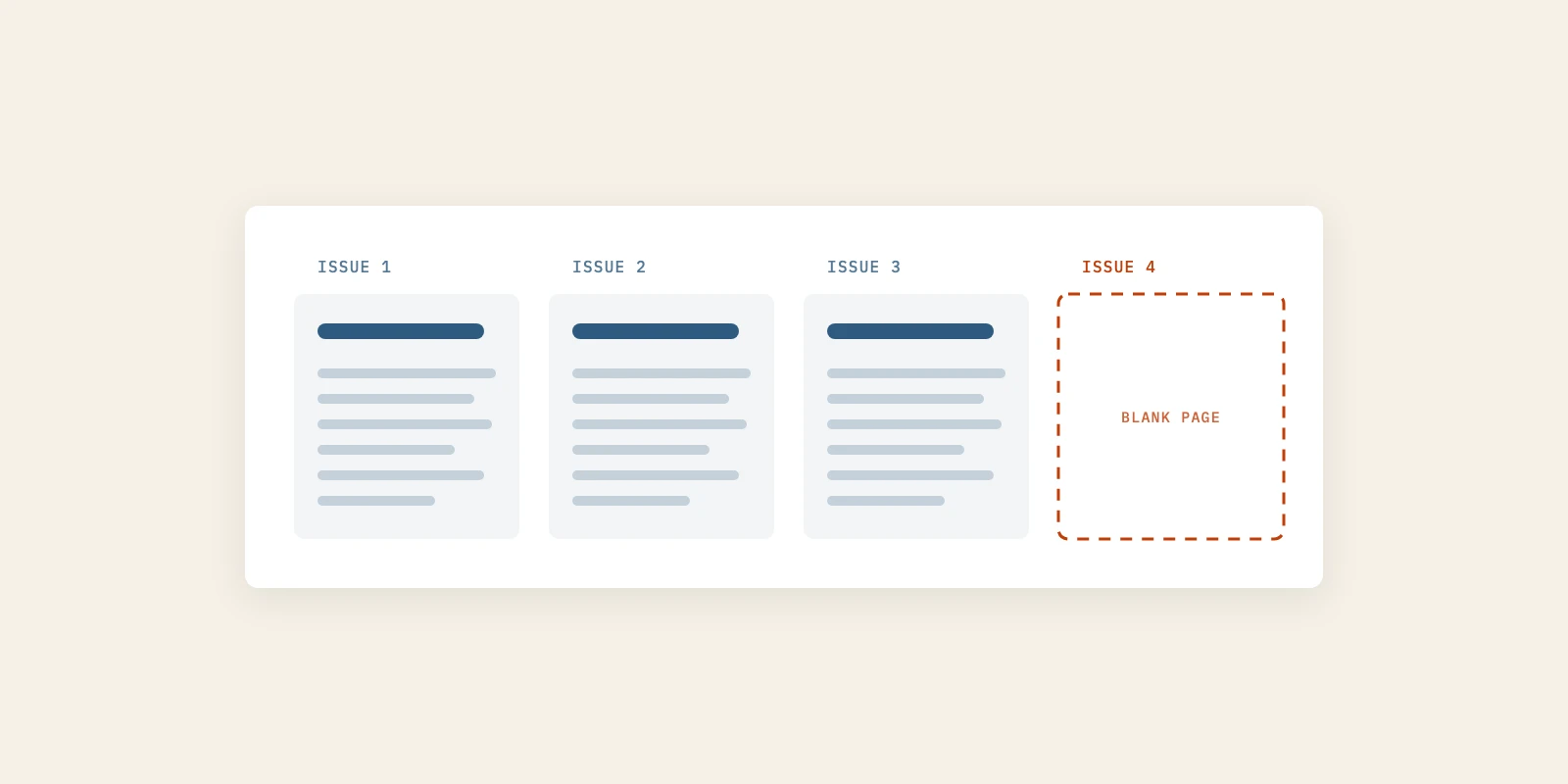
Quick Answer
A founder newsletter tends to stall around the fourth issue because the backlog of ideas that carried the first three runs out. Every issue after that becomes a fresh act of creation, competing with product, sales and support. The fix is supply, not willpower: build each newsletter from material your company already produces, capture it in a log between sends, reuse one format, and set a cadence that supply can hold.
Issue one is easy. Issues two and three usually come from notes you already had, opinions you already held, or a burst of launch energy that felt durable at the time.
By the fourth send the backlog is gone, and the newsletter stops being a thought and becomes a recurring job. Most advice on content marketing for tech companies treats that moment as a writing problem, so founders try to write better, and nothing changes.
If you haven't sent issue one yet, starting a newsletter that wins first customers is the earlier problem. This covers why the stall lands where it does, the six systems that keep a newsletter going past the first month, and how to pick a cadence your supply can actually hold.
Why a Founder Newsletter Stalls Around the Fourth Issue
A founder newsletter stalls around the fourth issue because that is roughly where the stock of pre-existing ideas runs out. Treat "issue four" as a rule of thumb from watching founder newsletters, not a measured figure: no public dataset counts newsletters by the issue they stopped on.
What the first three issues hide is the cost of fresh creation. Each one drew on material that existed before the newsletter did, so it felt cheap to write.
Issue four is the first one that has to be made from scratch, in a week that also holds a product fire, a sales call that went sideways and a loud support queue. The newsletter is the only item on that list nobody is waiting for, so it's the one that slips.
The wider data points the same way, with limits worth stating. When Newsletter Circle analyzed about 75,000 public Substack newsletters, it counted 41,000 active and 34,000 inactive, so roughly 45 percent had gone quiet.
Monthly was the most common schedule in that set at 24 percent, ahead of weekly at 21 percent. It's a snapshot of one platform, it doesn't isolate founder-run newsletters, and it can't tell a newsletter that stopped from one that is between issues.
Read with those limits, it still says one useful thing. Going quiet is the ordinary outcome for a newsletter, not the exception, so a founder who wants to keep one going needs a system rather than a better intention.
How to Keep a Founder Newsletter Going Past the First Month
Keep a founder newsletter going by changing the job from invention to capture. Six systems do that, and each one removes a specific reason the fourth issue slips.
Each step below says what the system is, how to set it up, an example, how to tell it's working and the mistake that usually breaks it. Set up the first three before your next send and the rest within a month.
1. Build Every Issue From Material Your Company Already Produces
The newsletter should harvest what your company produces anyway, not demand a new category of work every week. Instead of asking what you should write about, ask what a customer would care to read from the week you already had.
Most early-stage software companies generate more of this raw material than they notice:
- Support tickets, and the answers you already typed.
- Sales-call objections, and the reply you gave on the call.
- Changelog entries, and the reason each one exists.
- A customer question that came up twice in one week.
- A decision you made, and the option you rejected.
- A metric you watched, and what you changed because of it.
Say a customer asks in Intercom why an export runs overnight instead of on demand. Your reply about the tradeoff between cost and freshness is already most of an issue on how you make product decisions.
You'll know it's working when you stop opening a blank document on send day. The common mistake is filtering the material for impressiveness, which throws away the ordinary questions your readers actually share.
2. Keep a Capture Log Between Sends
A capture log is a running list where raw material lands the day it happens, with one line on why a reader would care. It's the editorial calendar turned around: instead of planning topics forward, you record what the week already produced.
| Raw Material | Where It Comes From | Reader Value in One Line |
|---|---|---|
| Customer question | Support inbox | Reframes why the problem matters |
| Sales objection | Call notes | Answers it for everyone who didn't ask |
| Product decision | Changelog or Slack thread | Explains the tradeoff you made |
| Metric change | Weekly dashboard review | Shows what you learned and did next |
The rule that keeps it honest is simple. Nothing enters the log unless it came from real work, which stops the newsletter drifting into commentary that sounds smart and has no operational core.
Set it up as one shared document or a Notion table with those columns, and add a line within a day of the event. It's working when the log holds at least two unused items on send day, and it breaks when you log only topic titles and have to reconstruct the detail later.
3. Give Every Issue the Same Repeatable Format
A repeatable format is a fixed set of slots every issue fills in the same order, so writing becomes assembly instead of composition. Readers learn where to look, and you stop redesigning the newsletter each week.
A format that suits most founder newsletters has three slots:
- The situation: the question, objection or decision, quoted or paraphrased from the log.
- What you did or decided, and the option you rejected.
- What it means for the reader, ending in one question they can reply to.
An issue about the overnight export takes the customer's question, your tradeoff, and a closing question asking readers how fresh their data really needs to be. It's working when a draft takes one sitting, and it breaks when you add a fourth slot every time you have a good week.
4. Fix the Send Day and Let the Length Vary
Hold the send day constant and let the issue shrink to fit the week, never the other way round. A short issue on the usual day keeps the promise, while a long issue three days late teaches readers that the newsletter is unreliable.
Basecamp's product method makes the same trade for software projects and calls it fixed time, variable scope. As Ryan Singer writes in Shape Up, "Without a time limit, there’s always a better version."
In practice, pick the day now, say Tuesday morning, and write the issue so its first slot can stand alone if that's all the week allows. Keep the send mechanics identical too, using one email marketing checklist every time, so a short week never becomes a sloppy send.
It's working when you ship on bad weeks. The mistake is treating a short issue as a failure and skipping the send instead.
5. Tie Capture to a Slot That Already Exists in Your Week
Attach the capture habit to something you already do at a fixed time, such as the Friday metrics review or the Monday support handover. A consistent cue does more for habit formation than a floating intention to write when there's time.
That comes from research, not just productivity lore. In a study of habit formation by Phillippa Lally and colleagues in the European Journal of Social Psychology, 96 volunteers repeated a chosen daily behavior in the same context. Among participants whose data fit the model, the time to reach near-peak automaticity ranged from 18 to 254 days.
The same paper found that missing one opportunity did not materially affect the process. For a newsletter, that means one skipped week is a slip, not a verdict.
Set a fifteen-minute capture slot on the existing cue, and judge the habit by weeks logged rather than issues sent. The mistake is scheduling capture for whenever there's time, which in a small company means never.
6. Decide in Advance What Happens When a Week Goes Wrong
Write the missed-week rule before you need it, because a newsletter usually dies in the gap after a skipped issue, not in the skipped issue itself. Silence becomes the default only when nobody decided what else to do.
A workable rule has three tiers:
- If the log has material, send a one-slot issue on the usual day.
- If it doesn't, send a two-line note naming what the next issue will cover and when it will arrive.
- If two weeks go wrong in a row, move to the next slower cadence openly and tell readers why.
It's working when no gap on your list runs longer than one cycle. The common mistake is disappearing for a month and returning with an apology issue, which spends the reader's attention on you instead of on anything useful.
Newsletter Cadence Compared by What Your Supply Can Support
The right newsletter cadence is the one your capture log can feed for a year, not the one that sounds most serious. Count usable log items per week for a month, then match the rhythm to that number.
| Cadence | Log Items per Week | What It Gives You | Where It Breaks |
|---|---|---|---|
| Weekly | Three or more | Practice, and material that stays fresh | The first bad fortnight, if supply is thin |
| Fortnightly | One or two | An honest match for most early teams | Drift, unless the send day is fixed |
| Monthly | Fewer than one | The least effort per month | The longest gap for the habit to fade |
Those thresholds are a working heuristic, not a benchmark, so adjust them once you've logged a real month. The pattern they encode is what matters.
Monthly sounds sustainable, and it's also the rhythm with the least practice and the longest decay between issues. A fortnightly newsletter you keep is worth more than a weekly one you abandon at issue four.
A Newsletter With One Owner Inherits That Owner's Calendar
A newsletter that only the founder can produce will go quiet whenever the founder's week fills up. The fix is spreading capture across the team, not hiring a content team.
Whoever handled support that week adds two lines to the log, sales adds objections after calls, and product adds the reason behind each changelog entry. The founder still writes the issue, but writes it from material other people gathered.
This is also the handover point if you outsource the writing. Better Marketing runs founder newsletters this way: we start from the capture log and the customer calls, then write in the founder's voice, so every issue keeps its first-hand detail.
Whoever you hand it to, a freelance writer or a B2B demand generation agency running outreach from the list, give them the log rather than a topic list. A topic list just recreates the blank page for someone else.
Every Newsletter Issue Archived on Your Domain Keeps Working
Publish each issue as a page on your own site as well as in the inbox, because an archived newsletter keeps earning attention long after the send. An email reaches your list once, while a page on your domain can be found by Google, ChatGPT and Perplexity for years.
Issues built from capture make unusually good pages. Google's guidance on helpful, people-first content asks whether content demonstrates first-hand expertise and provides original information, which is exactly what a support answer or a product decision contains.
That archive is owned media in the strict sense, and it's the raw material an AI SEO service works with when it tries to get a company cited in AI answers. Before you pay for AI SEO services, check how many of your newsletter issues exist as indexable pages at all.
Keep the archive pages plain: one issue per URL, a descriptive title and a visible date. Don't gate them behind a signup wall, since a page a crawler can't read can't be cited.
When a Recurring Newsletter Is the Wrong Commitment
A recurring newsletter is the wrong commitment when your company doesn't yet produce the material that feeds one. No customers, no sales calls and no shipped product mean an empty capture log, and no system fixes an empty supply.
- Before your first customer conversations, write individual essays or posts, and start the newsletter once support and sales give you material.
- When the only supply is product updates, a public changelog page does the job better than an issue dressed up as editorial.
- When you'd be writing mostly to hit a schedule, a quarterly letter to a hand-picked list beats a weekly send nobody needed.
None of this argues against owning an audience. It argues for starting the clock only when supply exists, because a newsletter that dies at issue four costs you the readers who signed up for it.
Restart a Stalled Newsletter With One Capture Week
If your newsletter stalled, don't rewrite the intro or switch platforms. Spend one week filling the capture log from support, sales and product, then write the next issue from it in the three-slot format on a fixed day.
Pick the cadence your log supports and write the missed-week rule before you need it. Content marketing for tech companies compounds only when the channel survives ordinary weeks. The replies a steady newsletter earns are the warm conversations a B2B demand generation agency works from, and Better Marketing turns them into first customers without a single ad.