
Quick Answer
Account-based marketing focuses sales and marketing on a named list of high-value companies, while demand generation builds interest across a whole market of buyers who are not shopping yet. A seed-stage startup selling to enterprise usually leads with founder-led account-based marketing on a short target account list and runs light demand generation beside it. Neither needs ad software, and a B2B demand generation agency can take over the market-wide half later.
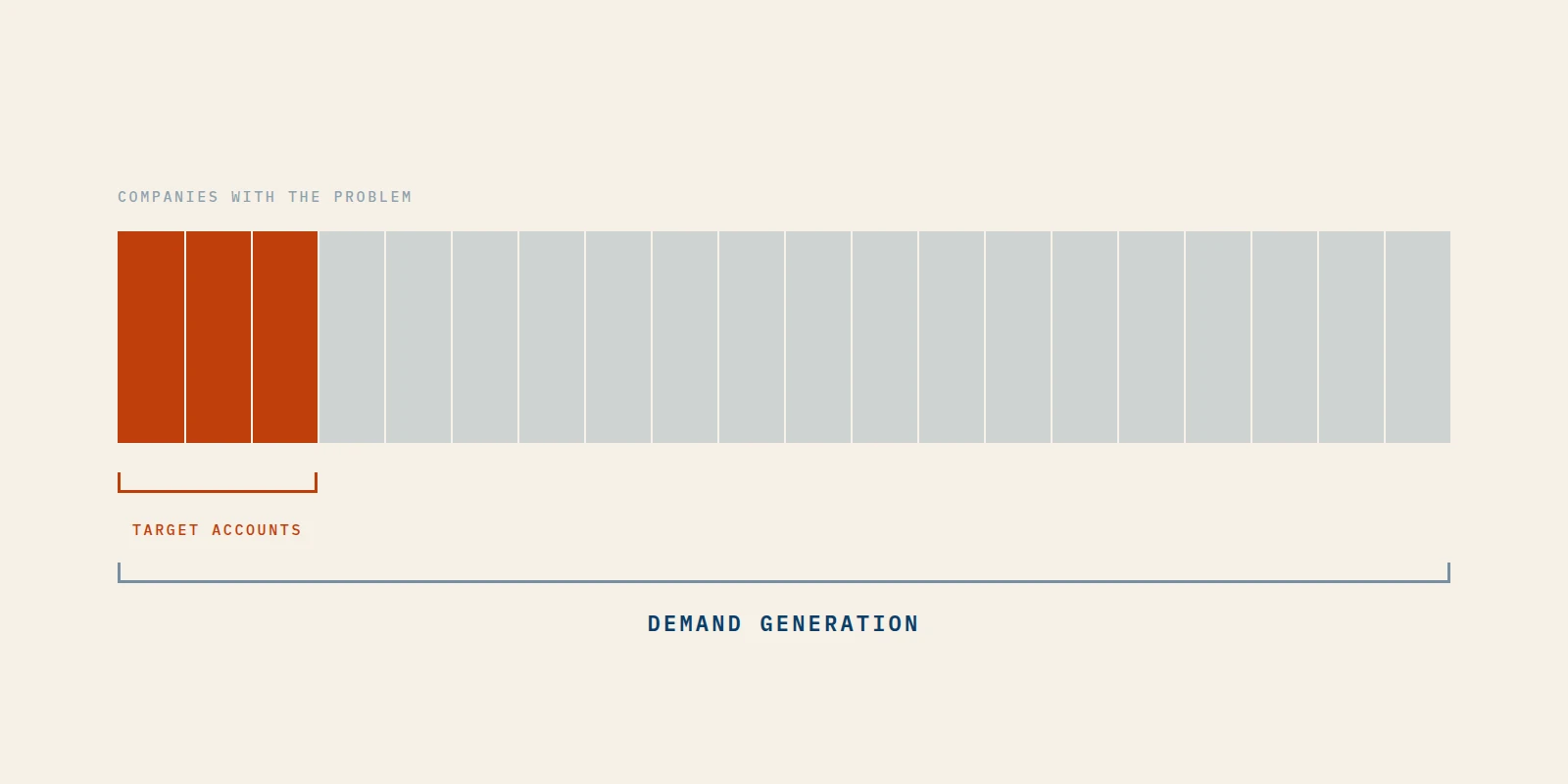
Your first enterprise deals came from people who already knew you, and the next ones have to come from companies that do not. Account-based marketing means picking the specific companies you want as customers and aiming your sales and marketing at them, one account at a time. Demand generation aims wider, at everyone who has the problem you solve.
When I asked ChatGPT and Perplexity on 8 October 2026 which one a seed-stage enterprise startup with no ad budget should run first, both said ABM. The first-page Google guides I read compared the two for marketing teams, with tiers, measurement and team alignment.
In this post I compare the two in one table, give you a list-size test that picks which to lead with, show how to run founder-led ABM without ad spend, and explain where demand generation still has to carry the load.
How Account-Based Marketing and Demand Generation Differ
Account-based marketing starts from a list of named companies and works inward, while demand generation starts from a market and works toward whoever responds. ABM asks which few buyers you must win. Demand generation asks how to make the whole market remember you.
Wikipedia credits Bev Burgess at the Information Technology Services Marketing Association with coining the term in 2003. Her framework splits it into three types: one-to-one for a single account, one-to-few for small clusters and one-to-many for hundreds of accounts run with software.
| Question | Account-based marketing | Demand generation |
|---|---|---|
| Who it targets | A named list of companies you choose in advance | Every buyer with the problem, most of them unnamed |
| First move | Research one account and the people who buy there | Publish something useful about one problem |
| Who does the work at seed | The founder, doing sales and marketing as one job | The founder, writing and distributing |
| Main signal | Meetings and replies inside target accounts | Replies, mentions and inbound conversations |
| Main cost without ads | Founder hours per account | Founder hours per piece of content |
| Main risk | The list is wrong and months go to the wrong companies | Attention arrives from companies that will never buy |
| When it pays | Few buyers, large contracts, a long sales cycle | Many buyers, or a problem few people search for yet |
I read the last row first. It tells you which shape your market has, and the rest of the table follows from that.
Where the Two Overlap at a Seed Company
At seed the overlap is bigger than any table shows. The founder writes the posts, sends the emails and takes the calls, so both programs run through one calendar. The useful question is which list you plan your week around.
ABM is also not lead generation, which collects contact details from anyone willing to share them. I compared lead generation with demand generation in demand generation vs lead generation for seed-stage founders.
Why Enterprise Buying Groups Change the Math
Enterprise purchases are made by a group, which marketing texts call the buying center. Account-based marketing plans for each person in that group at each target account. Demand generation reaches whoever in the market reads your work, which may be one person at a company that needs five to agree.
Wikipedia's history of ABM notes that in long sales cycles it can raise customer lifetime value, and that it is usually employed by enterprise sales organizations. That matches where I would use it. The bigger and slower the deal, the more each named account is worth the hours.
A List-Size Test That Tells You Which to Lead With
The fastest way to choose is to count the companies that could realistically buy and see how big their first contracts would be. This takes an afternoon with your closed deals and a spreadsheet, and I run it before planning any campaign.
1. Count the Companies That Fit Your Buyer Profile
Write down every company that matches your paying customers on industry, size and the problem you solve. Use your closed deals as the template, not a persona deck. If you have fewer than three customers, use the companies that took a second meeting.
2. Mark the Accounts Worth One-to-One Work
Flag the companies whose first contract would change your year. These are the accounts worth researching person by person. Everything else on the list is market, not target.
3. Read the Count Against Three Bands
If the flagged list is under about fifty companies, lead with one-to-one account-based marketing. Between fifty and a few hundred, group them into clusters by shared problem and run one-to-few. Above that, lead with demand generation and keep a short top list for personal outreach.
These bands are my working rule, not a published standard. They come from one constraint, which is how many accounts a founder can research well in a month.
4. Check If Your Market Already Knows the Problem
Search your problem in your buyers' own words and look at what comes back. If buyers already compare vendors, a named list can be worked directly. If nobody describes the problem yet, ABM alone will not teach the wider market, and demand generation has to run beside it from week one.
Pro tip: Keep the flagged list fixed for a full quarter. Swapping accounts every few weeks resets the work before any account has seen enough of you to reply.
How to Run Founder-Led ABM Without an Ad Budget
Founder-led account-based marketing is a weekly routine, not a software purchase. ABM software sells account data and targeting at scale, and a founder with twenty-five accounts can do the core of it by hand.
- Pick twenty-five accounts from the flagged list.
- Name three people at each one: the user, the budget owner and the person who signs.
- Read what each company has said in public in the last quarter.
- Send one useful note per person per month, tied to something they said.
- Write one public post a week on the problem those accounts share.
- Log every reply against the account, not the person.
The fifth item is where ABM and demand generation meet. A post written for twenty-five accounts is read by everyone with the same problem, so one calendar runs both programs.
I keep the log in a spreadsheet with one row per account. A CRM can come later, once the list has proved itself.
Where Demand Generation Still Has to Carry the Load
Account-based marketing cannot reach buyers you have not named, and at seed your list is partly a guess. The LinkedIn B2B Institute's 95-5 rule page says its research shows that "95% of your potential buyers aren’t ready to buy today." If anything like that ratio holds for your list, most of your twenty-five accounts are not in market this quarter.
Demand generation keeps you remembered by the accounts on your list and by the ones you missed. When an unlisted company replies to a post, I add it to the list, and that is how the list gets better.
The two programs also feed each other. Account-based marketing tells you which problems your best accounts talk about, and demand generation turns those problems into posts the rest of the market can find. I write the weekly post from the notes on the target accounts, never from a keyword list alone.
This half is also where outside help fits first, because it is repeatable work on a schedule. The account work depends on your relationships, so it stays with you longer.
When to Bring in a B2B Demand Generation Agency
Keep the account-based marketing work yourself while the list is short, and hand off the market-wide half when your weekly posts and newsletter start to slip. A B2B demand generation agency can run that half while you keep the twenty-five accounts. I lay out which seats to keep and which to rent in how to structure a demand generation team.
Ask any agency how it would use your target account list. A good answer names your accounts and the problem they share, and it does not start with a lead count or an ad budget.
The handoff works best with a written brief. I would give an agency the flagged list, the problem those accounts share, three phrases buyers used on calls and the posts that drew replies. That brief keeps the market-wide work pointed at the same companies your outreach is working.
Pro tip: Share the flagged list in the first agency call. How an agency reacts to twenty-five names tells you more than its case studies.
Start With Named Accounts and Keep the Market Warm
Account-based marketing and demand generation are two ends of one plan at a seed company. Lead with founder-led ABM on a short target account list when your contracts are large and your buyers few, and keep demand generation running so the rest of the market knows you. Hand the market-wide half to a hire or a B2B demand generation agency once it outgrows your calendar.
Run the list-size test this week. If you want help with the demand generation side, that is the work we do at Better Marketing.