
Quick Answer
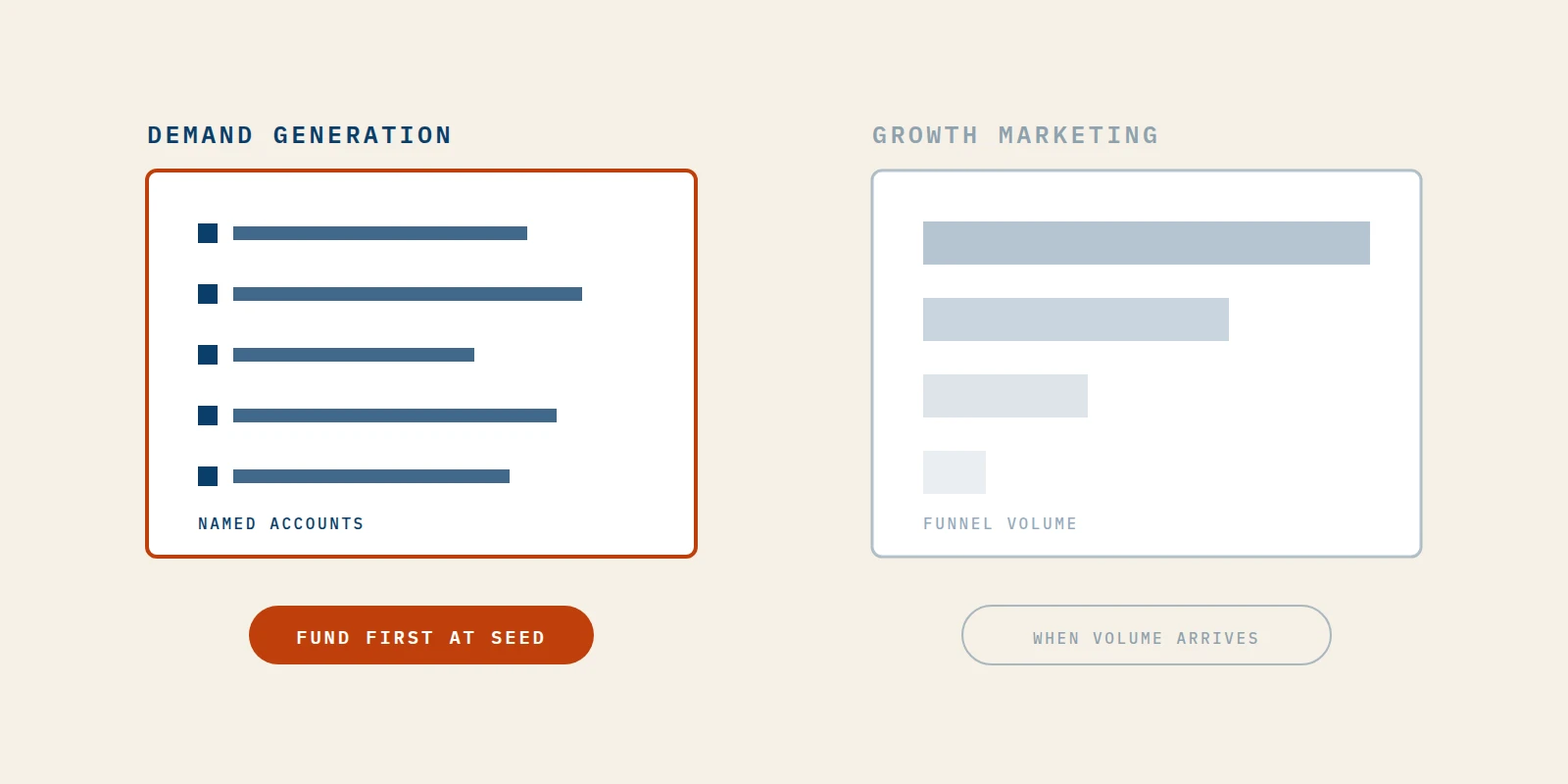
Demand generation builds interest and sales conversations among buyers who are not shopping yet, while growth marketing runs experiments across signup, activation, retention and referral. A seed-stage B2B startup with a long sales cycle and few accounts usually needs demand generation first, because growth tests need volume it lacks. Product-led startups with steady signups suit growth marketing, and neither discipline requires paid ads or a B2B demand generation agency on day one.
Your board wants to know where pipeline will come from, and the first marketing role you post will be read as your answer. Demand generation is the work of making the right buyers aware of a problem, and of you, before they start shopping. Growth marketing is a looser label for running fast experiments anywhere between a first visit and a renewal.
When I searched growth marketing vs demand generation on Google on 8 October 2026, eight of the nine organic results were guides on company blogs. Most spent their length defining both terms and listing tactics, and ChatGPT and Perplexity gave me opposite answers the same morning.
In this post I compare the two side by side, give you five questions that pick which to fund first, explain why growth tests stall at enterprise deal volumes, and show who to hire for each.
How Growth Marketing and Demand Generation Differ
Demand generation creates future buyers for a sales conversation, and growth marketing improves conversion at every stage of a funnel that already has traffic. The first works before anyone raises a hand. The second works on the people already moving through your product.
Wikipedia's entry on demand generation says it is common in business-to-business selling and in other long sales cycles, and it pairs marketing programs with a structured sales process. That pairing is the point. Demand generation ends in a conversation that your salesperson, often you, can run.
Growth marketing grew out of growth hacking, which traces back to the term growth hacker that Sean Ellis coined in 2010, according to Wikipedia's history of growth hacking. The method is a loop of small experiments, often A/B testing, where you keep what works and drop what does not.
| Question | Demand generation | Growth marketing |
|---|---|---|
| The job | Create interest and sales conversations among buyers who are not looking yet | Find and scale the levers that raise signups, activation, retention and referrals |
| Where it starts | Before the first website visit | At the first visit or signup |
| Main signal | Qualified conversations your sales process accepts | Conversion rate at each stage, then revenue kept |
| Work without ads | Founder posts, a newsletter, podcast guest spots, outreach to named accounts | Onboarding emails, signup flow tests, referral prompts, in-product nudges |
| Needs volume to work | No, it works with a short list of accounts | Yes, experiments need enough users to read a result |
| Typical first title | Demand generation manager | Growth marketer or growth marketing manager |
| Time to a readable result | Months, often longer than one sales cycle | Weeks, once traffic is steady |
I read the table from the bottom up. The last two rows decide most seed-stage choices, because they tell you what each discipline needs before it can show you anything.
Where the Two Jobs Overlap
Maria Pergolino is a B2B marketing leader whose past roles include Marketo. In June 2017 she wrote on LinkedIn that "Growth marketing, growth hacking, and demand generation are essentially the same thing." In the same post she called demand generation the more popular term and growth marketing the trendier one.
The overlap is real, and I agree with her on it while disagreeing on what it means for a seed company. Both use content, both measure, and both answer to revenue. The difference that matters to you is where each one starts and how much volume it needs before it tells you anything.
Lead generation, which collects contact details, sits inside both and is not the same as either. I compared it with demand generation in demand generation vs lead generation for seed-stage founders.
Where Each One Starts in the Funnel
Demand generation starts with people who have never heard of you. The LinkedIn B2B Institute's 95-5 rule page says its research shows that "95% of your potential buyers aren’t ready to buy today." Demand generation is how you stay in front of that group until their moment comes.
Growth marketing starts once people arrive. It asks why a trial user never activated, why an account did not renew and what would make a happy customer refer a peer. That makes customer retention as much its job as acquisition.
Five Questions That Tell You Which to Fund First
The quickest way to choose is to look at how your buyers arrive and how many of them there are. These five questions take an afternoon with your CRM or a spreadsheet, and I answer them before anyone writes a job post.
1. Count the Accounts That Could Ever Buy
If your whole market is a few hundred enterprise accounts, you can name them, and demand generation fits that shape. Growth marketing assumes a stream of anonymous visitors large enough to test on. A list that fits in one spreadsheet is not that stream.
2. Check How Long Your Sales Cycle Runs
Measure the days from first conversation to signed order on your last five deals. When that runs for months, a growth experiment cannot see its own result inside a quarter. Demand generation is built for that wait, because its job is staying remembered until the buyer is ready.
3. Find Where New Customers Enter
If buyers sign up and start using the product alone, you have a self-serve motion, and growth marketing has something to work on from week one. If every customer starts with a sales call, the call is the funnel, and demand generation fills it. Many seed products are the second kind, even with a free trial on the website.
4. Count Conversions per Month at Each Stage
Write down last month's signups, activations, demos and closed deals. I look for the stage with the most events, because that is the only place an experiment can be read soon. If no stage reaches a few dozen events a month, I would not hire anyone to run tests yet.
5. Ask Who Owns Renewal Today
If customers leave after their first year, growth marketing's retention work may pay back faster than new pipeline. If renewals hold and the problem is too few first meetings, fund demand generation. Your churn and renewal records answer this in an hour.
Pro tip: Write your five answers down before you talk to recruiters or agencies. A candidate pitching their own discipline will make both sound right for you.
Three or more answers pointing to named accounts, long cycles and sales-led entry mean demand generation first. Three or more pointing to self-serve signups and steady volume mean growth marketing first.
Why Growth Experiments Stall at Enterprise Deal Volumes
Growth marketing depends on experiments, and experiments depend on volume. Wikipedia's article on A/B testing describes it as a randomized experiment judged with statistical hypothesis testing. That judgment needs enough events in each version to separate a real effect from noise.
A seed company selling to enterprise might close a handful of deals a quarter. Split that across two versions of a demo page and neither side ever reaches a readable count. The test can run for a year and still tell you nothing.
That is the hidden cost of hiring the wrong discipline first. A growth marketer with nothing to test drifts toward busywork, such as redesigning pages few people visit. A demand generation hire in the same seat would be starting conversations with named accounts.
Low volume does not mean no learning. With few deals, I learn from what prospects repeat back on calls, which founder posts get replies from the right job titles, and how new leads say they heard of you.
Neither Discipline Needs a Paid Ad Budget to Start
Neither growth marketing nor demand generation requires paid ads. One guide ranking on page one for this comparison on 8 October 2026 said the basic difference is that demand generation uses paid channels. I disagree, because paid channels are one tool for each, and a founder can run both without them.
Performance marketing is the discipline built on paid media, where you pay per click, lead or sale. That is a third job, and a seed founder without an ad budget can leave it for later. Here is what the other two look like with no ad spend.
Demand generation: founder posts on LinkedIn about one problem, every week
Demand generation: a short newsletter to the people you meet
Demand generation: guest spots on podcasts your buyers already hear
Growth marketing: onboarding emails that get a trial user to first value
Growth marketing: a referral ask at the moment a customer gets a result
Growth marketing: signup flow changes, tested one at a time
We do not run paid ads for anyone, and founder posts, newsletters and outreach are most of what we do. That work is slower than buying clicks. It also keeps working after a budget would have stopped.
Who to Hire First and When a B2B Demand Generation Agency Fits
Most seed founders should own the first months of demand generation themselves, then hire for whichever discipline the five questions point to. I lay out the seats in more detail in how to structure a demand generation team.
Keep the Work Yourself Until Buyers Repeat Your Message
Before you can say who buys and why in one sentence, any hire will spend months guessing. My readiness test is in the five-check test for a first marketing hire. Until it passes, a few hours a week of your own posts and calls does more than a new salary.
Hire a Growth Marketer When Self-Serve Signups Already Flow
A growth marketer earns their cost when there is a steady stream of trial users to work with. I ask candidates for an experiment that failed and what they changed after it. The answer shows if they test ideas or only ship them.
Bring in Demand Generation When Sales Needs More Conversations
When you have a clear buyer, a pitch that closes and too few first meetings, demand generation is the job. You can hire a demand generation manager or rent the work from a B2B demand generation agency while you learn what the seat needs. Ask any agency what it counts in month three, and treat an answer that starts with ad spend as a performance marketing pitch.
Pro tip: Paste your five answers into the job post or the agency brief. It filters out people who only know one of the two motions.
Fund the Discipline That Matches How Your Buyers Arrive
Growth marketing and demand generation share tools, but they start in different places and need different volumes. If your buyers are a known list of accounts on long sales cycles, I would fund demand generation first, done by you, a hire or a B2B demand generation agency. If signups already flow, a growth marketer has something to test.
Answer the five questions this week, then hire for the answer. If you want help with the demand generation side, that is the work we do at Better Marketing.