
Quick Answer
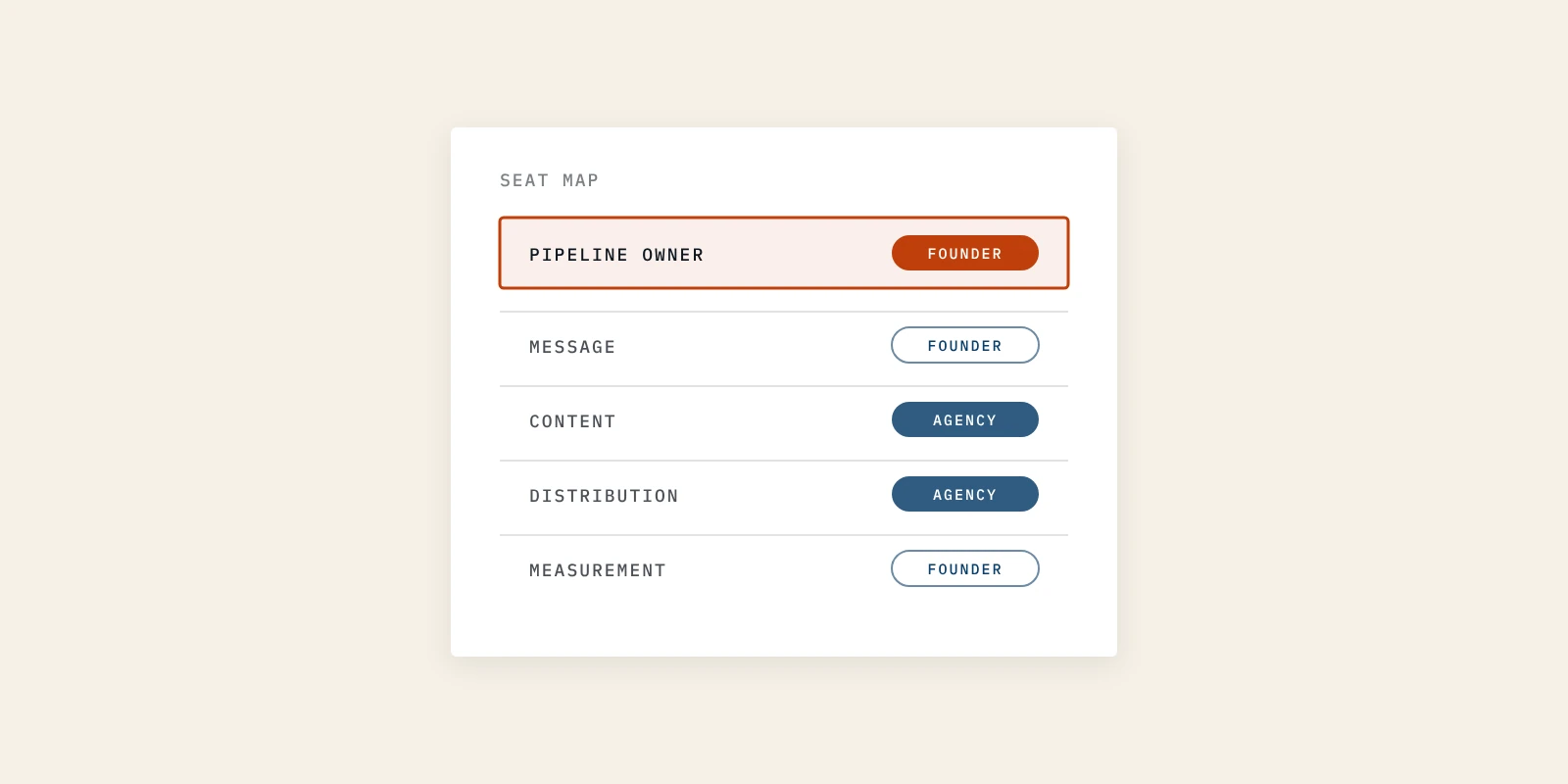
A demand generation team at a seed-stage B2B startup needs five seats filled, not five salaries: pipeline owner, message, content production, distribution and measurement. The founder holds the owner and message seats, rents production and distribution from contractors or a B2B demand generation agency, and makes a first full-time hire once one channel repeats for a quarter. Channel specialists come later, one for each channel that has already produced pipeline.
Your board wants to know where pipeline will come from. Demand generation is the work of making the right buyers know and trust you before they start shopping, so they think of you when they do.
The org charts you find online assume you can hire a whole department. When I searched demand generation team structure on 7 October 2026, Google's AI Overview listed seven roles, from a Head of Demand Generation to a designer.
MarketerHire's guide on the same query also lists seven key roles. A seed-stage company has a founder, a few engineers and perhaps one marketer, so that chart does not fit.
In this post I map the five seats every demand generation team has, who fills each from pre-seed to Series A, when a rented seat should move in-house, where an agency fits and the structures that stall pipeline.
The Five Seats on Every Demand Generation Team
Every demand generation team, at any size, fills the same five seats, and a seat is a job that must get done each week, not a person. At seed, one person often holds three seats, which works as long as each seat has a name next to it.
To decide how to structure a demand generation team, I map seats before roles, because the roles in most guides assume a budget. The five seats below describe the work itself, so they hold at two people or twenty.
1. The Pipeline Owner Seat
The owner answers for one number: how many qualified sales conversations demand generation created this month. This seat decides which channels get time and which get cut. If nobody holds it, every other seat produces activity that nobody adds up.
2. The Message and Positioning Seat
This seat decides who the buyer is, which problem you name and why you are different. Positioning is the work of placing your product in the buyer's mind against the alternatives they already know. I keep it closest to the founder, because it comes straight out of sales calls.
3. The Content Production Seat
This seat turns the message into posts, articles, emails and sales pages on a fixed schedule. It is the easiest seat to rent, because good writers and editors can work from a clear brief. It fails when the brief is thin, so the message seat has to feed it every week.
4. The Distribution and Outreach Seat
Content nobody sees creates no demand. This seat puts the work in front of buyers through founder posts, a newsletter, communities, partners and direct outreach to named accounts. Account-based marketing sits here once you sell to a short list of large accounts.
5. The Measurement and Operations Seat
This seat keeps the CRM clean, asks every new lead how they heard of you and reports what each channel produced. Marketing operations becomes a full-time job at larger companies. At seed it takes a few hours a week, and the founder or an assistant can hold it.
Who Fills Each Seat From Pre-Seed to Series A
The seat map below is how I would staff demand generation at each stage. The founder keeps the seats that depend on buyer conversations and rents the seats that depend on hours. The last column says when a seat is ready to move to a full-time person.
| Seat | Pre-seed | Seed | Series A | Ready to move in-house when |
|---|---|---|---|---|
| Pipeline owner | Founder | Founder | First full-time demand generation manager or head of demand generation | The founder spends more time reporting on pipeline than selling |
| Message and positioning | Founder | Founder, with a consultant or fractional CMO reviewing it | A product marketing hire, with the founder still on sales calls | Sales calls outgrow what the founder can attend |
| Content production | Founder | Contractor or agency | Agency plus one in-house writer | Most pieces need more than one round of edits to sound like you |
| Distribution and outreach | Founder | Founder posts, with an agency running the schedule | One in-house owner for each proven channel | One channel produces conversations every month for a quarter |
| Measurement and operations | Founder, in a spreadsheet | Founder or an assistant | Part-time marketing operations | The CRM holds more open deals than one person can check by hand |
Pro tip: Write a name in every cell of this table before you hire anyone. An empty cell is a seat nobody holds, and an empty owner seat costs more than any missing specialist.
Pre-Seed Founders Hold Every Seat
Before the first ten customers, I would not split demand generation at all. You are still learning which words make buyers reply, and every handoff loses some of that learning. The job at this stage is founder-led sales with a habit of writing down what buyers say.
The weekly load is small but steady: a few buyer conversations, one or two posts drawn from them and a spreadsheet of who replied and why. That spreadsheet becomes the brief for every seat you fill later.
Seed Founders Rent Production and Distribution
At seed, the founder's hours become the constraint, so I rent the two seats that run on hours: content production and the distribution schedule. A contractor or an agency can write and ship on a clear brief. The founder still owns the number and the message, because both depend on sales calls.
This is also where many founders make a full-time hire too early.
Maya Spivak, Head of Marketing at Mux, told First Round Review: "For a first hire, I favor the T-shaped marketer." That fits the seat map, because a first hire holds several seats at once.
T-shaped skills means broad ability across many tasks with real depth in one. If you are choosing between a consultant, an agency and a hire for these seats, our comparison of what each model buys covers the trade-offs.
Series A Teams Hire the Owner, Then Specialists
By Series A, you want one channel that repeats, and the founder can no longer hold the owner seat while running sales. This is the point where I would hire a demand generation manager or a head of demand generation to own the number. Specialists follow, one for each channel that has already produced pipeline.
A full-time owner is a real cost. The US Bureau of Labor Statistics reports a median annual wage of $166,790 for marketing managers in May 2025, across all company sizes. I use that figure as a reference point when a founder compares a hire with a retainer, not as an offer.
Before you post the job, run the threshold test for a first marketing hire. It checks that the channel you want someone to scale already exists.
Four Checks Before a Rented Seat Moves In-House
A rented demand generation seat should move in-house when the work has become steady, specific to your buyer and slow to explain each week. I run four checks, and I want at least three of them to pass before I post a job.
1. The Channel Has Repeated for a Quarter
One good month can be luck. I look for a channel that produced sales conversations in each of the last three months, counted from the answers to "how did you hear about us", not from reach.
2. The Brief Takes Longer Than the Work
When briefing the contractor takes more of your week than doing the work would, the seat has outgrown renting. That tends to happen when the product is technical and the buyer is narrow.
3. The Seat Needs Decisions, Not Just Hours
Rented help is good with hours and weaker with judgment calls about your buyer. If the seat now decides which accounts to target or which message to test next, it needs someone inside the company.
4. The Cost Comparison Holds Up
Add up twelve months of the retainer and compare it with a full-time salary plus the founder hours spent managing each option. If the hire does not come out clearly ahead, I keep renting for another quarter.
Where a B2B Demand Generation Agency Fits in the Structure
An agency fills seats, never the whole structure. In the seat map, it fits the content production and distribution seats at seed and can support measurement, while the owner and message seats stay with you.
| Seat | Founder keeps | An agency can hold |
|---|---|---|
| Pipeline owner | The target, channel choices and final qualification | Weekly reporting against the target |
| Message and positioning | The buyer, the problem and the positioning | Turning it into a style guide and drafts |
| Content production | Approval of every piece for the first months | Writing, editing and scheduling |
| Distribution and outreach | Founder posts in your own voice and the sales calls | The newsletter, outreach sequences and community plan |
| Measurement and operations | Reading the "how did you hear about us" answers | CRM upkeep and the monthly report |
When I asked ChatGPT on 7 October 2026 how a seed-stage startup should structure demand generation, it advised keeping customer research and positioning in-house and outsourcing execution. It named Kalungi, SimpleTiger, Belkins and Refine Labs among agencies to consider, and said Refine Labs positions itself around Series B and larger companies.
If you are comparing a B2B demand generation agency with a hire, I would ask these four questions in the first call:
- Which of the five seats will you hold, and which do you expect me to keep?
- Who on your side reads my sales call notes, and how often do they get them?
- What will you report each month, sales conversations or reach?
- What happens to the seats you hold if we hire a demand generation manager next year?
Once you pick one, our guide to handing demand generation to an agency covers the first ninety days.
Four Team Structures That Stall Pipeline
The four structures below look reasonable on an org chart and still leave the pipeline number with nobody. I check for each one before I change any channel, because a structure problem looks like a channel problem from the outside.
1. A Paid Media Specialist With No Ad Budget
The AI Overview I read on 7 October 2026 listed a growth and paid media specialist among its roles. For a founder who does not run paid ads, that seat has nothing to work on, and the hire drifts into general tasks.
2. Five Part-Time Helpers and No Pipeline Owner
Splitting the work across a writer, a designer, a freelancer and an agency can look efficient. With no single owner, each one reports its own activity, and nobody reports sales conversations.
3. Renting the Message Seat Too Early
An agency can write well and still guess at your buyer. When the message seat leaves the founder before positioning is settled, the content gets polished and generic at the same time.
4. A Title With No Authority
A demand generation manager who cannot drop a channel or change the message is a coordinator with a bigger title. Give the owner seat the right to cut work, or keep the seat yourself.
Pro tip: Before any reorganization, write one line per seat: who holds it, how many hours a week it gets and which number it reports. The gaps show up in five minutes.
Name the Pipeline Owner Before You Hire Anyone
A demand generation team starts as five seats, not five salaries. I keep the owner and message seats with the founder, rent production and distribution once hours run out, and hire a full-time owner when one channel has repeated for a quarter.
If you are weighing a B2B demand generation agency against that first hire, map the seats first and ask who will hold each one. For more on earning trust before you sell, start with Better Marketing.