
Quick Answer
Co-marketing can help a small B2B founder reach a partner’s buyers by trading useful work for a clear promotion commitment. Start with a shared buyer problem and an asset the partner wants to use. Confirm the audience and the promised send before production. Cap the work, track buyer responses, and check that promotion happened before deciding to repeat the campaign.
For a founder with few contacts, co-marketing means creating and promoting useful work with a business that serves the same buyers.
We would ask a B2B demand generation agency to make that exchange explicit before starting production.
A technical founder may know a buyer’s problem well and still have almost nobody to send a useful answer to. An established partner may have those relationships, but little reason to lend them to an unknown product.
We would treat that imbalance as a design constraint for the campaign. This guide covers what to contribute, the evidence to require, a filled exchange worksheet and the signals that tell us to stop or repeat.
How Co-Marketing Can Earn Buyer Access Without a Large Audience
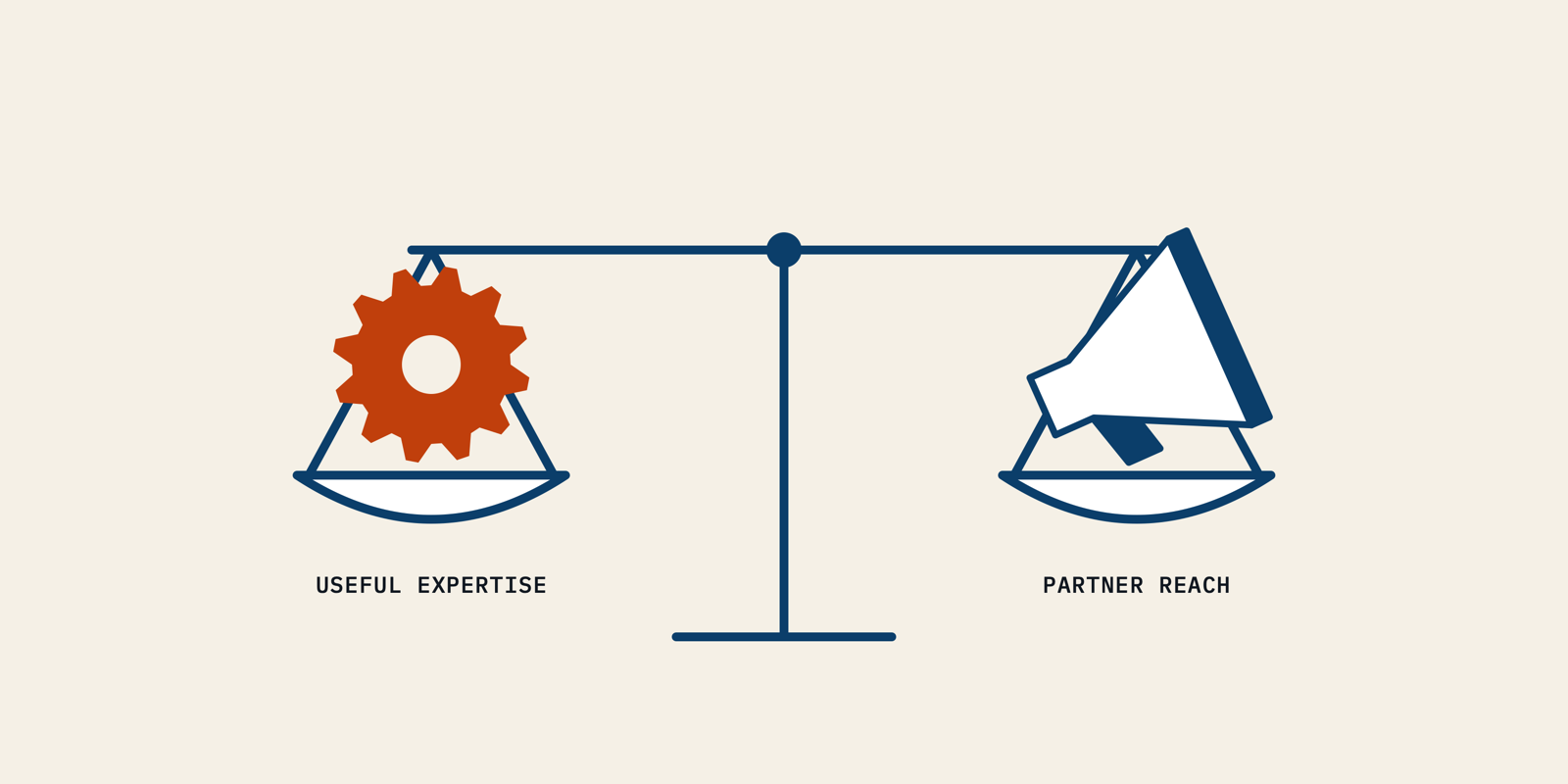
Co-marketing can earn buyer access when a founder contributes useful expertise and a partner commits to distributing it to relevant people. We would approve the exchange before approving the production work.
That is narrower than asking a company to become a partner. A useful first decision concerns a specific campaign, an intended buyer and something each side can check.
Our method uses an evidence field for every important promise. A plausible promise stays on hold until someone can show how it will happen.
1. Offer an Asset the Partner Can Use
We start with a task the partner’s customers already struggle to complete. The contribution could be a working diagnostic, an annotated checklist or a practical explanation of a difficult workflow.
The asset needs to help those customers even if they do not buy the founder’s product. A sales deck with the partner’s logo added does not meet that test.
PartnerStack’s definition describes co-marketing partnerships as combining expertise, channels and audience access. We would make the expertise concrete enough that a partner can inspect it before agreeing to promote it.
Bring a finished sample of the difficult part. Show the diagnostic logic, a useful checklist section or the workflow being explained. Do not ask the partner to imagine the value from a title.
We also name what the partner gains from using the asset. That might be a resource for customer conversations or a clearer explanation of an adjacent technical problem.
It should be a benefit the partner actually accepts. A founder’s assumption that the campaign will help retention is not evidence that the partner needs it.
2. Verify That the Partner Reaches Your Buyer
We check the buyer persona before discussing audience size. For a US SaaS founder, a large global technology following does not establish access to the right US decision-makers.
Ask the partner which customer role would use the asset, which problem brings that role to them and which channel reaches that group. Then request relevant evidence they can share.
That evidence might be a recent event agenda, public customer examples or an aggregate description of a relevant email segment. We would not request a private subscriber list to prove the point.
Blue Seedling’s co-marketing guide emphasizes matching customer profiles and understanding the work involved. Our addition is to record the evidence beside the proposed audience, including what remains unknown.
We distinguish the partner’s overall audience from the audience committed to this campaign. A relevant newsletter is useful only if the partner agrees that the asset belongs in it.
3. Name the Distribution Commitment
We would turn “we can promote this” into a channel, an owner, an approval date and an observable action. Production begins after those details are accepted by the people responsible.
An agreed email placement needs an actual send owner. A joint session needs a host and an invitation plan. A resource-page feature needs someone who can approve and publish it.
We would ask what evidence will show that the action happened. A published URL or a redacted send report can settle that question without exposing a partner’s customer records.
The arrangement does not automatically create an audience the founder owns. We would keep that distinction visible when evaluating different kinds of distribution assets.
4. Fill In the Exchange Before Production
We put the proposed exchange in a short working sheet. The following illustration is hypothetical, with planning choices rather than measured results or industry benchmarks.
Imagine a US cloud-cost software founder proposing a practical session with a cloud consultancy. The founder brings technical knowledge; the consultancy has customer relationships relevant to the topic.
| Field | Illustrative Entry | Evidence Required Before Work Starts |
|---|---|---|
| Shared buyer | US SaaS engineering leaders who review cloud bills | Partner confirms the role and a relevant audience segment |
| Buyer problem | Connecting a bill increase to a change in workload | A real, publishable question supplied by either team |
| Founder contribution | A bill-review checklist and a short walkthrough | Partner reviews a usable sample |
| Partner contribution | Host the session and invite the agreed segment | Named send owner accepts the invitation date |
| Founder work cap | Eight hours for preparation and delivery | Both sides accept the limited scope; this is an illustrative cap |
| Partner benefit | A reusable customer education resource | Partner confirms that this resource is useful |
| Buyer next step | Request help applying the checklist | Agreed response route and a named person to handle requests |
| Review evidence | Published session page, send confirmation and relevant requests | Both teams agree what they can report |
We do not call this proposal ready merely because the rows are filled. The evidence column has to contain an observed artifact or an accepted commitment, not the founder’s guess.
The founder should choose a work cap that fits their own schedule. Eight hours illustrates the field; it says nothing about the effort a real campaign will require.
5. Treat Missing Evidence as a Hold
We would use three decisions for a co-marketing proposal. Unknown information deserves a specific follow-up task, while a confirmed mismatch deserves a different decision.
| Decision | Evidence State | Our Next Action |
|---|---|---|
| Ready | Relevant buyer, useful contribution and distribution commitment are confirmed | Release the agreed production work |
| Hold | A required fact or commitment is missing | Request the missing artifact; do not expand production |
| Reject | Buyer fit is wrong, contribution is unwanted or agreed scope exceeds capacity | Decline this campaign or propose a smaller exchange |
If the consultancy likes the checklist but has no send owner, we would hold the session. We would not build more slides to compensate for the missing commitment.
If its audience has no responsibility for cloud costs, we would reject that campaign. Another round of copy editing cannot repair the audience mismatch.
The opportunity cost matters. We would compare the proposed preparation with work the founder could do for existing customers or active sales conversations during the same hours.
Pro tip: We would leave unconfirmed evidence cells visibly empty. A complete-looking sheet can hide the exact promise that nobody has made.
Where to Find Partners Who Already Serve Your Buyer
We start co-marketing partner selection with the adjacent providers that current customers already use. The relevant connection is a shared customer problem that both businesses have a reason to address.
1. Start With the Customer Workflow
Ask a current customer which service providers or tools help with the work immediately before or after your product. We would use that answer to form a short, relevant research list.
In a hypothetical cloud-cost SaaS campaign, the adjacent role is a consultancy helping customers operate their cloud systems. That relationship explains the possible fit; the consultancy’s size does not.
We would still ask the prospective partner to verify the audience and the proposed contribution. A customer’s suggestion starts the research; it does not approve the campaign.
2. Check a Recent Public Campaign
We read a prospective partner’s recent event or resource page before proposing a format. Look for the intended role, the problem addressed and the person responsible for the material.
A technical workshop and a broad executive newsletter may serve different readers. Our co-marketing strategy would follow the relevant audience’s existing habits rather than copying the most visible format.
If partnership work would add another unfinished channel, we would first revisit how to choose one demand-generation motion. A promising partner still needs a place in the founder’s actual schedule.
What a B2B Demand Generation Agency Can Own in Co-Marketing
A B2B demand generation agency can prepare assets and coordinate a co-marketing campaign after the founder and partner accept the exchange. We would keep buyer judgment and partner commitments with the people who can make them.
1. Cap the First Campaign
We prefer the smallest format that delivers the proposed buyer value. Joint webinars make sense when a live demonstration or discussion matters; a useful written resource may need less coordination.
PMA’s practitioner guide describes the work behind partner campaigns, including roles, promotion and follow-through. We would use those categories to expose work before accepting a production date.
| Responsibility | Accountable Party | Work We Would Delegate |
|---|---|---|
| Technical claim and buyer problem | Founder | Editing and production after factual review |
| Partner audience and promotion | Partner owner | Coordination and reminders |
| Asset preparation | Agreed production owner | Drafting, design and session preparation |
| Interested buyer response | Named commercial owner | Recording and routing requests |
A B2B demand generation agency can help carry that production work. We would brief it with the accepted exchange and work cap, alongside the wider one-page demand-generation plan.
2. Release Work Against Evidence
We separate approval of the idea from approval to spend time. Review the sample first, confirm the promotion commitment next, then release the remaining production work.
If the partner changes the audience or date, check the proposal again. A later session may conflict with customer work, even if the original plan was affordable.
We include revisions and approval responsibilities inside the work cap. Otherwise a small campaign can become an open-ended editing assignment before anybody sees the invitation.
Pro tip: We would write down the work that pauses if the promotion date slips. A missed date should trigger a scope decision before it triggers more production.
How to Diagnose a Co-Marketing Campaign Before Repeating It
We verify that the agreed distribution happened before judging a co-marketing campaign’s buyer response. Missing promotion and an unappealing offer call for different changes.
Marketing attribution helps connect an observed response to its source. We would record the campaign source with each relevant inquiry and check for an existing conversation before calling it a new opportunity.
| Observed Result | What It Supports | What We Would Do Next |
|---|---|---|
| Promised promotion did not happen | Execution was incomplete | Resolve the commitment before producing another asset |
| Promotion reached the wrong buyer role | Audience fit needs correction | Recheck the intended segment and proposed partner |
| Relevant reach occurred, but nobody engaged | The asset or message needs investigation | Ask for feedback before increasing production |
| People engaged but had no clear response route | The next step needs attention | Repair the response path and ownership |
| Relevant buyers requested a useful next step | There is a reason for another bounded test | Repeat with a fresh cap and track subsequent buyer progress |
We would avoid treating the table as proof of causation. A quiet campaign can have several problems, and a small audience may not provide enough evidence to separate them.
Keep lead generation separate from sales progress. A registration shows interest in an event; it does not establish a buying problem, purchasing authority or willingness to discuss the product.
We would track the next meaningful action against defined demand-generation stages. Keep the observed action and its date, rather than promoting every attendee into a pipeline report.
The partner also needs its own review. We would ask if the resource proved useful and if the work stayed within the accepted scope, without assuming that both sides wanted identical outcomes.
A repeat needs renewed agreement. We would not turn a useful session into a standing campaign program until both teams can explain what they want to repeat and what they want to change.
Approve the Exchange Before You Build the Campaign
We would begin a co-marketing proposal by naming the buyer, the useful contribution and the evidence of distribution. The first missing commitment tells the founder what to resolve next.
A small audience does not prevent a founder from contributing expertise. It does make an undefined exchange expensive, because the founder can spend scarce time before earning any real access.
We would give a B2B demand generation agency the accepted scope once the exchange is ready. The founder still owns the buyer judgment and the decision to repeat.
For help turning that accepted scope into useful content and a consistent demand-generation routine, we would start with Better Marketing.