

Quick Answer
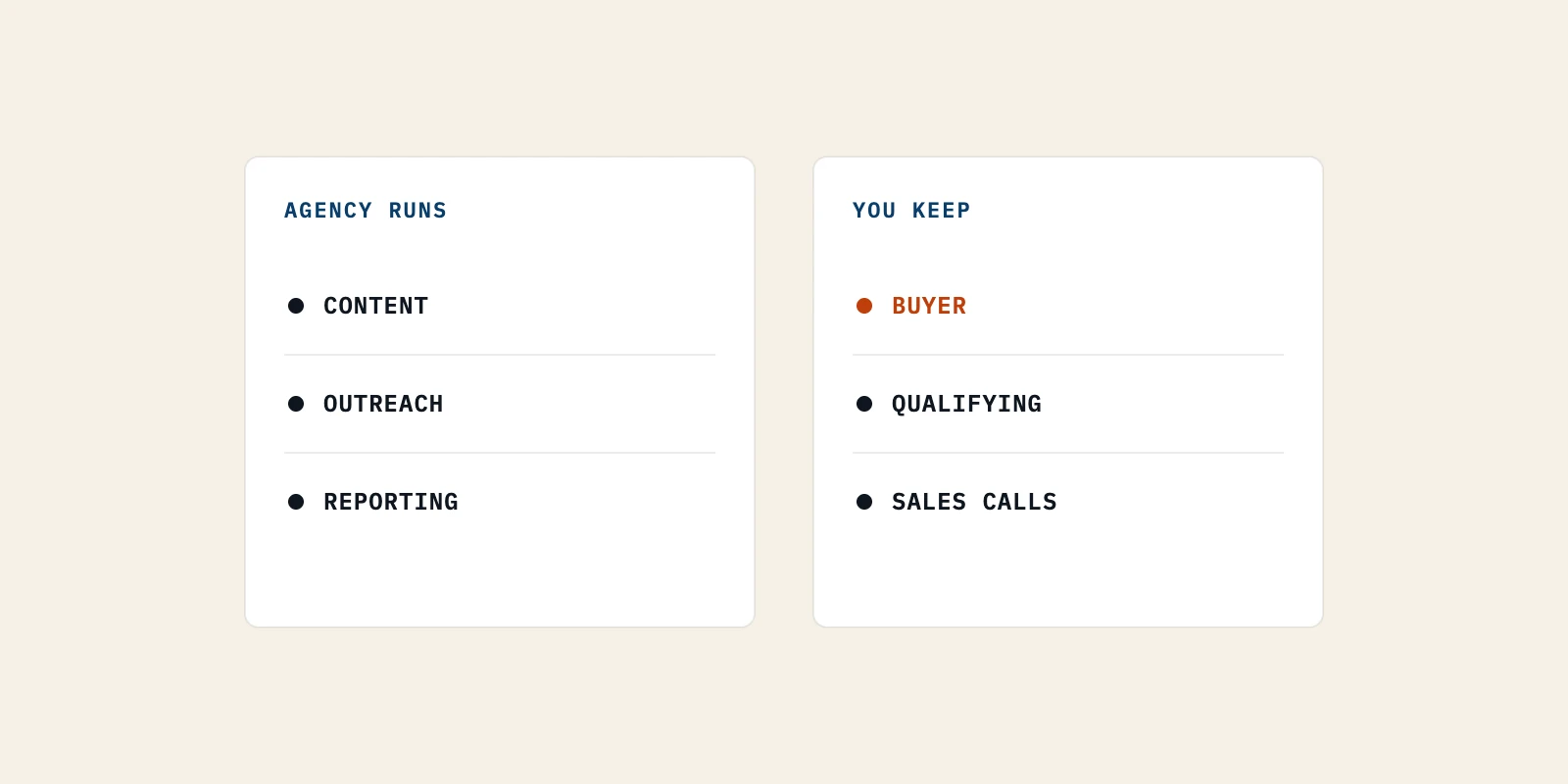
Outsourced demand generation works when the agency runs the channel and the founder keeps the buyer. Hand over content, outreach and reporting. Keep the buyer brief, final qualification and the sales calls. Agree service-level terms in writing, run the first 90 days in three stages, and judge the work by named accounts and real conversations, not by lead volume, so pipeline stays tied to buyer intent.
Outsourcing demand generation to a B2B demand generation agency is one of the fastest ways for a seed-stage team with no marketing staff to build pipeline, as long as the handover is designed as carefully as the campaign.
In plain words, demand generation means creating the awareness, trust and interest that make the right buyers want a sales conversation. Wikipedia defines demand generation as "the focus of targeted marketing programs to drive awareness and interest in a company's products and/or services."
Founders want help with the workload, but they do not want an outside team flattening the buyer into a list.
This post covers what to hand over and what to keep, a five-step handover, the weekly founder input, where outsourcing goes wrong, and when an agency speeds up demand generation most.
What to Hand Over and What to Keep
Hand an agency the work that needs hours and craft, and keep the work that needs your knowledge of the buyer. I would treat outsourcing as a capacity decision, not a decision to let someone else own the market.
Wikipedia defines outsourcing as "a business practice in which companies use external providers to carry out business processes that would otherwise be handled internally." In demand generation, that means the agency can run content production, outreach, reporting and content marketing for tech companies, while you keep buyer judgment.
The agency should create demand, not only collect contacts, because demand generation and lead generation do different jobs. I want the founder to own the buyer language, the final qualification call and the sales relationship.
| Work | Who Owns It | Why |
|---|---|---|
| Content production and distribution | Agency | Needs steady weekly hours and craft |
| Outreach sequences and list building | Agency | Needs volume, tooling and testing discipline |
| Reporting and channel testing | Agency | Needs a routine the founder rarely has time for |
| The buyer brief and positioning | Founder | Only the founder has heard buyers explain why they buy |
| Final qualification of conversations | Founder | Decides which accounts are real pipeline |
| Sales calls and closing | Founder | Keeps the customer relationship where it belongs |
Outsource the hours, not the buyer. That line sounds simple, but it is the part most founders skip when board pressure turns demand generation into a scramble for meetings.
Pro tip: Before kickoff, tell the agency which work it can change without approval and which buyer-facing claims need your signoff.
How to Hand Demand Generation to an Agency in Five Steps
Most outsourced demand generation fails because the client stops showing up once the invoice is paid. The founder hands over the buyer along with the work, and no agency can rebuild knowledge it was never given.
Google's AI Overview for "outsourced demand generation", checked 29 September 2026, names the same two risks: thin nuance about the product, and misalignment when the ideal customer profile is loosely defined. These five steps close both.
1. Write the Buyer Brief Before the Kickoff
A buyer brief is a two-page document the agency works from, owned by the founder. I would write it before the kickoff, because a kickoff call rarely captures the words buyers use when they feel the pain.
Include the ideal customer profile, the three problems buyers name in their own words, the objections heard on calls, the proof you can show, and the words to avoid. For example, a founder selling data-privacy software to heads of compliance at mid-size US banks writes down that compliance heads reply to "exam findings" and ignore "data governance", then pastes five real reply snippets with names removed.
The measure is simple. The agency's first drafts should use the buyer's words without being told twice. The mistake is handing over a pitch deck instead of buyer language. A deck says what you sell. A brief says why they buy.
2. Hand Over Execution, Keep Qualification
The agency runs the channel, and the founder decides which conversations count. I want that split written down because outsourced demand generation breaks when every reply gets treated as equal.
The agency produces and sends. Replies that ask buyer questions route to the founder the same day. The founder marks each as qualified or not and says why. Once the core channel runs, an AI SEO service can add specialist reach, but it should still learn from the same founder-owned qualification loop.
Say a compliance head asks if the tool covers state privacy laws. The agency routes it, the founder takes the call, and the founder logs the reason it qualified.
The measure is that every qualified or disqualified reply carries a one-line reason the agency can learn from. The mistake is letting the agency qualify leads alone, which is how volume gets mistaken for pipeline.
3. Agree Service-Level Terms in Writing
A service-level agreement should cover outputs, response times and responsibilities on both sides. I like a short version for demand generation because a long contract can still miss the daily handoffs that shape quality.
Wikipedia says a service-level agreement is "an agreement, typically a binding contract, between a service provider and a customer that define particular aspects of the service", such as quality of service, availability and responsibilities. In practice, name the weekly outputs, how fast routed replies reach the founder, what the founder owes the agency each week, the reporting cadence, and what happens when either side misses.
Scope in writing also makes a quote comparable when you are checking what a demand generation agency really costs. Without written scope, two proposals can look similar while asking the agency to do very different work.
For the privacy founder, the terms say the agency routes every buyer question within one business day and the founder approves new messaging within two. The measure is that both sides can point to the terms when something slips, without an argument. The mistake is agreeing on channels and a fee but not on what the founder owes in return.
Pro tip: Put founder responsibilities in the same document as agency outputs, so accountability runs both ways from the start.
4. Run the First 90 Days in Three Stages
The first 90 days should move through learn, launch and judge, roughly a month each. I prefer that rhythm because it gives demand generation enough structure to learn without turning the first month into a noisy channel test.
In stage one, the agency interviews the founder, reads calls and sets up tracking and lists. In stage two, it launches one channel to one segment. In stage three, both sides review named accounts and conversations and decide what to scale. If the first channel is not obvious, choose the channel that fits your stage instead of copying another company.
For the privacy founder, the agency spends stage one on the buyer brief and a list of target banks. It launches founder-voice outreach and a short newsletter to compliance heads in stage two, then uses stage three to double down on the message that drew replies.
The measure is a written review at the end of each stage. The mistake is launching every channel in week one, which leaves nothing clean to judge in month three.
5. Judge the Work by Named Accounts and Conversations
Count the accounts that moved and the conversations that happened, by name. I do not trust demand generation reporting that celebrates volume while hiding which buyers actually changed behavior.
Use four funnel stages you can count, then make the report list target accounts aware, engaged, hand-raised and in sales pipeline this month, with names. That gives the founder and agency a shared scoreboard instead of a pile of contacts.
For the privacy founder, the month-three review shows which named banks replied, which asked buyer questions and which booked a second call. The measure is named movement between stages, reviewed monthly.
The mistake is judging the agency by lead volume or impressions, which rewards the wrong work. In enterprise demand generation, a small number of named accounts can teach you more than a large spreadsheet of people who never asked a buyer question.
What the Agency Needs From You Each Week
An outsourced demand generation engagement needs a small, protected slot of founder time every week, and it goes wrong fastest when that slot disappears. I would block the time like a sales call, because the agency cannot invent fresh buyer context from old notes.
The founder's weekly inputs are:
Answer routed buyer questions the same day
Approve or correct new messaging
Share one thing heard on a sales call
Mark each reply qualified or not with a reason
Flag any change in product, pricing or ideal customer profile
This is not busywork. It is how the agency learns the edge cases that separate a curious contact from a real enterprise buyer.
For the privacy software founder, the most useful weekly note might be that compliance heads ask about state privacy laws before they ask about workflow. That one observation can change a subject line, a newsletter angle and the next sales call opener.
Pro tip: If you cannot protect the weekly slot, assign a named deputy before launch rather than leaving the agency to wait for scattered replies.
Where Outsourcing Goes Wrong and How to Prevent It
Outsourced demand generation goes wrong in predictable places, and each one has a fix the founder controls. I do not treat these as reasons to avoid outsourcing, because every fix sits inside the handover.
"They will never understand the product."
This becomes true only when the founder hands over product claims instead of buyer language. The fix is a buyer brief carrying real objections, real proof and the words to avoid.
"Agencies produce volume, not pipeline."
This happens when qualification sits outside the founder's judgment. The fix is to route buyer questions to the founder and mark every reply qualified or not, with a reason.
"I will lose the customer relationship."
Keep final qualification, sales calls and closing with the founder. The agency opens the conversation, the founder owns the relationship.
"Nothing will show for a quarter."
Stage the plan so each phase has a job: stage one learns, stage two launches, stage three judges named movement. Write a short review at the end of each one.
This method has one weakness. The handover asks for founder discipline every week, and a founder mid-fundraise or mid-crunch will struggle to give it. I name a deputy up front who can answer routed questions when the founder is unavailable.
When a B2B Demand Generation Agency Speeds Things Up
A B2B demand generation agency speeds things up most when the founder knows the buyer, has proof to show and needs pipeline faster than a first marketing hire could deliver it. I would use an agency when the company needs a working routine, craft and capacity from day one while the founder keeps selling.
That is the moment a B2B demand generation agency can help the founder turn buyer knowledge into content, outreach, reporting and follow-up without building a marketing function from scratch. The agency brings the operating rhythm. The founder brings the market truth.
When founders ask what demand generation services cover, the real question is what someone else can run without weakening the sales motion. In this setup, demand generation services include the channel work, the testing routine and the reporting, while qualification and sales calls stay close to the founder.
I also like this model for enterprise-track startups because it keeps trust at the center. You can build demand generation around useful content, precise outreach and named-account learning, rather than treating the market as a list to exhaust.
Outsource Demand Generation Hours and Keep the Buyer
Outsourced demand generation works when the handover is designed, with a written brief, execution handed over, qualification kept, terms agreed, 90 days in stages, and named accounts as the scoreboard. I would not let an agency start until those pieces are clear.
If you keep the buyer close, outsourcing gives the agency room to do the work you do not have hours for. It also keeps the founder in the moments that decide pipeline quality.
That is the operating principle I would use with any founder choosing a B2B demand generation agency. It is also the way we think about trust-led growth at Better Marketing.