
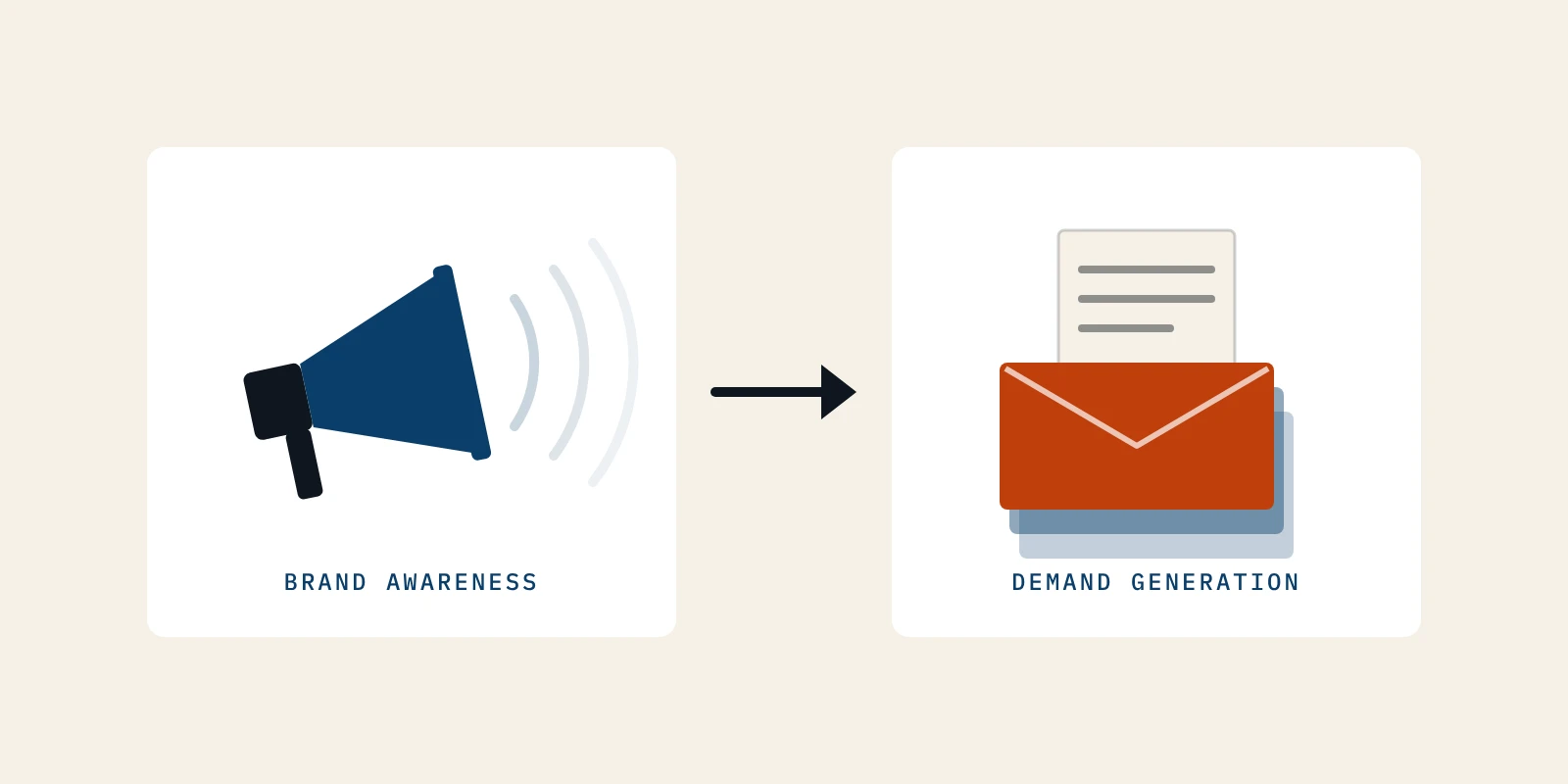
Quick Answer
Brand awareness measures how many buyers can recall a company, while demand generation is the work that turns the right buyers into sales conversations. At seed stage, broad awareness campaigns rarely pay back, but demand generation aimed at named buyers builds their recognition as a side effect. A B2B demand generation agency should report conversations first and use branded searches and how-did-you-hear answers as the awareness signal.
An investor asks why nobody in your market has heard of you, and someone suggests a brand awareness campaign. Brand awareness is how easily the buyers you care about can recognize or recall your company's name when their problem comes up. Demand generation is a different job: getting those buyers into conversations about the problem you solve.
When I checked Google on 16 October 2026, the four ranking pages I read for this comparison all said to run both. None said what a founder with no ad budget should do first, and I think that gap matters more than the definitions.
In this post I compare the two side by side, explain why broad awareness waits at seed, give four ways to check awareness among your named buyers and show what to fund first.
How Brand Awareness and Demand Generation Differ for a Seed Founder
Brand awareness is a state of mind in your market, and demand generation is the work that creates buying conversations. One is a result you measure, and the other is a program you run.
That difference decides what you can buy. You can pay for reach and hope recognition follows, or you can pay for work that starts conversations and let recognition build among the people who matter.
What Brand Awareness Measures
The Wikipedia entry on brand awareness defines it as the extent to which customers can recall or recognize a brand. It splits awareness into brand recognition, where a buyer confirms they have seen your name, and brand recall, where they produce it from memory.
Above both sits top-of-mind awareness: the first name a buyer gives when asked about a category with no prompt. In B2B that is the position I care about most, because a buyer can only call the vendors they remember.
If you have searched what is brand awareness, most answers stop at reach and impressions. I find recall among named buyers a more honest measure for a company selling to a few hundred accounts.
What Demand Generation Produces
Wikipedia describes demand generation as marketing programs that build awareness of, and interest in, what a company sells. Awareness is in the definition, but it is the means rather than the end.
I judge demand generation by three counts: talks with buyers who fit, named accounts that engage twice and deals that reach a second call. Lead generation sits at the end of that work, capturing contact details from buyers who already show interest.
Where the Two Overlap
The two overlap more than most comparisons admit. A founder post, a useful email to a named account and a talk at a small event all build recognition and start conversations at once.
Timing is why the overlap matters. John Dawes of the Ehrenberg-Bass Institute estimates that just 5% of business buyers are in the market in a given quarter, because firms change providers around every five years.
So most of the buyers you reach this quarter will not buy this quarter. Awareness is what carries your name to the quarter they do, and demand generation is how you reach them in the first place.
The Two Side by Side
This is the comparison I use when a founder asks which one a plan is really selling.
| Question | Brand awareness | Demand generation |
|---|---|---|
| What it is | A result: buyers can recognize or recall your name | A program: work that starts conversations with buyers who fit |
| Who it targets | Everyone in the category, often through broad reach | A named list of accounts and the people inside them |
| Typical work from other firms | Sponsorships, display and video ads, PR, conference booths | Founder posts, useful email to named accounts, content, small events |
| How it is measured | Recall surveys, share of voice, branded search | Conversations, repeat engagement, opportunities created |
| How fast you can see it | Slowly, and hard to trace to a single deal | Sooner, through replies and calls you can count |
| Fit at seed stage | Weak as a standalone budget line | Strong when aimed at a short list |
We do not run paid ads, so the awareness column describes work other firms sell. It can be a fair choice for a company with a broad market and money to test. That is rarely a seed company selling to enterprise.
Three Reasons Broad Brand Awareness Waits Until After Seed
Broad brand awareness rarely pays back at seed because your buyers are few, reach costs money and awareness without a next step leaves nothing to count. None of these says awareness is useless, only that it comes later.
1. Your Buyers Are a List, Not a Market
A seed company selling to enterprise may have a few hundred accounts that could buy in the next two years. I would rather have forty of them recognize the founder's name than forty thousand strangers recognize the logo.
B2B brand awareness at this stage looks more like account-based marketing than a campaign. You know the names, so you can reach them directly instead of paying for the crowd around them.
2. Reach Costs Money You Need for Conversations
Awareness campaigns from other firms are priced on reach: impressions, booth space and sponsorship tiers. Every dollar there is a dollar not spent on the founder hours and follow-up that turn a known name into a call.
When I checked Ubersuggest on 16 October 2026, brand awareness drew 2,400 US searches a month and brand awareness vs demand generation drew 10. Plenty of people want awareness, and very few stop to ask what it should be traded against.
3. Awareness Without a Next Step Leaves Nothing to Count
A board meeting asks what the money produced. A sponsorship that buyers saw but never acted on gives you an impression count and a feeling, and both are hard to defend six months later.
Demand generation work leaves a trail: a reply, a second meeting, a buyer who says they read your post. That trail is also the best awareness evidence a small company can collect.
Pro tip: Before you approve any awareness spend, write down the one action a buyer should take after seeing it. If nobody can name the action, the spend buys reach, not demand.
How to Measure Brand Awareness Among Your Named Buyers
You can measure brand awareness at seed without a survey budget by counting four signals your buyers already give you. Each one works with a few dozen conversations rather than thousands of visits.
Most guides on how to measure brand awareness assume a brand tracking study. B2B International describes three survey measures: first mention, spontaneous recall and prompted awareness. I borrow the same three ideas and collect them in sales calls instead.
1. Ask How Every New Buyer Heard of You
The simplest awareness signal is the answer to one question on a form or a first call. I keep the buyer's own words, because a podcast name or a colleague's name tells you more than a dropdown choice.
I wrote up how to collect and report these answers in our guide to self-reported attribution. At seed, ten honest answers beat a dashboard.
2. Ask Which Vendors Come to Mind Before You Name Yourself
On a first call, before the pitch, I ask which companies the buyer would look at for this problem. If your name comes up unprompted, that is top-of-mind awareness, the strongest signal there is.
If it does not, I ask if they had heard of us before the call. That gives you prompted recognition, the weakest form, and it still tells you if your work reached them.
3. Count Replies That Mention Your Work
Cold replies are an awareness test you are already running. I tag every reply that mentions a post, a talk, a newsletter or a colleague, and I compare the share month to month.
A rising share means your demand generation is building recognition inside the list. A flat share after three months means buyers are not seeing the work, whatever the reach report says.
4. Check Branded Searches in Google Search Console
Google added a branded queries filter to Search Console on 20 November 2025, splitting search traffic into branded and non-branded queries. Google says it works only for sites with enough queries and impressions, so a young site may not see it.
Until then, I use the regular query filter in Google Search Console with the company and product names. A few branded searches a week is an early sign that buyers remember you.
Google also warns, "Due to the dynamic and contextual nature of brand classification, some queries may occasionally be misidentified." I treat the split as a trend line, not an exact count.
| Signal | What it shows | Works with few buyers |
|---|---|---|
| How did you hear about us | Which piece of work reached the buyer | Yes, from the first conversation |
| Vendors that come to mind | Top-of-mind awareness or brand recall | Yes, with one question per call |
| Replies that mention your work | Recognition inside your named list | Yes, with a few dozen replies |
| Branded searches | Buyers looking you up by name | Only once search volume builds |
Pro tip: Ask the vendor question on every first call for one quarter. Ten answers in a spreadsheet tell you more about your brand than a reach report.
What to Fund First in the Brand vs Demand Decision
Fund demand generation first and point it at a named list, so brand awareness builds where it counts. Move money into broad awareness only once one channel starts conversations and the list itself is the limit.
The brand to demand idea, where awareness work and demand work share one message, is sound. At seed, I apply it by making every awareness asset do demand work: each post, talk or guide should give a named buyer a reason to reply.
| Your situation | Fund first | Why |
|---|---|---|
| No named list of target accounts yet | The list and founder conversations | Awareness has no audience to land on |
| Buyers already search for your category | Demand generation with search content and outreach | Demand exists to capture and widen |
| Buyers do not know the problem exists | Demand generation that teaches the problem to the named list | Teaching the problem builds awareness and demand at once |
| One channel works and the founder is the bottleneck | More demand generation capacity, then selective awareness | You have a message proven to start conversations |
| Investors ask about share of voice | A short report of recall signals from the list | It answers the board with evidence you already hold |
If you need the cash split itself, I covered how to protect a demand generation floor in a small B2B marketing budget. The split matters less than the order.
The same order applies one step later. Brand awareness vs lead generation is a version of this trade-off, and demand generation vs lead generation explains where capture fits once buyers already know you.
Pro tip: Write your named list before any brand work starts. If a proposed awareness asset would not reach at least one account on it, move that money to conversations.
What to Ask a B2B Demand Generation Agency About Brand Awareness
Ask any agency what brand awareness it will create, among whom, and how you will see it in the first ninety days. A good answer names your accounts and the signals above, and a weak one names impressions.
When I review a B2B demand generation agency proposal for a founder, these are the questions I put to it, in two groups.
Questions About Who Sees the Work
Which named accounts will see this work, and how will we know they did?
Does any line in the plan depend on paid reach, and what does it cost?
Which channels do our buyers already use, and how did you find out?
Questions About What Gets Counted
What should a buyer do after seeing the work, and where is that action counted?
Which awareness signal will you report each month besides reach?
What will you stop doing if replies do not mention the work after a quarter?
I would expect clear answers on the first call. If an agency cannot give them, the plan is selling reach under a demand generation name.
Earn Brand Awareness Through Demand Generation First
Brand awareness is a result, and demand generation is the work that earns it among the buyers who can sign. At seed, I fund conversations with a named list first, measure awareness through how buyers heard of you and which vendors they name, and add broad reach only after one channel works.
If you want that work run by a B2B demand generation agency that never buys ads, Better Marketing builds it with founders.