
Quick Answer
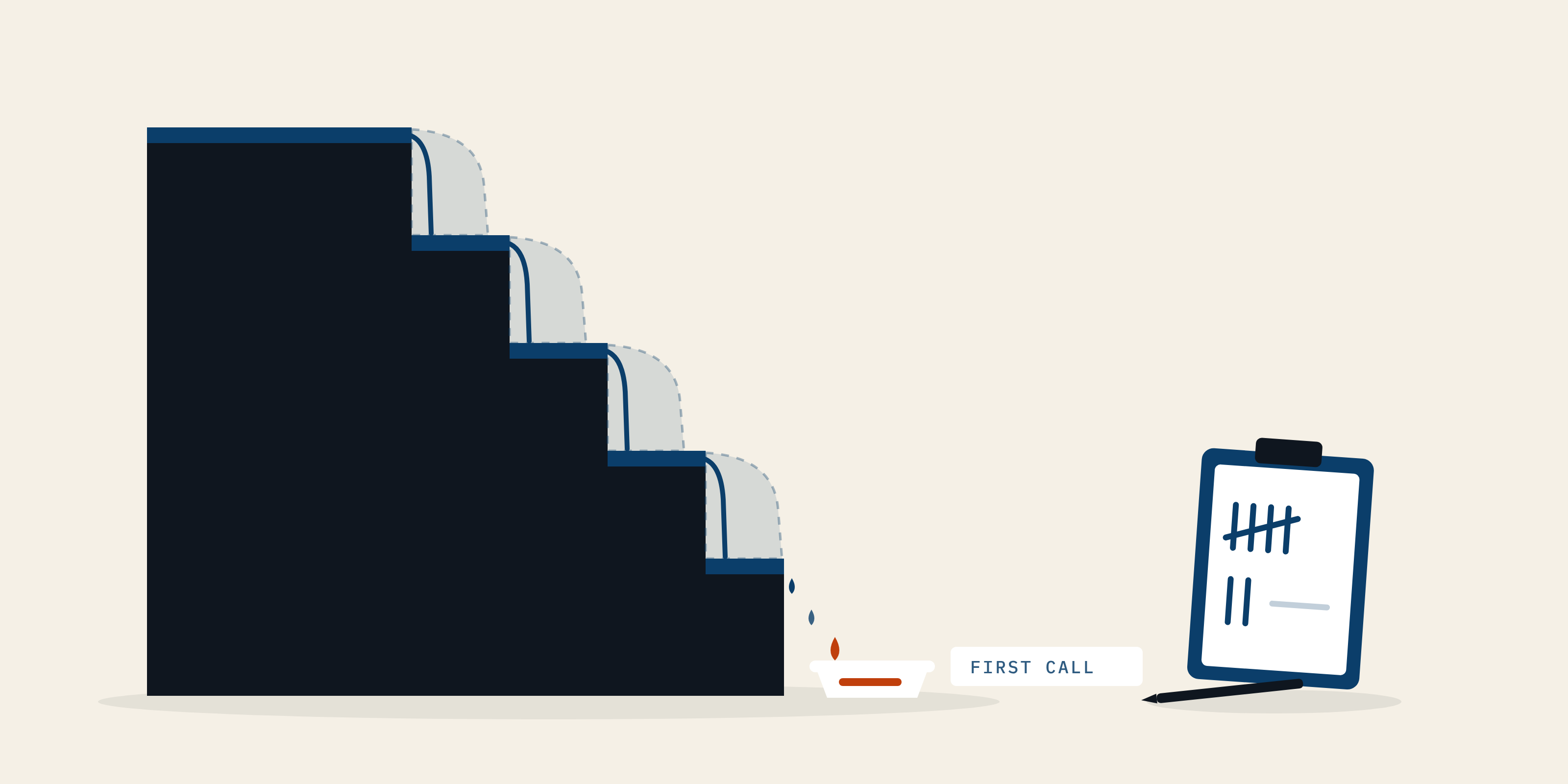
The demand waterfall, built by SiriusDecisions and now run by Forrester, tracks buyers from first interest to a closed deal, but its lead stages and conversion rates assume more volume than a seed-stage B2B startup has. A small team gets more from counting named accounts, engaged buying groups, first calls, qualified opportunities and wins by hand. The full model, or a B2B demand generation agency, earns its place once separate people own separate stages.
Your board asked for a demand waterfall, and the template you found starts with thousands of inquiries. A demand waterfall splits the path from a buyer's first reply to a signed contract into stages, so you can see where buyers stall. It was designed for companies with marketing operations teams and enough leads to make percentages mean something.
When I searched demand waterfall on Google on 14 October 2026, the first page was glossaries, PDFs from 2016 and 2017, and vendor blogs. None of them said what to do with twelve target accounts and one founder doing the selling.
In this post I explain where the model came from, why it breaks at low volume, a version you can keep in a spreadsheet, how to show it to your board, and when the full model is worth adopting.
What the Demand Waterfall Is and Why Your Board Asks for It
The demand waterfall is a shared map of the stages a buyer passes through before revenue, with a count at each stage. Boards ask for it because it turns marketing and sales into one funnel they can read on a single slide.
SiriusDecisions, a B2B research firm, built the model and revised it twice. Wikipedia records a 2012 update called the Rearchitected Demand Waterfall and a 2017 update called the Demand Unit Waterfall. Forrester completed its acquisition of SiriusDecisions on 3 January 2019, so the model now sits with Forrester.
The Classic Stages From Inquiry to Closed Deal
Most explanations I read for this post list the same five lead stages. If you have searched siriusdecisions demand waterfall, this is the version you probably found.
| Stage | What it means | Who decides |
|---|---|---|
| Inquiry | A person raises a hand: a form, a download, an event signup | Nobody yet |
| Marketing qualified lead (MQL) | The inquiry meets a marketing score or fit rule | Marketing |
| Sales accepted lead (SAL) | Sales agrees the lead is worth a follow-up | Sales |
| Sales qualified lead (SQL) | Sales confirms a real need, budget path and timing | Sales |
| Closed won | The deal is signed | The buyer |
The MQL vs SQL vs SAL debate lives in the middle three rows. Each one is a handoff between people, and the model exists so those handoffs use the same definitions.
How the Model Moved From Leads to Buying Groups
The 2017 Demand Unit Waterfall stopped treating a single lead as the unit of demand. Forrester defined a demand unit as a buying group organized around a need.
It was renamed again in May 2021. The B2B Revenue Waterfall announcement says the model targets buying groups and adds renewals, cross-sell and upsell. The same release cites Forrester’s 2021 study finding that 95% of consensus purchases involve three or more people across two or more departments.
So the Forrester revenue waterfall and the B2B revenue waterfall are the same lineage. They count groups, not form fills.
Why a Board Still Asks for It
Investors have seen the waterfall in larger companies, and it answers their real question: where does pipeline come from, and where does it stall? I think the question is fair even when the template is wrong for your size.
The mistake is copying a large company's stages and rates onto a company with a handful of deals. The answer to the board's question changes shape at seed, even though the question does not.
Why the Classic Waterfall Breaks When You Have Few Leads
The classic demand waterfall breaks at seed because it runs on rates, and rates need volume. Three problems show up first, and I would check for all three before building anything.
1. Conversion Rates Swing on a Single Deal
With five qualified opportunities in a quarter, one deal moving or stalling changes your conversion rate by twenty points. A board that reads that swing as a trend will ask the wrong questions. Counts and names tell the truth at this size, and percentages mostly add noise.
2. Lead Scoring Needs Volume You Do Not Have
Lead scoring ranks prospects against a scale so a team can decide who gets attention first. That only helps when there are more leads than people to call them. If you can personally read every inquiry in ten minutes a day, I see no reason to build a scoring model to rank them.
3. One Person Fills Every Stage
The MQL, SAL and SQL stages exist to manage handoffs between marketing, a sales development team and account executives. At seed the founder is often all three people. A handoff you make to yourself does not need a stage, and adding one creates admin without new information.
A Seed-Stage Demand Waterfall You Can Keep by Hand
Keep the waterfall's logic, which is a fixed set of stages with a count at each, and change what you count. I would track accounts and conversations instead of leads, in a spreadsheet or a simple customer relationship management tool. The goal is a sales pipeline you can explain account by account.
Here is how each classic stage translates for a company selling to enterprise buyers with a small team.
| Classic stage | What it assumes | Seed-stage version | How to count it by hand |
|---|---|---|---|
| Inquiry | Enough form fills to sort | Named target accounts | A list of companies you have chosen to pursue this quarter |
| MQL | A score separates good leads from bad | Engaged buying group | Accounts where two or more people have replied, attended or read something and said so |
| SAL | A handoff from marketing to sales | First conversation | Accounts where someone took a call with you |
| SQL | A sales team qualifies need and timing | Qualified opportunity | Accounts with a stated problem, a person who can buy and an agreed next step |
| Closed won | Enough wins to calculate rates | Won, with the source in the buyer's words | Signed deals, each with how the buyer said they first heard of you |
The second row does the most work. A single enthusiastic contact rarely closes an enterprise deal, so counting two or more engaged people per account follows the same buying-group logic Forrester moved to, without the software.
None of the pages I read for this post gave that last column. Every stage can be filled from your inbox, your calendar and your call notes, and none of it needs marketing automation.
Pro tip: Add a column for the date each account entered each stage. After two quarters the dates tell you your real sales cycle, which matters more at seed than any conversion rate.
How to Show the Waterfall to Your Board in Counts, Not Rates
Show the board your demand waterfall as counts and names, and explain any movement in one sentence. A slide with five numbers and the accounts behind them answers the pipeline question better than a funnel chart full of percentages.
The slide I would build has four lines.
The count at each of the five stages this quarter, next to last quarter.
The names of the accounts that moved forward, and the ones that stalled.
The source of each first conversation, as the buyer described it.
One sentence on what you will change before the next board meeting.
The source line answers the marketing sourced pipeline question without an attribution tool. I explain how to collect it in self-reported attribution for a board that asks where pipeline starts.
If a board member pushes for MQL vs SQL numbers, show the counts and explain why rates on five deals mislead. I would let the account names on the slide make that case for you.
Pro tip: Keep last quarter's slide in the appendix every time. A board trusts a waterfall more when it can see the same five lines move from one meeting to the next.
When the Full Waterfall and a B2B Demand Generation Agency Earn Their Place
Move to the full demand waterfall when the counts get too large to read by hand or when separate people start owning separate stages. Until then, the hand-kept version gives the board everything the full one would.
These are the signs I would watch for.
You hire a sales development rep or a second account executive, so handoffs become real.
Inquiries arrive faster than you can read them each day.
You run marketing automation and need agreed rules for who gets which lead.
You sell to existing customers often enough to track renewals and expansion.
At that point the full model, or Forrester's newer version, pays for the definitions it asks you to agree on. If your target accounts are already a short named list, the account-based marketing view in ABM or demand generation at seed stage fits the same stages.
When the accounts are named but the first stage stays thin, a hire or a B2B demand generation agency can work on filling it. The metrics I would ask either one to report are in which demand generation metrics matter.
Count Accounts and Conversations Before You Count Leads
The demand waterfall is a good question asked with a large company's arithmetic. At seed, keep its stages, count named accounts and conversations by hand, and report counts and names to your board. Move to the full model when separate people own separate stages, and bring in a hire or a B2B demand generation agency when the first stage needs filling.
If you want help building the top of that waterfall without paid ads, that is the work we do at Better Marketing.