

Quick Answer
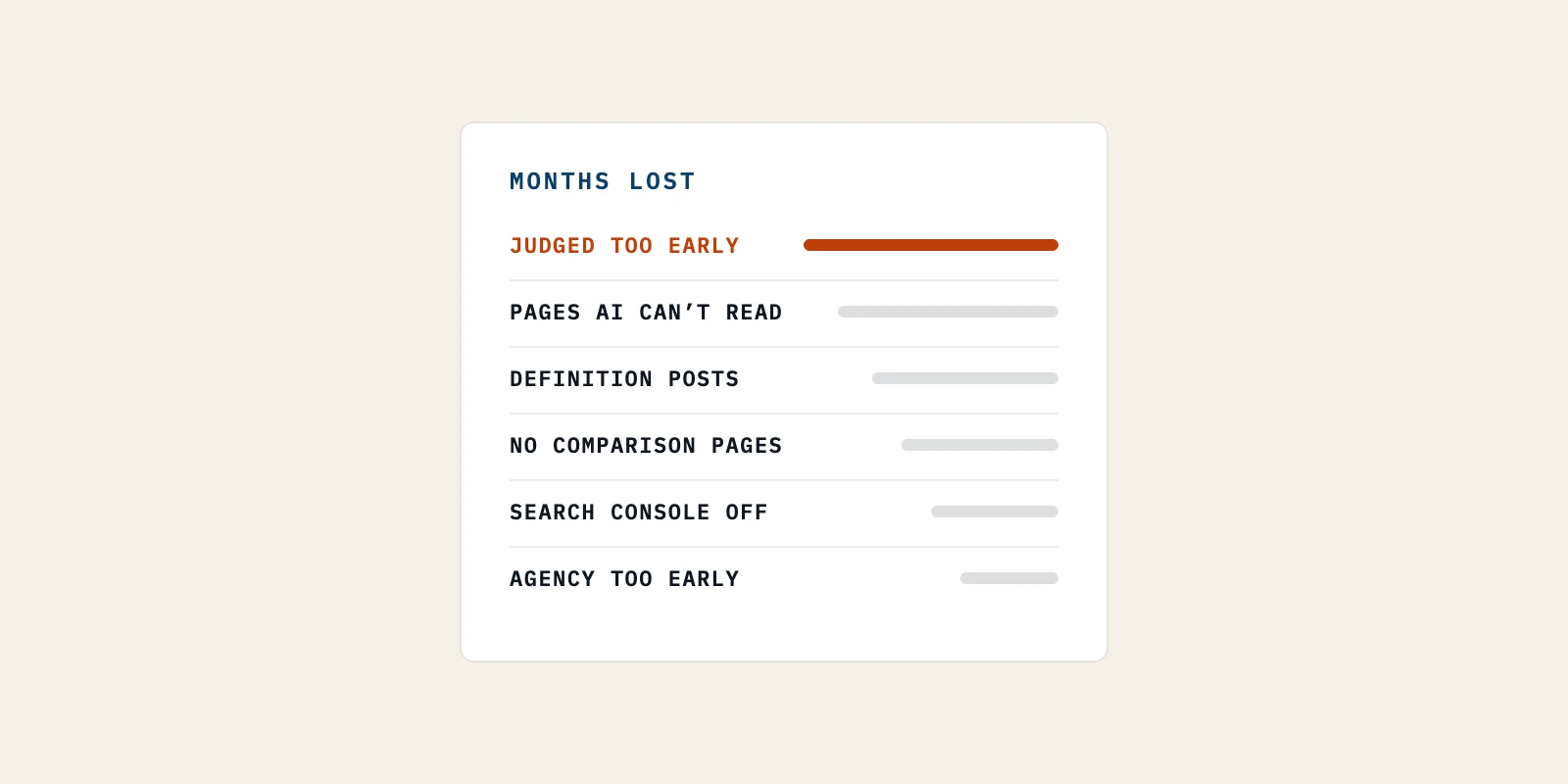
The SaaS SEO mistakes that cost a bootstrapped founder the most months are about timing and access, not keywords. The worst are judging pages too early and shipping pages AI crawlers cannot read. Next come definition posts big sites own, missing comparison pages, ignored Search Console and hiring a SaaS SEO agency too early. Fix access and measurement in week one, then publish the pages buyers search before a demo.
SEO is the work of getting your pages found, and clicked, when buyers search for the problem you solve. Most bootstrapped founders reach for it once the old-colleague referrals dry up.
The trouble is that SEO punishes mistakes slowly. A wrong call in month one often shows up as silence in month six, long after you've forgotten the call.
I've read the ranking lists of SaaS SEO mistakes, and most were written for funded teams with writers and engineers. I'll cover the six mistakes that waste the most time on a young domain and the order I'd fix them in. I'll also cover three worries I'd ignore and what on-track progress looks like.
The Six SaaS SEO Mistakes That Waste the Most Months on a New Domain
The SEO mistakes to avoid first are the ones that reset the clock. I'd put judging pages too early and blocking AI crawlers at the top, then unwinnable definition posts, missing comparison pages, ignored Search Console and early hiring. Each one costs months, not days, because SEO results arrive slowly and the damage stays hidden until results were due.
Most lists of common SaaS SEO mistakes rank them by how often they happen. I rank them by how much time they burn for a founder working alone.
| Mistake | Five-Minute Test | What You Lose | First Fix |
|---|---|---|---|
| Judging a page before Google has ranked it | Does each page have a publish date you track? | Pages rewritten or deleted before they had a chance | Wait at least 90 days before any verdict |
| Pages AI crawlers cannot read | Does View Source show your main sentences? | Accurate mentions in ChatGPT, Claude and Perplexity | Serve key copy as plain HTML |
| Definition posts big sites already own | Who holds the top five spots for the query? | Months of writing that earn no clicks | Pick narrower buyer problems |
| No comparison or alternatives pages | Do you have a page for each rival buyers name? | The searches closest to a purchase | Write one honest comparison page |
| Search Console left for later | Can you say how many pages Google has indexed? | Early signals and silent indexing errors | Connect it and inspect key URLs |
| Briefing a SaaS SEO agency before the basics are stable | Can you name who ships the fixes inside your team? | A slower ramp because the inputs keep changing | Start after ten pages and a stable pitch |
1. Judging a Page Before Google Has Had Time to Rank It
The costliest SEO mistake, in my view, is a verdict issued too soon. Picture a founder who publishes, checks traffic at week four, sees nothing, then rewrites or deletes the page.
Google's SEO Starter Guide says some changes "could take several months." It adds that you'll likely want to wait a few weeks before judging if a change helped.
If you've ever typed "how long does SEO take to work" into Google, the best public answer is old but sobering. In Ahrefs' 2017 study of 2 million pages, only 5.7% of pages reached the top 10 within a year for at least one keyword. Most of those that made it took about two to six months.
Say you run a two-person scheduling tool out of Columbus and publish four pages in March. If you rewrite all four in April, the clock restarts, and your first honest reading moves from summer into fall.
I date every page when it goes live and don't judge it before 90 days. That rule isn't from Google. It's my buffer for a young domain with few backlinks.
2. Shipping Pages That AI Crawlers Cannot Read
The second mistake is building the marketing site so that only a browser running JavaScript can see the words. Google's crawler renders JavaScript, but the web crawler behind most AI answers doesn't.
Vercel's December 2024 analysis with MERJ found that none of the major AI crawlers it tested render JavaScript. That list covers OpenAI, Anthropic and Perplexity, while Gemini (through Googlebot) and AppleBot do render.
HubSpot hit this with its pricing pages. In Aja Frost's September 2026 account for Growth Unhinged, the pricing pages were built with JavaScript. AI tools pulled HubSpot's prices from outdated third-party sites instead.
The test takes a minute. Open a key page, choose View Source, and search for a sentence from your headline. If it isn't there, AI crawlers probably can't read it either. We walk through the fixes by cost in how Googlebot renders React while AI crawlers do not.
3. Writing Definition Posts That a Big Site Already Owns
The third mistake is spending your first months on "what is" posts. On a young domain, those queries usually belong to sites with years of links and a huge head start in domain authority.
The odds are poor even for established sites. Ahrefs' 2023 study of about 14 billion pages found that 96.55% get zero traffic from Google.
Definition queries also lose clicks to AI summaries on the search engine results page. Pew Research Center found users clicked a result in 8% of visits when an AI summary appeared, against 15% when none did.
My test is to search the query and look at who holds the top five spots. If they're household names and an AI summary answers the question, I pick a narrower problem. We explain how to price a query before writing in the click math we use for startup SEO.
4. Skipping the Comparison Pages Buyers Search Before a Demo
The fourth mistake is avoiding pages that name competitors. Founders worry it looks petty, so they skip the searches that sit closest to a purchase.
In B2B SaaS SEO, I treat "[your tool] vs [rival]" and "[rival] alternatives" as searches from people already shortlisting software as a service vendors. When I searched "SaaS SEO strategy" on 30 September 2026, Google's AI Overview told readers to build competitor comparison pages early. ChatGPT gave similar advice when I asked it the same day.
Here's the test. List the three tools prospects named on your last ten calls, then check if you have a page comparing yourself with each one.
A good comparison page is honest. It says where the rival is the better choice, uses a table, and states only facts you can link to. A page that trashes a competitor tends to read as an ad, and buyers notice.
5. Leaving Google Search Console Until There Is Traffic to Measure
The fifth mistake is waiting for traffic before connecting Google Search Console. That's backwards, because Search Console shows problems and signals long before clicks arrive.
Its URL Inspection tool shows Google's indexed version of a page and tests if a URL might be indexable. Search engine indexing failures are silent otherwise, and a page that isn't indexed can't rank at all.
The test is simple. Can you say, today, how many of your published pages Google has indexed? If not, connect Search Console this week and inspect your five most important URLs.
I watch its Performance report for impressions first, because a page has to be shown before it can be clicked. We run a fuller version of this check in a content audit for a small SaaS blog.
6. Briefing a SaaS SEO Agency Before You Have Ten Pages and a Stable Pitch
The sixth mistake is asking outside help to scale inputs that are still changing. A SaaS SEO agency can add volume and judgment when your pitch stays stable and someone on your team can edit the site.
We've written about how one agency model can cover three different jobs. I use that split to decide which support a small team should brief first.
My test has two parts. Can you name the person who will ship technical fixes within a week? And has your one-line description of the product held still for two quarters?
If either answer is no, I'd finish the access and measurement fixes first. When you're ready, a fixed-scope SaaS SEO consultant project can turn those notes into a cleaner agency brief.
Pro tip: Put the publish date in a column next to every URL in your sitemap. The first time you're tempted to rewrite a page, the date tells you if it's too early.
Which SaaS SEO Mistake to Fix First When You Have Five Hours a Week
I'd fix SEO mistakes in the order that unblocks the next step, with access first, measurement second, page choice third, patience fourth and hiring last. This sequence works as a simple SaaS SEO checklist for the first two months, sized for about five founder hours a week.
The hour estimates below are my own planning numbers for a small marketing site, not published benchmarks.
1. Week One, Make Every Key Page Readable Without JavaScript
Run the View Source test on your homepage, pricing page and top product page. If the copy is missing, the cheapest fix is often to hard-code the key sentences as plain HTML. I'd budget an afternoon for a simple site, longer if a developer has to change how pages render.
2. Week One, Connect Google Search Console and Check Indexing
Verify the domain, submit your sitemap and inspect your five most important URLs. I'd budget an hour. Fix any page marked as not indexed before you publish anything new.
3. Weeks Two to Four, Publish Comparison Pages Before Definition Posts
Write one honest comparison page for each rival your prospects name most. Then write one page on a narrow problem your buyers describe on calls. That's usually two to four pages for a founder writing alone.
4. From Week Five, Date Every Page and Hold Your Verdict for 90 Days
Log each page's publish date and leave it alone while Google indexes and tests it. Use the time to write the next page, not to rewrite the last one. Your SaaS SEO strategy lives or dies on this patience more than on any tactic.
5. After Ten Pages, Decide If You Need Outside Help
With ten pages live and 90 days of Search Console data, you'll know which pages earn impressions and where you're stuck. That's the point where I'd weigh a consultant or an agency, because you can finally brief one with evidence.
Pro tip: Keep a short list of phrases prospects use on calls, word for word. It's the fastest source for your next comparison page and your next problem page.
Three SEO Worries I'd Leave Out of Your First Month
Some SEO advice aimed at startups sounds urgent but rarely moves the result for a young SaaS site. I'd park these three until the access, measurement and page-choice mistakes are fixed. If you're reading up on SEO for SaaS startups, I'd put these three at the bottom of the list.
• Moving the Blog From a Subdomain to a Subfolder
By my estimate, moving blog.example.com to example.com/blog can eat a week of founder time. Google's SEO Starter Guide lists subdomains versus subdirectories under things it believes you shouldn't focus on. Its advice is to do whatever makes sense for your business.
• Writing an LLMs.txt File
An llms.txt file is a plain-text map of your site meant for AI models. HubSpot's team built one with hidden test details, per Aja Frost's account. Their server logs showed no visits, and the models didn't know the planted details when asked. I'd skip it until someone shows new evidence.
• Chasing a Domain Authority Score
Domain authority is a score developed by Moz, not by Google, and a backlink bought to raise it rarely brings a buyer. We explain why a single-digit score is normal early on in how to improve domain authority from 8. I'd earn a few real links from partners and customers instead.
What On-Track SaaS SEO Looks Like in the First 90 Days
On-track SEO in the first 90 days shows up as indexing and impressions, not traffic. If these four signals appear, I'd keep going even with almost no clicks yet.
• Indexed Pages Match Published Pages
Every page you published shows as indexed in Google Search Console. A gap here is the first thing I'd fix, since nothing else matters for a page Google hasn't indexed.
• Impressions Rise Before Clicks Do
The Performance report shows impressions climbing on your newer pages. Clicks lag behind, and on a young domain the lag can run for months.
• Queries Move Into the Top 20
Some queries you didn't target by name start showing up in positions 11 to 20. I treat that as the early sign a page is being tested for more searches.
• A Prospect Mentions a Page Without Being Asked
The strongest signal is a demo that opens with "I read your comparison page." I log these with self-reported attribution for early-stage teams, because analytics tools often miss them.
Pro tip: Screenshot your Search Console Performance chart on the first of each month. Three screenshots side by side show the trend far better than any single day.
Fix Access and Patience Before You Brief a SaaS SEO Agency
The SaaS SEO mistakes that waste the most months are about timing and access, not clever keywords. I'd make key pages readable without JavaScript, connect Search Console, publish comparison pages before definitions and hold every verdict for 90 days.
Brief a SaaS SEO agency when ten pages and a stable pitch give it something to build on. If you want a second opinion on where your site stands, Better Marketing works with early-stage software founders on exactly this.