

Quick Answer
A bootstrapped founder whose referrals have dried up should start a B2B newsletter first when 50 or more right-fit people would recognize the sender's name and a sales signal is needed within six months. A blog comes first only when buyers already search for the problem and the founder can wait longer. With neither, direct outreach comes first. The strongest setup publishes every issue as a page on the company's own domain.
Your warm intros have run out. An email newsletter is a recurring email you send to people who asked for it, and a B2B newsletter is one written for buyers at other companies.
A blog is a set of articles on your own website that strangers can find. Both cost you the same scarce thing, which is a few founder hours every week.
When I checked the Google top 10 for this question on 29 September 2026, the guides were written for authors, creators and job seekers, not software founders.
In this blog I'll cover my three-number test, how the channels differ, why each one stalls, and the hybrid that gets you most of both.
Which to Start First, a B2B Newsletter or a Blog, When Your Network Runs Dry
Start an email newsletter first if you can name 50 or more people who fit your buyer and would recognize your name, and you need a sales signal within six months. Start a blog first only if buyers already search for the problem and you can wait longer than that.
That is my rule of thumb, not a law. The three numbers behind it take one evening to gather, and they settle the blog or newsletter question better than any list of pros and cons.
1. Count the Warm Names You Can Email Today
Open your LinkedIn connections, your old work contacts and every thread from the last two years. Count the people who match your buyer and would open an email from you without asking who you are.
Former colleagues count. So do people who took a demo and said "not now," and the peers your first customers introduced you to. Your first five customers came through this circle, and that is why it is worth one more careful pass.
The email newsletter works on this list because it asks for nothing. A one-time pitch to an ex-colleague burns the relationship if the timing is wrong. A useful monthly note keeps you in their inbox until the timing is right, which is how referral marketing works when nobody is actively referring you.
My threshold is 50 names. Below that, I would write those people individual emails instead of a broadcast.
2. Check If Buyers Search for the Problem at All
Type the problem your product solves into Google the way a buyer would, then check the phrases in a keyword tool. You are looking for questions your buyer types, not your product category.
Here is what that looks like. When I checked Ubersuggest on 29 September 2026, "newsletter vs blog" showed 210 US searches a month with an SEO difficulty of 36. That is enough demand to justify one post.
If the questions your buyers ask show zero searches, a blog will not bring them to you. Ahrefs studied about 14 billion pages and found 96.55% get no traffic from Google, and no search demand was the first reason it named.
3. Set How Many Weeks You Can Wait for a Signal
Write down how many weeks of savings you are willing to spend before this channel has to show a sign of life. Be honest, because the two channels pay back on very different clocks.
An email newsletter sent to 60 warm readers can produce a reply in its first week. A new post on a young domain usually needs months before it earns steady impressions, and that assumes the topic has demand.
If your number is under 26 weeks, the blog cannot be your only bet.
| Your three numbers | What I would start with |
|---|---|
| 50+ warm names, any search demand, under 26 weeks | Email newsletter, published on your own domain |
| Under 50 warm names, clear search demand, 26+ weeks | Blog, with a signup box on every post |
| 50+ warm names, clear search demand, 26+ weeks | Email newsletter first, then turn the best issues into posts |
| Under 50 warm names, no search demand, any timeline | Neither yet, so start direct outreach and customer calls |
Say you spent 12 years as a VP of Engineering at a freight software company, and you now sell a dispatch tool from Columbus. You count 80 operations leaders who know you.
Your buyers rarely search for the problem by name, and your savings cover about 40 more weeks. That is a clear newsletter-first result.
Pro tip: Count the warm names in a spreadsheet, not in your head. I only count a name when I can write down why that person would open my email.
How an Email Newsletter and a Blog Differ on What a Founder Needs
An email newsletter reaches people who already know you, and a blog reaches people who do not. Every other difference follows from that, including how fast each one pays back.
Founders often type "newsletter or blog which is better" into Google. This is the comparison I walk them through instead.
| Question | Email newsletter | Blog |
|---|---|---|
| Who sees it | Only people on your list | Anyone who searches or gets a link |
| Time to first signal | Days, if the list is warm | Months, on a young domain |
| What compounds | Trust with named people | Rankings and links over time |
| Can Google and AI tools read it | Only if you publish it on the web | Yes, if the pages are indexed |
| Weekly founder time | Two to four hours per issue | Four to eight hours per post |
| What failure looks like | Silence from people who fit | Pages with zero impressions |
| The number to watch | Replies from named accounts | Search impressions, then clicks |
The time rows are my planning estimates, not a benchmark. Your numbers will move with how fast you write.
The row that matters most for a founder whose network has run dry is the first one. An email newsletter can only reach the people you already have. It will not refill your network by itself unless each issue can also be found on the web.
The same logic answers the LinkedIn newsletter vs blog question. A LinkedIn newsletter reaches people on a platform you do not own, so I treat it as distribution for the email newsletter, never as the home for it.
Why a Blog Is Slow to Pay Back on a Young Domain
A blog on a new domain is slow because it has to earn trust from Google before it earns readers. I plan for that wait before I write the first post.
Ahrefs' study of about 14 billion pages gives three reasons pages get no search traffic. Two of them hit a new SaaS blog hard, and a third problem has arrived since.
• Your Buyer's Problem May Have No Search Demand
Niche B2B problems often have tiny search volume. A post can rank first for a query nobody types and still send you nothing.
This is common in the markets ex-engineering leaders sell into, where buyers describe the pain in their own words. Check the demand before you write, not after.
• A New Domain Has Few Links to Rank With
Pages with more referring domains get more traffic in the Ahrefs data. A young SaaS blog usually starts with a low domain authority score and very few links.
We have written about raising domain authority from a single-digit score, and it is slow work. Content marketing on a blog pays back later than founders expect, and that delay is normal.
• AI Answers Now Take Part of the Click
When Google shows an AI summary, fewer people click through to a website. Pew Research Center found users clicked a result in 8% of visits with an AI summary, against 15% without one, based on March 2025 browsing data.
So a ranking on the search engine results page is worth less traffic than it was. I work out if a ranking is worth chasing with the click math I use for small sites.
Pro tip: Before you commit to a SaaS blog, write down five questions buyers asked you on calls. If none shows search demand, I would put those answers in an email newsletter first.
Why an Email Newsletter Stalls Without a List to Send To
An email newsletter stalls when the warm list runs out, because email has no built-in way for strangers to find you. That is the real trade in the blog vs email newsletter decision.
Jane Friedman put the lifespan problem plainly when she wrote, "Once you send an email, its lifespan will be a couple weeks at most." Her comparison for writers adds that a sent email is unlikely to be found through search or social.
• Nobody Can Find an Issue They Were Not Sent
An issue that lives only in inboxes is invisible to Google and to AI assistants. Your best explanation of your buyer's problem cannot be cited by ChatGPT if it only exists in 80 inboxes.
This is the gap that neither Perplexity nor ChatGPT raised when I asked them this question on 29 September 2026. Both said "blog first" and treated email as a place for content to go after it is found.
• Inbox Metrics Flatter the Channel
Open rates look healthy even when nobody reads. Apple's privacy features load emails in the background, which I cover in detail in what a good newsletter open rate looks like now.
A founder who judges the email newsletter by opens will think it is working months after it stopped. I only trust replies.
• Growth Stops When the Warm List Is Used Up
Once you have added every warm name, email marketing has no engine of its own to add more. Most founder newsletters also fade early, and the issue-four stall is predictable enough to plan around.
This is why I never recommend an email newsletter that lives only in the inbox.
How to Run a B2B Newsletter That Also Works as a Blog
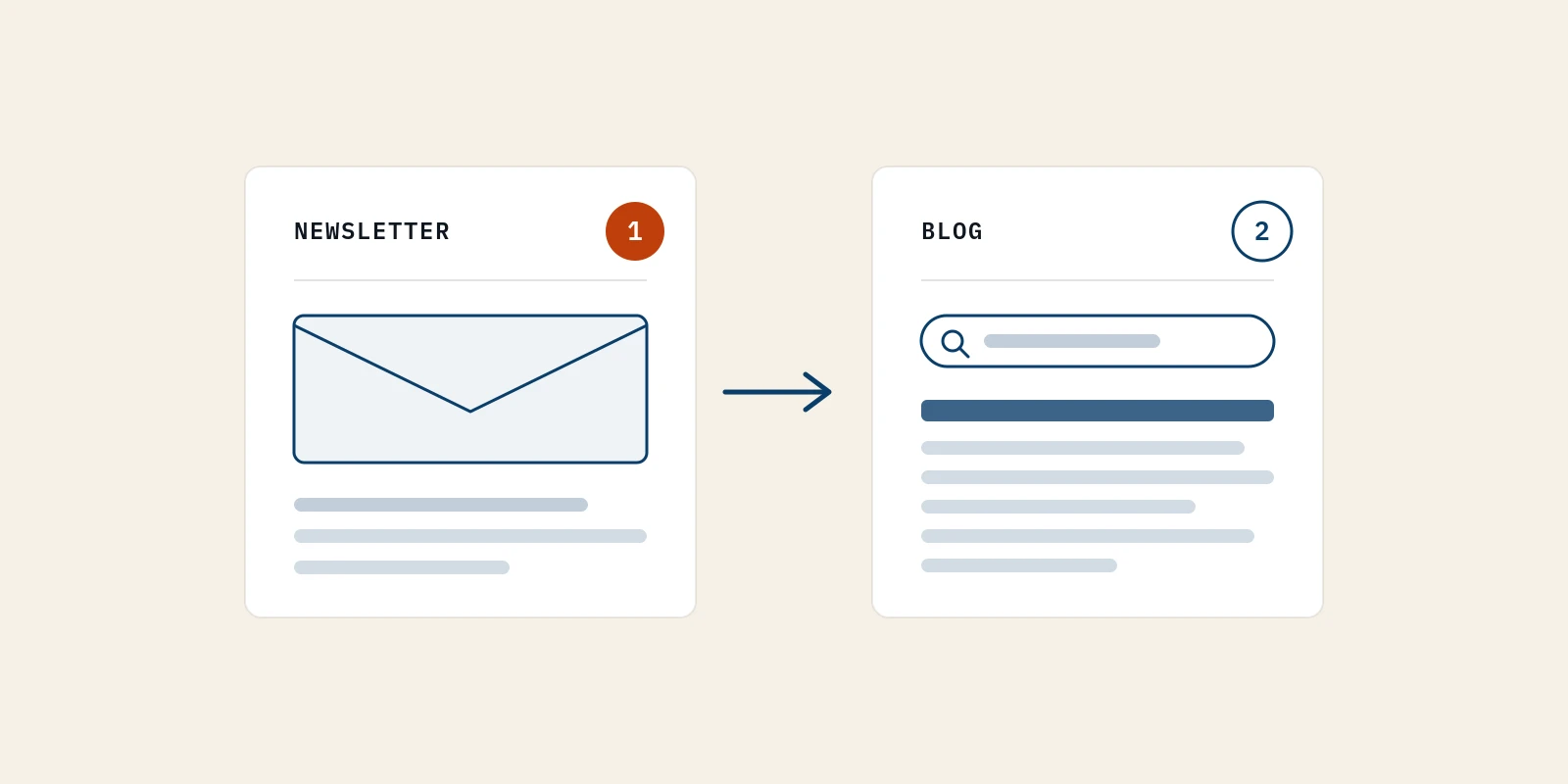
Run your B2B newsletter as a web publication by sending each issue by email and publishing the same issue as a page on your own domain. You get the warm reach of email and the findability of a blog from one piece of writing.
This is the B2B newsletter strategy I recommend to most founders who score newsletter-first on the three-number test. The steps below are the ones I would follow.
1. Put Every Issue on a Page on Your Own Domain
Most newsletter platforms publish each issue as a web page. beehiiv's own guide says a newsletter account comes with a website, and Substack publishes newsletters as websites too.
Point that archive at a subfolder or subdomain you own. Jane Friedman warns against posting the same piece on Substack and on your website, so pick one home. For the Substack newsletter vs blog question, I would rather the home be my own domain.
2. Write the Subject Line as the Question a Buyer Types
A subject line like "Issue 7" helps nobody. A subject line like "How to cut dispatch errors without a second shift" works in the inbox and as a page title.
I write the headline first and then check it against Google autocomplete. That one habit is what turns an email newsletter issue into a findable page.
3. Add a Signup Box to Every Page
Every archived issue should end with a one-line signup offer. This is how a stranger who finds one page from search becomes a subscriber.
That box is how the email newsletter starts refilling the network that ran dry. The platform choice matters less than people think. We have compared beehiiv and Substack for software founders if you want to pick in an afternoon.
4. Turn the Best Issue Each Quarter Into a Full Post
Each quarter, pick the issue that got the most replies. Expand it into a full post with sources, examples and a clear answer at the top.
The replies tell you the topic matters to buyers before you spend a day on it. If you want outside help running this, a B2B newsletter service can own the sending and the archive while you supply the argument.
Pro tip: Put the web archive on your main domain from issue one. Moving it later means redirects, and redirects can cost a young site the little search history it has.
What to Measure in the First 90 Days of Either Channel
Measure replies for an email newsletter and impressions for a blog, and ask every new lead where they heard of you. Those three numbers tell you inside 90 days if the channel deserves more hours.
• For the Email Newsletter, Count Replies From Named Accounts
A reply from someone who fits your buyer is the only early signal I trust. On a newsletter our team writes for SunLead, the open and click rates were healthy, but what mattered was which named accounts replied.
If you are 12 issues in and no one who fits has replied, change the topic before you change the design.
• For the Blog, Watch Impressions Before Clicks
In the first 90 days, a new post rarely gets clicks. Watch impressions in Google Search Console instead, since they show Google is testing the page.
Zero impressions after 90 days usually means no demand or no links. I use the same verdicts I use in a content audit for a small SaaS blog.
• For Both, Ask New Leads Where They Heard of You
Add one open question to your demo form or first call. I use "Where did you first hear about us?" We explain how to code those answers in self-reported attribution for early-stage teams.
This is the only way I know to see the email newsletter or the blog in your pipeline when the numbers are this small.
When Neither Channel Is the Right First Move
Neither channel is right when you have fewer than 50 warm names and your buyers do not search for the problem. In that case, I would spend the next 90 days on direct outreach and customer calls.
ChatGPT gave the same caution when I tested it on 29 September 2026. It suggested most founder time should go to direct selling in the first months, with content running in parallel.
I agree, with one change. Write down every question buyers ask on those calls. In three months, that list becomes the first ten issues of your email newsletter, and you will know the demand is real.
Run the Three-Number Test Before You Write Anything
I would start by counting your warm names, checking search demand for your buyer's questions, and setting how many weeks you can wait. For most founders whose network has run dry, that points to a B2B newsletter first.
Make it an email newsletter published on your own domain, so each issue also works as a blog post. Measure replies, not opens, and review after 90 days.
If you want a second opinion on your three numbers, Better Marketing works with early-stage software founders on exactly this call.